


 Francais
 Deutsch
 Italiano
Refine Your Search
Bruchsal Germany 1945 stock footage and images
- Showing 373 to 378 of 10461 results more
more Hide
Hide
Protests as Allied troops withdraw from Trieste, Mobs storm the American embassy in Belgrade.
Protests in the Balkan Peninsula as Allied troops withdraw from Trieste and it is handed over to Italy. Yugoslavians vow to never give up Trieste as United States and British troops prepare to withdraw. View of Trieste's port, streets and a soldier guarding from behind a barbed wire fence. Sign says "Trsta ne damo". Italians in Zone A of the Free Territory of Trieste. Man in car speaking to a border control officer crossing to Italy. Italian flag and writing "W Trieste Italiana". Italians see the raising of their flag for the first time since 1945. Italians with Italian flags and placards saying "Viva Trieste" and "L'Istria e Italiana" ("Istria (region) is Italian" in English). Mobs raising their fists in front of the United States embassy in Belgrade, storming the embassy following defiant speeches in which Marshall Tito of Yugoslavia threatens to invade Trieste. Yugoslav rioters break into a fight in front of the American embassy. Yugoslav policemen marshal unruly rioters in the street.
Early allied victories in Europe during World War II are challenged by German counter attacks in late 1944
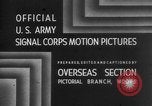
Elements of U.S. Army arriving in a town in France, in August, 1944, during World War 2. Local people line the sides of the roads to welcome them. Young French women reach up to American soldiers in the back of an open stake truck and later mingle with them on the ground. Some of them kiss the soldiers. Some American flags are displayed by people in the crowd of well-wishers. One American soldier holds up a souvenir Nazi flag.Large crowds of French people gathered in a square to welcome the Americans. Many display the "V for Victory" sign with their hands. Film fades to a brief glimpse of a fallen soldier, and new slate reads: "Counterattack." Next, U.S. Medical Corpsmen are seen carrying American wounded to ambulances in the field in December, 1944.Several views of medics attending to American wounded soldiers. American infantrymen advancing across a field beside a Pershing T26E3 tank. (Note: It has 6 bogey wheels. Not designated M26 until 1945.) American infantry advancing into area of burning buildings and then into built up part of town, where they take up defensive positions inside a building. A U.S. soldier firing out a building window. Other U.S. soldiers firing from positions behind a wall. One is next to a mortar. Buildings burning and destroyed all around them. Close-up of American soldiers firing M1 Garand rifles from behind the wall. Infantrymen hunkered down behind a stone wall with light snow atop it. An explosion from a hand grenade raises smoke. A medical Corpsman checks a fallen American soldier for sign of life. Next, a Chaplain is seen reading from a small bible or prayer book, as he stoops over the fallen soldier. Fallen and wounded soldiers are carried to a truck, from the battlefield, on stretchers. Scene shifts abruptly to captured German film depicting two junior officers conversing in the field and then to German Field Marshal Erwin Rommel conversing with an artillery assault gun officer. Rommel holds a pair of eyeglasses in his right hand. The gun officer wears binoculars around his neck. A war torn city. German Volkssturm (People's Militia) parading. Some carry panzerfaust anti-tank weapons over their shoulders. A field full of German King Tiger II Ausf. B Heavy Tanks. One being driven out of the field. A German SdKfz 251 halftrack maneuvering in woods. it is covered with foliage for camouflage. German soldier in an open single seat courier car. It and he are spattered with mud. Close-ups of the mud-spattered driver smoking an cigar. German infantry moving across a field and moving along a road, in the mist. German infantry moving along a muddy road near a forest. A German V-1 Buzz bomb seen overhead with engine running. It flames out. Next an explosion and rising smoke is seen inside a town.
Reconstruction work underway in North Korea after World War II
Views of North Korea during 1945 through 1950. Reconstruction going on in North Korea, new buildings being built. Korean country side and small islands in the bay as waves break on the shore. A group of North Koreans arrives at diamond mountain resort and look at Koo Rong Hun falls, they pose for pictures. Men and women in a reading room.
The Franklin D Roosevelt Memorial unveiled at Grosvenor Square in London, England
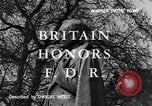
Unveiling of memorial statue of Franklin D Roosevelt in London England. King George VI of England and wife of Franklin D Roosevelt, Eleanor Roosevelt, walk to a monument wrapped in a British flag. Mrs Roosevelt pulls a string and statue of Franklin D. Roosevelt is unveiled. British guards at attention pay homage to the great leader. Inscription on the monument reads 'Franklin Delano Roosevelt 1882 - 1945'. King George VI places a wreath at the statue. Clement Attlee, Mrs Roosevelt and Queen Elizabeth at the ceremony. Winston Churchill along with his wife. Churchill looks at the monument.
UN Commissioner Adrian Pelt and members of an Advisory Council meet people and the Emir of Cyrenaica in Libya.
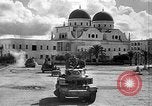
A film depicts steps in Libyan independence. Allied soldiers on tanks during World War II. A tank goes past a ruined building. People gathered look as the Union Jack is unfurled. People read a proclamation pasted on a wall. Ruins of World War II. A meeting in the United Nations in 1945 where it is suggested that Libya be placed under temporary UN trusteeship. A resolution in the UN on 21st November, 1949 to create an independent Libya. The Russian delegate to the UN states his disagreement. The United Kingdom delegate speaks in favor of the resolution. A UN aircraft lands and taxis in Libya. Advisory Council members, led by Mustafa Qasim Mizran, who is first to exit the plane and is head of the National Party and Director of the School of Arts and Trades in Tripoli, are joined by UN Commissioner in Libya Adrian Pelt as they are greeted by dignitaries. The headquarters of the Commissioner and the Advisory Council in Tripoli. A sign reads 'Office of the United Nations Commissioner in Libya'. Members of the Advisory Council include representatives from Tripolitania, Cyrenaica, Fezzan, Egypt, France, Italy, Pakistan, the United Kingdom, the United States and a minority group delegate. Cars carrying the representatives drive out of the gates of the headquarters. They meet people to become aware of their problems. People greet the UN Commissioner and the members of the Advisory Council. A visit to Benghazi where they meet the Emir of Cyrenaica. People holding placards in front of the Emir's palace to greet the Advisory Council. They meet the Emir, who is the religious Muslim leader, in his place. The headquarters of the Commissioner and the Advisory Council, where Mustafa Qasim Mizran is seen touching his face, as he stands behind king Idris,
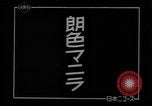
Scenes of Manila, Philippines, early during the Japanese occupation in World War II
Title card with title “Roaring color Manila” in Japanese. A street corner in Manila after the Japanese invasion and occupation in World War 2. Japanese flag in storefront as Filipinos walk pass store. Closeup of the statue of St. Anthony of Padua with a kneeling woman and child, in front of the Church of St. Francis (the former San Francisco Church, now site is occupied by Mapúa University), Church of Our Lady of Angels, Intramuros, Manila, Philippines. Camera pans down over the statue. View from above, at a short distance, of parishioners going in and out of the church. (This church was destroyed in the battle of Manila, 1945, but the statue survived.) A Japanese sign outside of a building. View inside the building, where many school children are seen walking through an exhibit of artwork and other displays of school projects. Closeup of one drawing on display, depicting a Spanish Toreador. Several displays of Japanese calligraphy. A model of two small structures. Closeup of several schoolboys interested in small objects on display. A group of schoolgirls at exhibits of clothing designs and patterns. A cartoon sign in the building, in Japanese but mostly in English. It shows two small girls and a boy in different exercise poses and two ducks walking past them near their feet. The sign announces in Japanese and English, "Radio Taisou Daily Calisthenics on the air." It also reads: "Health First" and "Mass exercise at Luneta Park." A man conducts calisthenics in the open in front of a rotunda. Jorge B. Vargas, chairman of the Japanese-sponsored Philippine Executive Commission, sits inside the rotunda observing a vast field filled with school children following the lead of the exercise director, as they perform calisthenics. The Rizal Monument (1225 Roxas Blvd, Ermita, Manila, 1000 Metro Manila) is seen far in the background. Some closeups of the children as they exercise. Wide view of the children organized in lines across the field. The French renaissance-style Luneta Hotel (414 Kalaw Ave, Ermita, Manila, 1045 Metro Manila, 1000 Metro Manila) is seen in the background.
CRITICALPAST.COM: About Us | Contact Us | FAQs - How to Order | License Agreement | My Account | My Lightboxes | Shopping Cart | Advanced Search | Featured Collections | Website Terms & Conditions | Privacy Policy ©2026 CriticalPast LLC.
License Agreement |
Terms & Conditions |
Privacy Policy
©2026 CriticalPast LLC.