


 Francais
 Deutsch
 Italiano
Refine Your Search
Bruchsal Germany 1945 stock footage and images
- Showing 3835 to 3840 of 10471 results more
more Hide
Hide
Germany invades various nations of Europe during opening years of World War II; civilian refugees evacuating war torn cities.
Past events show German invasions during World War II. German flags in view. German soldiers march. German planes fly in formation during Nazi Party rally at Luitbold Arena in Nuremberg Germany. Adolf Hilter salutes a parade as armored cars and German soldiers pass by. German Luftwaffe aircraft pass overhead in formation during a rally. Comparison shot shows German Wehrmacht army soldiers marching in close ranks, followed by a close up shot of United States Army soldiers marching in close ranks. Both shots shows large numbers of marching soldiers close-up. German Chancellor Adolf Hitler in discussion with Hermann Goering (Göring). They approach a map and then turn their backs. British soldier on lookup watches the sky over London for signs of German bombing raid as parliament buildings and the River Thames are seen in the background. Elevated view of city center, streets, bridges and Russia Orthodox Church in the Soviet Union; possibly Moscow. View of the United States Capitol building in Washington DC. Animated map shows the German positions. Aerial view of devastation from German Luftwaffe bombing of Poland on September 1, 1939. Damaged buildings and houses in Poland due to German bombing in World War II. Polish civilians lined up. Polish people near wrecked horse cart and equipment. Polish citizens carry dead bodies on litters and dig graves for citizens killed in bombing. British people near Big Ben and Parliament buildings on September 3, 1939, the date England declared war against Germany. In London, British children walking toward railroad station near signs that read "To Evacuation Trains", to be evacuated from the London area for safety during the war. Scenes of anguished citizens in England and in France saying goodbye to loved ones including boys and girls being evacuated to safety away from cities, and French women saying goodbye and kissing French soldiers. Close-up view of a French child's arm band with his name and other identifying information, as he leaves in an evacuation. Men leaving for war service. They hug and embrace with emotion. Women wave handkerchiefs at a bus departing with children, then weep. German soldiers march invading Denmark and Norway in April 1940. Sad civilians flee in trucks.
U.S. Military experts evaluate the Spanish Civil War and militarization of fascist Italy and Germany under Mussolini and Hitler.
Documentary titled the "'Rehearsal of War." Film begins showing shells bursting in hills as a soldier runs for cover in foreground. Next, a Republican Soldier helps a wounded comrade walking along a road. More views of combat in Spain. View of the State, War, and Navy Building in Washington, DC. Sign over a doorway reading: "Chief of Staff." Inside, General Malin Craig, in civilian clothes, flanked by two officials, examines a report entitled, "Analysis of the "Brihuega Campaign." The document also reads: "Guadalajara Front." and is dated 3/27/1937. A document (Classified "Confidential") is shown that discusses the capabilities of the French 20mm Moteur canon firing 300-400 shots per minute with explosive shells.Glimpse of an Army officer's hand marking a map in a book. On his table is a book entitled,"Two World's in Conflict, We or They." Flags of Germany and Italy are seen. Closeup of Benito Mussolini in arms-crossed pose. Italian crowd cheering. View of Adolf Hitler standing with Marshal Hermann Goering, German Army Chief of Staff, Werner von Fritsch, and Rudolf Hess (just barely seen). Animated map of Europe shows Germany and Italy with desired expansion of both. Mussolini walks with military officers past a large Italian trimotor transport aircraft. A field filled with Italian light tanks armed with one small gun each. Each is crewed by one man. A parade of German Sd.Kfz.7 halftrack transporters filled with troops and each pulling an 88mm Flak gun on a Sonderanhänger 201 trailer. Brief view of formation of high wing monoplanes with fixed landing gears, flying overhead. German troops in realistic field exercise of infantry and Panzer I Ausf. A tanks. Closeup of tank with troops. Flame throwing tanks firing in a desert area. Adolf Hitler addressing an audience, finishes with a half-hearted Nazi salute. U.S. Military officers discuss Axis blitzkrieg tactics charting reports from the Spanish campaign on maps. View of Saint Jean de Luz, France, where U.S. Ambassador to Spain, Claude Bowers, is seen on the telephone at the Miramar Hotel where he has taken temporary refuge. Final scenes show a 4-stacker U.S. Navy warship patrolling in Spanish waters and the Captain and officers inside aboard ship reviewing maps and positions.
American Undersecretary of War speaks to difficulties facing Allies in confronting Germany and Japan in World War II
Undersecretary of War, Robert Porter Patterson, Sr. speaks about a report from the General staff outlining the needs for combating Germany and Japan in World War 2. He cites Operation Husky, the invasion of Sicily, as an example of what will be needed. He continues to narrate in the background as an animated map appears showing the buildup of supplies and Allied forces in North Africa; Allied air forces flying 60 thousand sorties over Sicily and, the direct amphibious assault using 3,200 vessels. Map also depicts opposing forces of 12 (“unwilling”) Italian Divisions and 3-1/2 German Divisions. View of Allied troops carrying some of their 31 thousand casualties on stretchers from field ambulances. Allied medics attending to the wounded. Some are seen lying on stretchers in a row on the ground near a wall. Interior of a field hospital where surgeons and other medical personnel treat the wounded. Animated map shifts to Europe with Germany at its center, showing , in contrast to Sicily that was only an “outpost,”, the heavily fortified perimeter of Axis controlled areas; the axis industrial might; and the disposition of 300 German Divisions (mostly on the Eastern front) defending the region. Next, the map illustrates Japan’s defended regions in the Pacific Image returns to Undersecretary Patterson i n his office, speaking of the Allied offensives planned for next year (1944), and emphasizing their challenge and difficulty. Scene shifts to General Jonathan Wainwright and his garrison at Corregidor, in the Philippines, surrendering to Japanese forces in 1941. Japanese military camera pans over the Americans being taken prisoner. Other Americans and Filipinos are seen being marched together under guard. Scene shifts to classic views of the Japanese attack on Pearl Harbor, Hawaii, on December 7, 1941. View of Japanese soldiers executing two Chinese civilians in 1937. Dangling bodies of persons hung by Nazis during Operation Barbarossa in Russia, in 1941 A Russian soldier comforts a little girl as he escorts her across a snowy landscape. Time bomb left by German forces retreating from Naples, Italy, in 1943, blows up a Post office building . Views of damage to building and bodies of victims. American Military Police assisting a victim. American soldiers carrying an injured civilian on a litter. Scene shifts to British Foreign Minister, Anthony Eden, Soviet Foreign Minister, Vyacheslav Molotov, and U.S. Secretary of State, Cordell Hull, entering a hall in the Spiridonovka Palace, during the 1943 Moscow Conference in Russia. Close-up of the American, Soviet, and British flags on a table. View of many delegates seated around the table. Close-up of Molotov, Eden, and Hull signing conference document.
United States 1st Infantry Division soldiers cross the Ramegan bridge and enter into Germany during World War II.
The role of United States 1st Infantry Division in various campaigns during World War II. United States 1st Infantry Division men cross the Ludendorfff bridge at Remagen, over river Rhine in Germany. Smoke rises from the banks of the river. American soldiers move across Germany and enter Czechoslovakia. Closeup of faces of war weary United States Army infantrymen shown. A U.S, Army soldier sleeps.
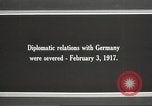
U.S. severs diplomatic ties with Germany; President Woodrow Wilson signs documents in the White House; April 2 declares war.
U.S. severs diplomatic ties with Germany on February 3, 1917. View of American President Thomas Woodrow Wilson at the White House in Washington DC. President Wilson seated at a desk reads documents. He signs a document and hands it to an official. President Wilson addresses the Congress and declares war on Germany on April 2, 1917.
Norwegian, French, Latvian and Lithuanian volunteers boarding trains to Germany in the European Theater during World War II.
Volunteers entrain to Germany in the European Theater during World War II. Minister-President of Norway Vidkun Quisling and an officer inspect police volunteers in Norway. The volunteers standing in formation. Several trees in the background. Insignia on the volunteers' uniforms. The Minister-President salutes and the officer hands over a flag to one of the volunteers. French volunteers inspected in Versailles, France. A few officers in front of the volunteers. The volunteers moving in columns on a path. The volunteers at a rail station with their baggage. They board a train to Germany. Latvian and Lithuanian volunteers for German Army service and a large crowd at a rail station. The volunteers boarding a train with their baggage. The train leaves the rail station. The volunteers waving to the crowd gathered at the station.
CRITICALPAST.COM: About Us | Contact Us | FAQs - How to Order | License Agreement | My Account | My Lightboxes | Shopping Cart | Advanced Search | Featured Collections | Website Terms & Conditions | Privacy Policy ©2026 CriticalPast LLC.
License Agreement |
Terms & Conditions |
Privacy Policy
©2026 CriticalPast LLC.