


 Francais
 Deutsch
 Italiano
Refine Your Search
Bruchsal Germany 1945 stock footage and images
- Showing 4057 to 4062 of 10471 results more
more Hide
Hide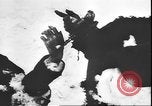
Dead and injured Soviet citizens, including children, after attacks by Germany on the Soviet Union in World War 2
Devastation and death in the Soviet Union after attacks by Nazi Germany during World War II. People mourn the death of Russian civilians. Corpses of Russian atrocity victims frozen in the snow. Women bend and weep over the dead. View of corpses of burned children in a building. Girls who had been sexually and physically assaulted by the German soldiers are escorted across a snowy courtyard, weeping. Bodies of murdered Soviet citizens hanging from poles after they resisted the Nazis. Soviet citizens and soldiers recite a pledge to revenge the Nazis.
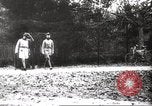
Emperor of Germany, Wilhelm II, and Archduke Franz Ferdinand of Austria, pose for pictures in Tyrolean costume
Archduke Franz Ferdinand of Austria and Kaiser Wilhelm II of Germany, on an outing together. Photographer seen with tripod and camera on hill in background. The two monarchs are dressed alike in Tyrolean costume. They converse as photographers record the event.
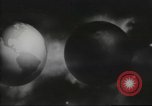
Fascists in Italy and Nazis in Germany as they parade in Europe prior to World War II.
A prelude to the World War II. A map locates places in Europe. Fascists in Italy. Nazis in Germany as they riot and parade. Soldiers marching in Italy. People watching the soldiers. Buildings along the sides of the street. German soldiers marching holding flags. People watching them. Adolf Hitler standing at the window of a building and greeted by the people and soldiers.
Japanese Ambassador Oshima signs economic pact with Germany; French men work on machinery in a German artillery plant in France.
Opens with scene of Japanese Ambassador to Germany, General Hiroshi Oshima ascending stairs to greet German Foreign Minister Joachim von Ribbentrop. The Japanese and German representatives are shown signing an economic pact. Scene changes to French young men working in a German plant in occupied France during World War II. Prisoner French young men are seen working as apprentices in the German artillery plant. Men working on machines in the plant and then seated in a dining hall to have a meal. The French workers receive diploma certificates on completion of their training.
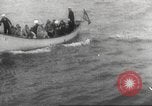
U.S. Navy ship accepts refugees from a European Country, possibly Germany
A U.S. Navy lifeboat flying the American flag and manned by sailors is seen carrying about a dozen American and/or European civilians at high speed through the water. Closeup of civilians sitting on the floor of a another boat amidst pieces of luggage and other items. Sailors with them hold onto cargo to steady themselves as the boat rocks about. Civilians are assisted by sailors as they come aboard the Navy ship, from the smaller boats. They are greeted by Ship's officers. Some women board, followed by a man who hands a little girl to a sailor who brings her on deck, where she joins another little girl, similarly dressed in the company of an older woman. Glimpse of civilians on deck, including some gathered around the chlldren. A well-dressed, distinguished looking older man converses with a woman. Those on board watch for others who may be boarding. A view from the ship of a boat filled with luggage as it arrives beside the ship. As sailors maneuver the boat alongside the ship, an old and infirm woman with her companion is also seen on the boat. Closeup of an officer and as many as 10 sailors assisting the old woman. As they raise her to bring her on board, it is seen that she is in a chair (possibly a wheel chair). For the first time the background is seen in some of these scenes, showing a hilly shore not far from the ship, with a fortress or similar structure at its peak. Next, sailors are seem stacking luggage on the deck. Another boat arrives at the ship and a large crate is hauled from it and wrestled aboard by sailors. Another boat of passengers arrives and sailors help men and women from it to board. View of deck where a 4-inch / 50 caliber Mark 9 deck gun covered in canvas is at the center of the aft deck. Passengers and sailors walk around it. Elsewhere, on deck, a large group of sailors (or Marines) dressed in Khaki work uniforms are donning backpacks and equipment, with the help of other sailors.Sailors, in whites, are also being so equipped. Some civilian passengers have now found places to sit, some on chairs, and others on luggage or convenient spots on deck. A sailor distributes sandwiches to the civilians, who are seen eating them. An official Kriegsmarine launch (probably from a German vessel) approaches the American Naval ship.. Launch ship from Germany is filled with officers and sailors and displays the German Swastika flag. A U.S.Coast Guard Captain converses with a Navy Lieutenant on deck. Sailors in a boat approach a local person,wearing a beret, in a small boat, and purchase several bottles of wine, in a basket, from him.
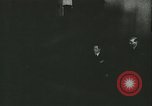
A parade of German Armed Forces at night in Vienna, Austria during the Anschluss (Unification of Austria and Germany).
German Armed Forces parade in Vienna, Austria after Nazis occupy it during the Anschluss (Unification of Austria into Greater Germany by the Nazi Regime). German leader Adolf Hitler reviews troops. Officers stand in front of 'Cafe Heinrichhof Cafe' and review troops. German armed Forces in vehicles drive past on streets at night.
CRITICALPAST.COM: About Us | Contact Us | FAQs - How to Order | License Agreement | My Account | My Lightboxes | Shopping Cart | Advanced Search | Featured Collections | Website Terms & Conditions | Privacy Policy ©2026 CriticalPast LLC.
License Agreement |
Terms & Conditions |
Privacy Policy
©2026 CriticalPast LLC.