


 Francais
 Deutsch
 Italiano
Refine Your Search
Bruchsal Germany 1945 stock footage and images
- Showing 4099 to 4104 of 10471 results more
more Hide
Hide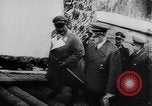
Adolf Hitler's plans and actions for conquest of Austria and Czech Sudetenland; events leading up to and through Munich Pact
Film opens showing Adolf Hitler ascending stairs to the Bergfhof, accompanied by Marshal Hermann Goering, and followed by other high ranking Nazi officers. Inside, General staff officers begin briefing Hitler about plans for German expansion Eastward. Finger points to Austria on map. Next, on March 12, 1938, Border Guards are seen dismantling barriers at the border as German troops march into Austria. German aircraft fly overhead. Hitler stands in his open touring car as it drives into Vienna, where local people line the sidewalk, and welcome him with the Nazi salute. Maps depict the fall of Austria and illustrate the anticipated conquest of Czechoslovakia. Brief overlay image of Bismark as narrator quotes him about Bohemia being key to control of Europe. German troops advancing up steep mountainous terrain. German soldiers on horseback and wagons passing road sign pointing to cities of Karlovy Vary and Cheb, in the west Bohemia region of Czechoslovakia. Czech troops marching in formation with shouldered arms. View of Czech Avia B-534 warplanes at an airfield. Interior of a Czech Skoda works munitions factory. President of Czechoslovakia, Edvard Beneš, signing papers at his desk. French lancers marching in formation, on parade. (Narrator comments on French military alliances with Czechoslovakia and Great Britain.) View of warships in British fleet. Hitler outdoors, surrounded by German military officers, looking over large maps. Animated map highlights the "Sudetenlands" bordering Germany, including districts of Bohemia, Moravia, and parts of Silesia inside Czechoslovakia, where use of German language was common. Street scene from that area showing some youths in uniforms, marching. Hitler giving speech about bringing the German people together again. The uniformed youth marching at a camp. Sign erected on stone wall at the camp reads: "Die Faune ist mehr als der..."(the flag is more than ...) Youth in Naval garb march on a street with a Nazi flags. Spectators give Nazi salutes. Young men in Khaki uniforms march with Nazi symbols. Scenes shift to similar parades in Norway, Sweden,China,and the United States. Back in Czechoslovakia, Hitler reaches down from his podium to shake hands with parading youth. Images of Admiral Chester Nimitz, Lieutenant General Walter Krueger, Senator Robert Wagner, Wendell Wilkie, Henry J. Kaiser, and American military members, superimposed on American flags. Sudentenland Nazi supporters marching. Konrad Ernst Eduard Henlein, Sudeten German politician, with a Nazi officer. More views of Sudeten Nazi supporters. Nazis in an office showing blackjacks. Hospitalized Czechs who suffered at hands of Nazi supporters in street fights. Hitler speaking before the Bundestag. Closeup of Joseph Goebbels.Foreign minister Maxine Lichtenhof speaking to League of Nations meeting announcing Russia's readiness to back action against Germany. Czech borders being closed. British Prime Minister Neville Chamberlain arriving by plane in Munich. Benito Mussolini, Adolf Hitler, and Hermann Goering with Chamberlain, at the meeting to sign the Munich Agreement. View of protests by people in the streets of Czechoslovakia. French Prime Minister Edouard Daladier and Chamberlain, both being praised by countrymen upon their respective returns from Munich. (Chamberlain seen arriving just before giving famous "peace for our time" speech.)
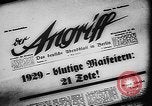
German people during Beer Hall Putsch on the streets to oppose KPD; and later scenes including Adolf Hitler speaking at May Day celebration
Unrest in Germany in decade following World War I. Rally and demonstration in Munich in Marienplatz area, between Communist KPD members, police, and NSDAP brownshirts. This was known as the Beer Hall Putsch or Munich Putsch in November 1923. Crowds opposing the Treaty of Versailles. Trucks and jeeps loaded with policemen at the riot place. Buildings in the background. Scene shifts to a Nazi rally at the Lustgarten in Berlin on May Day (May 1, 1938). A tall May Pole is seen decorated with Nazi flags and streamers. Adolf Hitler addresses a large crowd from a dais on the steps of the Altes Museum. Swastika sign on panels on either side. German biplane aircraft fly in formation overhead, demonstrating German military buildup, re-militarization, and rearmament of Germany leading up to World War 2.
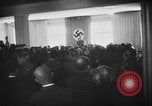
German Vice Minister Albert Speer honors engineers and escorts Adolf Hitler to steel plant showing performance of German tanks.
Nazi Germans start armament and intensify their preparations for war under leadership of Adolf Hitler in Germany. Adolf Hitler's Vice Minister Albert Speer decorates German engineers at a meeting and addresses the meeting in Germany, during World War II. Speer escorts Adolf Hitler and other German officials through a steel plant. Speer presses a lever and workers inside the plant operate controls. German Panzer tank and U.S. M3 Lee tank are compared side by side and tested by German forces evaluating them. German Panther tank is seen achieving obstacle tests that the American tank cannot. German army soldiers practice firing of antiaircraft weapons 'Panzerfaust' and 'Panzer-schredk' at a firing range.
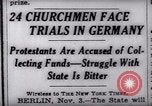
The Nazis begin assault against religious figures leading up to World War 2
German newspapers and weekly magazines in Germany. New York Times Newspaper article headline : "24 Churchmen Face Trials in Germany." Another paper reads: " Nazi to Stage Mass Trial of Religious Foes." and another reads: "Nazis Assail Pope - Order Nuns to Trial". Pictures of leaders of the historic political eras in German history, from Frederick the Great to Chancellor Adolf Hitler.
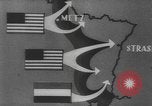
German prisoners are marched towards a stockade under the guard of U.S. soldiers in Metz France, near German border
U.S. Third Army soldiers advance in France nearing border with Germany during World War II. A map locates positions of Allied troops advancing towards Metz and toward Strasburg Germany. World War 2 United States Army soldiers of the 5th Infantry surround and bombard the French city of Metz. American soldiers surround Metz. They fire artillery on the battlefield. Smoke rises from the firing and bombardment and Metz cathedral is seen in the background. Camouflaged artillery fire against German positions. The American soldiers of the 5th Infantry advancing through sniper fire and engaged in building clearing operations in Metz. Bomb damaged buildings of Metz along the sides of a street. The soldiers searching houses. A street sign for Hermann Goering Strasse in Metz. Captured and surrendering German prisoners marching towards a stockade or prison under U.S. Army guard. A rubbled area. Bomb damaged buildings and destruction in Metz after Allied forces take control of the city.
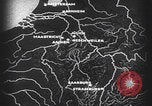
German Wehrmacht troops recapture village, British and Free French prisoners of war are led away (WW2)
German propaganda film with English dubbing. Wehrmacht troops enter a recaptured town during the Battle of the Bulge during winter of World War II. A map showing cities in the Netherlands, Belgium, Germany, and Eastern France. German Wehrmacht infantry march through the snow on the Western Front. German troops arrive at a village after the Rundstedt-Offensive allowed Germany to regain some territories from the Allied forces. German soldiers find a woman hiding in a cellar or basement. Wehrmacht troops pass by burning wreckage of American Jeeps and debris. Sign reads “Civilian travel beyond this point is forbidden” in English, French and German. German soldiers carry supplies to areas restricted to civilians. British and French prisoners of war (POWs) are captured by Germans. The prisoners of war are led away through snow covered streets. Some men carry injured prisoners. A French soldier holds a small pennant of Free France. British and Free French Prisoners of War (POWs) are marched to the rear. A destroyed church and its bell tower. A Roman Catholic relic lies among wreckage. Upturned chair and cabinet with scattered papers on the floor. A damaged statuette of Jesus Christ with hands missing. Wreckage in German homes and churches allegedly caused by United States occupation forces is shown. German Panzer tanks roll into a village, pushing aside a cart that is blocking the road.. German troops arrive with horse-drawn carts, passing by a dead white horse. Closeup view of faces of German soldiers marching through village.
CRITICALPAST.COM: About Us | Contact Us | FAQs - How to Order | License Agreement | My Account | My Lightboxes | Shopping Cart | Advanced Search | Featured Collections | Website Terms & Conditions | Privacy Policy ©2026 CriticalPast LLC.
License Agreement |
Terms & Conditions |
Privacy Policy
©2026 CriticalPast LLC.