A film titled 'Fighter kills'. Gun camera footage shows strafing attack against German airfield with destruction of a Messerschmitt Me-210 on the ground. Another sequence shows three Me-109s in different attacks, being struck and exploding in flight. Strafing attacks are seen against a number of barges along inland waterways and against several steam locomotives on railroads, in which their steam boiler explode. More air attacks show a twin engine German plane destroyed on the ground, and FW-190 airplanes destroyed in the air and on the ground. More strafing attacks on warehouses; waterways; and the shoot down of an Me-109 which explodes and crashes into the ground. The remainder of the clip shows numerous strafing attacks against German airfields and aircraft on the ground.
A 1940 movie entitled "Weltraum Schiff I Startet Eine Technische Fantasie" (Space Ship I launches a technical fantasy). Imaginary view of moon shining over Lake Constance in Friedrichshafen in the future. Views of a huge hangar and industrial complex with a rocket on a launch pad. A large crowd is gathered and listens to a technician speak about a moon rocket.project. Supposedly, the director of the Friedrichshafen airship shipyard speaks to some reporters about aircraft, flying, rocketry, and space travel, while speaking about manned rocket flight to the moon. He answers questions from members of the press corps. Animated pictures show critical distance for escaping earth's gravity and other aspects of a moon flight. Posters of various German Dornier airplanes line the briefing room, including: a circa 1937 Dornier Do 17; Dornier Do 24 3-engined flying boat; Do-X 6-engined flying boat; Dornier Do J II Wal; Dornier Do-19 aircraft; Dornier Do-18 push-pull twin engine flying boat, and the mammoth Do-X twelve-engine flying boat with its date, 1929, stenciled on the bottom of its left wing. From this point on, the narrator continues speaking but the images are of actual applications of rocketry to land vehicles and aircraft. View of a small rocket fired from a tilted trough type launcher. A sign warns about fire explosives ("Vorsicht Mit Feuer SprengstoffI"). Igniter being wired to rockets on the Opel RAK-2 rocket propelled car. Max Valier sitting in his rocket propelled car Valier RAK-6. Fritz Von Opel sitting in his rocket propelled car, Opel RAK-2. Fritz Von Opel driving his rocket propelled car, Opel RAK-2 at Avus track in Berlin on May 23, 1928. A sign above the seating area reads: "Zeitnahme" (Timekeeping). Driven by 24 solid-fuel rockets, the car raises smoke and dust in its wake as it reaches a speed of 230 km/h (143 mph). Brief view of the Opel-Sander Opel RAK-.3 Zopeltra rocket rail rider racing along a track in 1928. The Opel-Sander RAK-1 rocket propelled airplane on a launching rail. With Opel at the controls, It fires up and takes off in a cloud of smoke, at Frankfurt-am-Main airport, on 30 September 1929. A rocket test resulting in failure, as the rocket tumbles to the ground after rising only a short distance after launch. Men gather around a liquid oxygen tank as it fuels a rocket car driven by Max Valier. His white car is seen speeding along the ramp of an airport, past a twin engine high-wing monoplane. Next, Valier is seen in April 1930, smiling as he sits in his liquid rocket propelled car, surrounded by spectators. Glimpse of a rocket vehicle on a railway, as it fires up sending a cloud of smoke that obscures the scene completely. A poster showing starry sky and reading:"Die Erreichbarkeit Der Himmelskorper" (The accessibility of the celestial body). Fingers working rapidly on an arithmetic calculator. Fumes rising from a beaker of liquid oxygen. A technician (hands only, seen) pours liquid into one of a number of beakers in a laboratory. It produces a chemical reaction causing dark smoke to rise from the beaker. (World War II period).
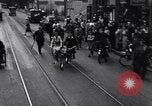
German traffic organized. Traffic policemen guide the traffic. Pedestrians walk on the streets. One way streets and few stops keep the traffic moving. Trees planted on the sides of the roads.
Berlin Wall being sealed after 17-day pass agreement ends. Anti-tank barrier behind the Berlin Wall. German residents bid farewell and say goodbyes to each other. Million and a quarter passes being issued to West Berlin residents. West Germans waiting in a queue. People walking by the Berlin Wall.
Captured German propaganda film designed to encourage the German population near the end of World War 2. The closed Theater des Volkes (Theater of the people) in Berlin is seen at it's start. Steel gates are being pulled across the entrance of the Deutsches Opernhaus (German Opera House). Steel gates are drawn across the entrance to the Schiller Theater on Bismarckstrasse in Berlin. A sign announcing the open hours at a play house, is covered by a cardboard. Likewise a sign at an opera theater is covered. (Narrator states that Joseph Goebbels, Nazi Reich Minister of Propaganda, has been given the title: "Reich Plenipotentiary for Total War.") City trams are diverted to carry war supplies. View of men loading boxes into one. A tram pulling rail cars loaded with freight. An automobile being towed by a tram. Morale boosting slogans posted in various places. (one reads "Relentlessly determined to win victory." Another reads "With the Leader (Fuhrer) to Victory." Joseph Goebbels, addressing a rally of armaments workers in the Rhineland District, tells them (according to the Narrator) "Before we admit the enemy to German soil, and submit ourselves to his will, we will first work our hands bloody and work to our last breath." The assembled workers applaud enthusiastically. Men and women over 65 years of age are mobilized to help with the war effort and seen engaged in light manufacturing. German miners coming off shift volunteer to dig trenches and prepare earthworks. The receive tools and march to a work site. Views of men digging defenses in East Prussia where it became urgent as the Soviet army drew near in October, 1944. In another similar scene, many women are seen working alongside men building defenses. A group of Nazi officers pose for pictures ostensibly working to also dig fortifications. A huge civilian work force is seen digging deep and wide ditches to stop or delay invaders.
Women perform final calibration and hand finishing of munitions casings. Army representatives perform inspections. A woman reams final holes for detonators (fuzes) in casing noses. Munitions are measured and passed through final set of acceptance guages, including a barrel gauge. Women stamp dates and other information on the casings with hammers and dies. The Casings are then rolled across a paint printer and moved by conveyor to shipping area.
CRITICALPAST.COM: About Us | Contact Us | FAQs - How to Order | License Agreement | My Account | My Lightboxes | Shopping Cart | Advanced Search | Featured Collections | Website Terms & Conditions | Privacy Policy ©2026 CriticalPast LLC.
License Agreement |
Terms & Conditions |
Privacy Policy
©2026 CriticalPast LLC.