


 Francais
 Deutsch
 Italiano
Refine Your Search
Bruchsal Germany 1945 stock footage and images
- Showing 4237 to 4242 of 10471 results more
more Hide
Hide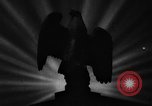
Hitler Youth members conduct a wintertime torchlight ceremony on skis in Germany, during World War II
Opening nighttime scene shows two Hitler Youth skiers descending a snowy hill. Each carries two flaming torches. They converge at a prepared fire site and light a large bonfire with their torches. View of numerous burning torches held by other Hitler Youth members on the hillside. Glimpse of flags and the large bonfire. (World War 2; WWII; WW2)
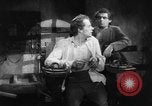
Various movie scenes of the German Movie 'Jud Suss' played by actors Kristina Soderbaum,Horst Caspar and others in Germany.
Excerpt from the German Movie adaptation of 'Joseph Suss Oppenheimer' (The Jews Suss) (Jud Süß), by Viet Harlan in 1940. Movie scenes: Horst Caspar and another movie actor talk. The German actor Kristina Soderbaum runs. Horst Caspar knocks at a door. An actor opens the door of a house. Both of them talk. Actors row a boat. The actor Horst Caspar carries Kristina Soderbaum. The actor and other cast of film bring Kristina outside the house. Horst Caspar shouts and calls to owner (actor) of the house. He puts Kristina (acting as a dead) down on the ground. The actor inside the house closes the doors of the house. An actor comes down the stairs. Horst Caspar and his men on horses, kill the actor. The men return.
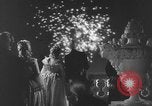
Various movie scenes of the German Movie 'Jud Suss' played by actors Ferdinand Marian,Heinrich George and others in Germany.
The German Movie adaptation of 'Joseph Suss Oppenheimer' (The Jews Suss) by Viet Harlan in 1940. Movie scenes: Two actors watch fireworks, standing in a balcony. Ferdinand Marian (Execution of Judd Suss) talks to actor Kristina Soderbaum. Men ride horses. Heinrich George, lying on bed and Ferdinand Marian talk in the presence of a guard. The men drink. Heinrich George comes outside and shouts at another actor. A crowd standing outside. Horst Caspar and Ferdinand Marian talk. Heinrich George is killed. Ferdinand Marian runs. Ferdinand Marian arrested.
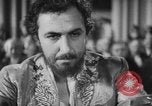
Trial and sentencing of Jud Süss (actor Ferdinand Marian) in climax of the antisemitic feature film 'Jud Suss' in Germany
The German Movie adaptation of 'Joseph Suss Oppenheimer' (The Jews Suss) by Viet Harlan in 1940 (Jud Süß). Movie scenes : A court session in progress. Jud Suss (Actor Ferdinand Marian) in witness box. The judges speak to Jud Suss. A panel of lawyers (actors) discuss. A band play. Jud Suss (Actor Ferdinand Marian) given death punishment. Judges and people (other actors) including Horst Caspar standing in the room.
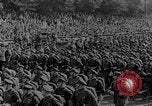
Montage of scenes involving Adolf Hitler and rise of the Nazi Party in Germany
Opens with German troops, including World War I veterans, parading before Crown Prince Wilhelm. The Imperial flag displayed on the reviewing stand. Scene shifts abruptly to Adolf Hitler at an outdoor podium giving an impassioned speech and then jumps to a nighttime torch light rally and parade of Nazi SA (Sturmabteilung) Storm troopers. Their leader, Ernst Röhm, presents them to Adolf Hitler, who is standing on raised platform. He and Röhm exchange Nazi salutes and Hitler shakes his hand. Hitler continues saluting the passing parade of SA marchers. An inordinately large faint image of Deputy Führer, Rudolf Hess is seen off to the right , while Hitler is clearly silhouetted against the black night background.
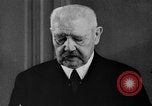
President Hindenburg re-elected in 1932. Freikorps (Free corps) active during unrest in Germany
President Paul von Hindenburg speaking briefly on occasion of his re-election in 1932. Armed elements of a Freikorps (Free Corps) controlling people exiting a building in Berlin. A large contingent of Freikorps marching on a street. Freikorps forming themselves and moving to control people demonstrating in Berlin. A parade on a city street being led by Freikorps, carrying batons. Many spectators line the sidewalk.
CRITICALPAST.COM: About Us | Contact Us | FAQs - How to Order | License Agreement | My Account | My Lightboxes | Shopping Cart | Advanced Search | Featured Collections | Website Terms & Conditions | Privacy Policy ©2026 CriticalPast LLC.
License Agreement |
Terms & Conditions |
Privacy Policy
©2026 CriticalPast LLC.