


 Francais
 Deutsch
 Italiano
Refine Your Search
Bruchsal Germany 1945 stock footage and images
- Showing 4555 to 4560 of 10471 results more
more Hide
Hide
Americans gather in 1934 to denounce dictator Adolf Hitler on the 1st anniversary of his coming to power.
On the one year anniversary of Adolf Hitler rising to power as Chancellor and Fuhrer in Germany, Americans assemble in Madison Square Garden, New York to denounce Adolf Hitler's ascendancy in Germany. People gathered in Madison Square Garden including New York Governor Al Smith, Ray Moley (seen speaking at podium), Rabbi Stephen S. Wise, and Mayor Fiorello La Guardia (also seen speaking at podium). Views of dignitaries on platform and of the gathering of 20,000 attendees in Madison Square Garden. Photographers click pictures. People watch and listen. From a March 12, 1959 newsreel featuring events from 25 years earlier.
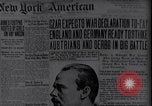
Headlines of prominent newspapers show rising tensions in Europe, assassination of Archduke and Russia's entry in World War I
Headlines of prominent newspapers show rising tensions prior to World War 1. Headline of New York American 'Czar expects war declaration today, England and Germany ready to strike, Austrians and Serbs in big battle'. Montage of headlines from various newspapers regarding looming war. Berliner Tageblatt New York Times headlines say 'Austria and Serbia ready for war, Russia gives warning to Germany, London still sees hope for peace'. New York Times and Freier Press headlines about the assassination of Archduke Ferdinand of Austria. Serbian police dragging the assassin. Blood stained tunic of Archduke. Burial ceremony of Archduke Ferdinand with coffin covered with Austrian flag. Czar Nicholas II of Russia reviews troops. Various Cossack regiments being reviewed. Russian Revolution scenes and mass demonstrations and riot in streets of Moscow as Bolsheviks seize power in 1917. Russian civilians and Bolshevik loyal soldiers armed with rifles marching in mass funeral processions and demonstrations in Russia against the Czar led government. Leon Trotsky speaking to a crowd and saluting Red forces as Bolshevik troops parade. Food distribution to Russian children and people eating on snow covered streets of Moscow around time of revolution. Headlines showing Russian entry in World War I. Snow covered Kremlin. Vladimir Lenin at a desk talking. More views of newspaper headlines regarding outbreak of World War 1.
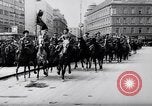
White Russian cavalry are honored by German forces in Zagreb, Croatia during World War II
White Russian Cossack Cavalry, who had fought with Germany, against Communist Soviet forces, parade on horseback on a street in central Zagreb, Croatia, during World War 2. They are being honored by Germany. German Cavalry officer, Lieutenant General Helmuth von Pannwitz, in fur hat, standing next to Field Marshal Paul Ludwig von Kleist, salutes the Cossacks as they pass. (He organized Cossack volunteers into the 1st Cossack Cavalry Division.) View of Cossack cavalry soldiers as they parade past the base of the equestrian statue of Josip Jelacic (Ban Josip Jelačić) in Jelacic Square, Zagreb, Croatia. (The statue is in its original north-facing placement in Ban Jelačić Square). Storefront sign in background for Cerjak I Drugovi, manufacturers of knitted goods, located at 6 Jelačić Square (Trg bana Josipa Jelačića 6, Zagreb). Individual White Russian soldiers and some German soldiers are decorated by Field Marshal Von Kleist. Afterwards, in a large field, Cossacks ride past and demonstrate a charge brandishing sabers.
Newspaper headlines relating to World War I.
View of picture of 1908 McLauglin-Buick and 1915 sedan auto. Map of Europe with German Iron Cross superimposed. Newspapers running off presses. Headline on paper reading, 'Arch Duke Assassinated.' Headline reading, 'Germany Declares War; All Europe is in Arms.' Headline reading, 'Germany Invades France', superimposed over German troops marching in background. Headline, 'French Resist at Marne.' Headline, 'Lusitania Sunk' with picture of the ship. Newspaper presses running. Printer reading paper with headlines 'U.S. Declares War.' Paper reading, 'U.S. At War.' Headline, 'U.S. Troops Land in France.' Billboard sign, 'Beat Back the Hun With Liberty Bonds' superimposed over picture of troops marching in background. Ships under construction. Destroyer underway.
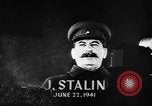
Russian war strategy against German invasion in World War II
Citizens in the Soviet Union mobilize for war effort against Germany in World War 2. Joseph Stalin gives a speech on June 22, 1941. Newspaper printing press running and newspapers being printed and distributed to spread news about mobilization. Russian men from every village come forward to fight against Germany. Russian men on horseback ride to mobilize. Groups of men and women mobilizing in recruitment drives for soldier activities and war production work in factories and mines. Young teenage boys work in a coal mine so older men can fight in the war. Russians of all ages mobilized. Russian women and young boys with rifles. Russians guard their fields and cattle and watch the skies for German invasion aircraft. Russian old men keep vigil in fields.
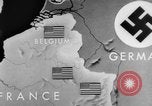
American advance in France and Belgium is stopped by German counterattack in December 1944. U.S. loses 78 thousand troops (WW2)
German forces smash into the U.S. First Army positions along a 45-mile front and advance deep into Luxemburg and Belgium, in Battle of the Bulge during World War II. Animated maps show Germany, France, and Belgium. German Panzer V "Panther" tank with several German soldiers riding on it approaches on road behind a large tree. German tanks, tank destroyers, troops, and artillery in transport on roads and then seen in action against American Army positions. Vehicles of a United States convoy wrecked and burning along road, as German troops advance past the burning vehicles. Fire and smoke rise from U.S. tanks, Jeeps, and trucks. U.S. soldiers captured as prisoner of war are marched on a town road. Frozen dead bodies of U.S. soldiers, victims of the Malmedy massacre, some with hands and feet tied, being placed army truck. Dead bodies of Belgian civilians being placed in large common grave. View of German officer ordering a firing squad to shoot. German troops smoke American cigarettes taken from dead U.S. troops. American troops in retreat and burning and destroying war materiel that could not be brought with them. American defenders firing artillery, including antiaircraft guns fired level, as antitank weapons. Skies streaked with contrails and dogfights between American and German airplanes. American aircraft bombing German positions after weather clears. American troops patrol in snow covered wooded areas. General Eisenhower talks with soldiers. German soldiers advancing. Newspaper headline reads: "Russians Smash Last Nazi Line." Another newspaper headline reads: "40 Jap Ships Sunk." Another reads: "3rd Army Deep in Germany." Narrator cautions against complacency, reminding of 78 thousand American soldiers lost during the Christmas holiday, in 1944. Views of dead U.S. Army soldiers following battles with Germans. Narrator offers closing public service war propaganda message: "If you have a War Job, Stick to it" and " If you Haven't, Get one!"
CRITICALPAST.COM: About Us | Contact Us | FAQs - How to Order | License Agreement | My Account | My Lightboxes | Shopping Cart | Advanced Search | Featured Collections | Website Terms & Conditions | Privacy Policy ©2026 CriticalPast LLC.
License Agreement |
Terms & Conditions |
Privacy Policy
©2026 CriticalPast LLC.