


 Francais
 Deutsch
 Italiano
Refine Your Search
Bruchsal Germany 1945 stock footage and images
- Showing 5467 to 5472 of 10471 results more
more Hide
Hide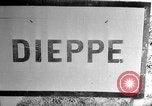
Allied Operation Jubilee offensive against Dieppe, France, during World War II.
Allied Operation Jubilee, the assault against Dieppe, France, during World War Two. A sign reads 'Dieppe'. Fighter aircraft diving down across a harbor area. German anti-aircraft guns are fired from fortified positions behind barbed wire. Explosion of a gas tank in the dock area. German defenders, in grass above beachhead, firing rifles and artillery pieces. Wrecked British Churchill tanks on Dieppe beach. Wrecked tanks and a landing craft along a shore. Dead bodies on the beach. German soldiers sitting abandoned craft in the water. The streets of Dieppe, France showing captured British soldiers being marched down a street escorted by German soldiers. A wounded English soldier being carried down a street by four other English soldiers. The wounded soldier with his left eye covered with blood. Other British casualties entering the town. Surrendering British soldiers being escorted up a country road. The coastline of Dieppe. City population going about their business. Men, women and children walking in a street. German coastal guns being erected. Various types of guns and their mountings, camouflaged gun positions, guns being raised into firing position. Coastal gun barrels. A German motor train moving through a street of Germany. A large half-track vehicle towing a string of trucks through a street. A ship plowing through a heavy sea. A large submarine fleet underway at sea. The guns of a battleship are fired. A Higgins boat going through water towards a coastline. Marines aboard the Higgins boat approaching the shore. A coastline showing invasion troops hitting the shore.

German troops march and Adolf Hitler addresses a large crowd during the Anschluss in Austria
German occupation of Austria, known as the Anschluss. An animated map shows Germany and bordering countries. Newspaper headlines of 'Berliner Illustrierte Nachtausgabe'. German troops march. Civilians give Nazi salutes. A man holds a Nazi flag. An official in a balcony. German troops on horses pass along Passau Bridge over the Danube River. German troops are greeted by cheering Austrian civilians. German Chancellor Adolf Hitler rides in a motorcade and waves at people in Vienna as his motorcade passes along the streets of the city. Sign reads 'Wien' (Austria). A large crowd gathers at the Heldenplatz (Heldenplatz, 1010 Vienna). Hitler exits the car and addresses the large crowd from a balcony. A woman looks through binoculars. Crowd watches Hitler's speech.
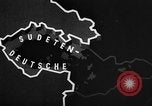
German troops march and Adolf Hitler meets Czech President Emil Hacha in Czechoslovakia.
German occupation of Sudetenland, Czechoslovakia. An animated map shows Germany and bordering countries. Newspaper headlines shown. German Chancellor Adolf Hitler meets Czech President Emil Hacha. A motorcade passes along the streets of Prague. A sign reads : 'Praha'. German artillery, vehicles and troops pass along the streets of the city. People give Nazi salute as Adolf Hitler passes in a motorcade. German troops march.
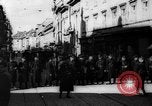
Crowds greet German troops and give Nazi salute as cavalry troops and infantry regiment pass along streets in Vienna, Austria.
Nazi Germany's occupation of Vienna, Austria. German troops standing in a line across a road. People give Nazi salutes as German troops arrive in jeeps. People greet the troops. The crowds give Nazi salute as cavalry troops and infantry regiment pass along the streets of the city. People standing on either sides of a road welcome the troops. People wave at the troops from windows of their houses.
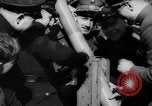
Crowds give Nazi salute as a motorcade passes along streets and Adolf Hitler addresses people in Vienna, Austria.
Nazi Germany's Anschluss occupation of Vienna, Austria. Crowds standing on either side of a road. They cheer and greet German Chancellor Adolf Hitler as he arrives in a motorcade. Adolf Hitler waves at people from his car. People give Nazi salute as the motorcade passes along streets. German troops standing at attention. Hitler reviews the troops. He addresses a large throng of people.
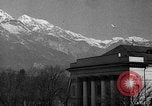
German troops stand at attention and soldiers in ceremony during Anschluss in Vienna, Austria.
Nazi Germany's occupation of Vienna, Austria (Anschluss). Views of buildings with mountains in the background. German troops stand at attention. Soldiers seen close-up as Nazi German flag is raised on flag pole.
CRITICALPAST.COM: About Us | Contact Us | FAQs - How to Order | License Agreement | My Account | My Lightboxes | Shopping Cart | Advanced Search | Featured Collections | Website Terms & Conditions | Privacy Policy ©2026 CriticalPast LLC.
License Agreement |
Terms & Conditions |
Privacy Policy
©2026 CriticalPast LLC.