


 Francais
 Deutsch
 Italiano
Refine Your Search
Bruchsal Germany 1945 stock footage and images
- Showing 583 to 588 of 10461 results more
more Hide
Hide
Justice Robert H. Jackson and other representatives prepare documents for war crime trials in Nuremberg, Germany (WW2)
Preparations for World War II war crime trials in Nuremberg, Germany. The chief United States prosecutor at the Nuremberg Trials Justice Robert H. Jackson with some Allied officials at the Palace of Justice (Fürther Str. 110, 90429 Nürnberg, Germany). Justice Jackson drafts documents for the prosecution of war criminals. He and other representatives draft documents at a round table. Few officials stand behind during the proceedings. The officials sign on various documents before the trial of the war criminals.
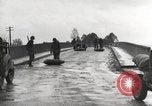
U.S. Army 12th Armored Division soldiers cross the Danube River bridge at Dillingen, Germany during World War II.
U.S. Army 12th Armored Division on the move in Dillingen, Germany during World War II. U.S. soldiers roll 500 pound bombs over the intact Danube River bridge at Dillingen in Bavaria Germany. U.S. medium tanks with soldiers loaded onto it as they cross the bridge at Dillingen.
German Generalleutnant Dittmar formally surrenders to U.S. soldiers in Magdeburg, Germany during World War II.
German General (Generalleutnant) Kurt Dittmar surrenders in Magdeburg, Germany during World War 2. German military commander General Dittmar, who was also Official Military Commentator of the German Armed Forces, stands with his party, including his son, young German soldier Berend Dittmar, Major Pluskat, and Major Werner, as American soldiers escort them. General Dittmar carries on an extended conversation with a French war corresondent. View of destroyed bridge span over the Elbe River, Magdeburg, Germany. German General Dittmar and his son, the boy soldier carrying a white flag with Red Cross on it, walk along sandy shore. They are met by U.S. Army soldiers of the 117th Regiment, 30th Infantry Division, including Captain Henry Abbes of Glendale, Long Island, New York, Commander of 'K' Company, who escort them. German General Dittmar conversing with captors while smoking a pipe, and then walking with his son, accompanied by American officers, through rubble strewn street of Magdeburg. (Records indicate that General Dittmar had traveled across the Elbe to ask for assistance in evacuating injured German soldiers and civilians from the east bank of the Elbe. U.S. Major General Leland Hobbs refused, and rather than returning across the River Elbe, Dittmar surrendered.)

The Konzerthaus and French and German Cathedrals at the destroyed Gendarmenmarkt in Berlin, Germany, at end of WW2 in Europe.
Workers installing pilings to re-enforce wrecked buildings at the Gendarmenmarkt in Berlin, at the end of World War II, in Europe. Wide shot of The Konzerthaus Berlin (Konzerthaus Berlin, Gendarmenmarkt 2, 10117 Berlin, Germany) with wrecked military and civilian vehicles in the square. Close up of detonated mortar shell. Steps of The Konzerthaus showing heavy bomb damage. Statue of Apollo, in a chariot drawn by two griffins, atop the building. The statue of a cherub, perched on a lion, playing pipes, and one on a panther, playing a harp. Camera pans from The Konzerthaus to The French Cathedral (Französischer Dom, Gendarmenmarkt 7, 10117 Berlin, Germany) and then to the German Cathedral (Deutscher Dom) at the Gendarmenmarkt. All buildings in Gendarmenmarkt sustained damage from the war.
German civilians purchase and read the first American newspaper printed in Aachen, Germany.
The first American newspaper in Aachen, Germany is printed during World War II. Crowds in the streets of Allied-occupied Aachen. A U.S. General speaks as the first American newspaper to be printed in Germany is dedicated. Presses roll and the first copies are produced which are then purchased and read by German civilians.
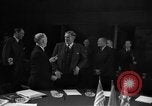
James F Byrnes, Anthony Eden and Vyacheslav Molotov gathered for Potsdam Conference in Potsdam, Germany during World War II.
Representatives of Allied nations gathered for Potsdam Conference at Schloss Cecilienhof Palace (Im Neuen Garten, 14469 Potsdam, Germany) in Potsdam, Germany during World War II. Interiors of the conference room. United States Secretary of States James Francis Byrnes speaks with Minister of War, Anthony Eden of Great Britain. He shakes hands with other representatives. Byrnes takes his seat at conference table. Soviet People's Commissar for Foreign Affairs Vyacheslav Mikhailovich Molotov enters and shake hands with Byrnes and staff. Representatives take their seats around the conference table. Document files kept on the table in front of them.
CRITICALPAST.COM: About Us | Contact Us | FAQs - How to Order | License Agreement | My Account | My Lightboxes | Shopping Cart | Advanced Search | Featured Collections | Website Terms & Conditions | Privacy Policy ©2026 CriticalPast LLC.
License Agreement |
Terms & Conditions |
Privacy Policy
©2026 CriticalPast LLC.