


 Francais
 Deutsch
 Italiano
Refine Your Search
Bruchsal Germany 1945 stock footage and images
- Showing 5971 to 5976 of 10471 results more
more Hide
Hide
German policemen and a USAF airman watch as explosives bring down the Reichstag dome in Tiergarten, Berlin.
Demolition of the Reichstag building dome in Tiergarten, Berlin, still in it's bombed out state following World War 2. Incendiaries start to burn and dome falls to ground. Writing on main entrance to the Reichstag. People look at the rubble of the tower laying on the crumbled floor of the Reichstag. The sky through the hole in the ceiling. People stand along sides of streets, some seated on their bicycles. Brandenburg Gate in the background. German policemen look at the Reichstag dome through binoculars. A U.S. Air Force airman standing with them. View of the dome from between the head of the airman and German officer. American airman looks through binoculars. The incendiaries start to burn. Flames as the dome catches fire during demolition process.
Rubble and construction work near the Tiergarten in Berlin.
Rubble and construction work near the Tiergarten in Berlin. Rubble lying around at a site. Men load bricks into wheelbarrows. Men use spading forks and shovels for the work. A wheel barrow lying near a pit. A man and woman with bricks on a stand. They scrape and clean the bricks with tools. Brick piles behind them. Men bring more bricks in wheel barrows and dump them nearby. Traffic on the road in the background.
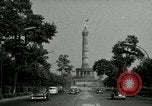
The Siegessaule or Victory Column and the Soviet War Memorial in Berlin.
The Siegessaule or Victory Column at one end of the Victory Avenue in Berlin. Traffic moves across the avenue. The Soviet War Memorial in Tiergarten. Cars and people pass by the Memorial. A tank before the Memorial. The Reichstag building in the background. The building in ruins. Military officers stand before the central pillar of the Memorial. Construction work in progress. Piles of rubble with buildings in the background.
Activities in Tegel, Gatow, and Tempelhof airfields during the Berlin Blockade of the Cold War.
Daily life for the people of Berlin during the Berlin Blockade. People listen to the radio at a street corner. People buy newspapers at a stand. Man reads the paper. German newspaper headline states that the Berlin problem has been put before the UN. Interiors of a food store, a lady clerk takes contents out of can and weighs it. People coming out of bakery, one woman carrying bread. U.S. planes fly over Berlin during Berlin Airlift operations. Route taken shown over a globe diagram. Men work on a new airfield at Tegel. Workers leveling concrete runway during the construction of Berlin Tegel Airport. Trucks and construction equipment. Coal being loaded into a barge at Gatow. Large drums of coal and equipment. A Short Sunderland flying boat taking off. American planes landing at Berlin Tempelhof airfield. People in truck as it moves towards the plane. People watch planes fly overhead.
The Berlin Airlift
Scenes from the Berlin Airlift. Views of transportation facilities shut down by the Soviets in June 1948. Glimpse of the city of Berlin, followed by views of empty railroad lines; barges idled in a canal; parked and silent trolley cars. Next, a U.S. Air Force Douglas C-54 Skymaster transport aircraft (military version of DC-4) is seen landing in Templehof aerodrome in Berlin. German children stand on a hill watching and waving at another C-54 on final approach to Templehof. A C-54 flying close to buildings on its final approach to the airport, followed by another landing near a line of trucks filled with goods brought in by the airlift. A military truck unloading supplies from C-54, tail number 42-72548, as another C-54 taxis up close behind it. Several C-54 airlift planes taxiing in a line on the Templehof ramp.
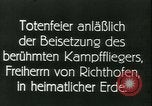
Repatriation funeral and burial of German flying ace Baron Manfred von Richthofen (the Red Baron).
German funeral and reburial of German flying ace Baron Manfred von Richthofen, seven years after his death. (His body had been originally buried in France, first in Bertangles and later in Fricourt). German soldiers march led by a band. The horse-drawn coffin escorted to the Invalidenfriedhof Cemetery in Berlin. Dignitaries walking during the procession. Honor Guard fires gun salute. Clergy and honored guests performing graveside ceremony. General Paul von Hindenburg is seen along with many Pour le Mérite aces (also known as the Blue Max or Blauer Max), including Bäumer, Loerzer, Boenick, Bolle, and others carrying Richthofen's coffin. Also seen at 1:44 is Manfred von Richthofen's mother, Kunigunde Freifrau von Richthofen walking beside her youngest son (Manfred's youngest brother) Bolko von Richthofen (Karl Bolko Freiherr von Richthofen). Bolko had recovered the body from Fricourt and repatriated the remains.
CRITICALPAST.COM: About Us | Contact Us | FAQs - How to Order | License Agreement | My Account | My Lightboxes | Shopping Cart | Advanced Search | Featured Collections | Website Terms & Conditions | Privacy Policy ©2026 CriticalPast LLC.
License Agreement |
Terms & Conditions |
Privacy Policy
©2026 CriticalPast LLC.