


 Francais
 Deutsch
 Italiano
Refine Your Search
Budapest Hungary 1916 stock footage and images
- Showing 79 to 84 of 876 results more
more Hide
Hide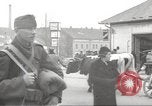
People and soldiers walking on the streets in Ruthenia, Hungary.
Life of the people in Ruthenia, Hungary (Carpatho-Ukraine). The market of Ungvar (Uzhhorod). Women at the market. Civilians gather on the street. Buildings in the area. Children and soldiers standing on the street. Hungarian soldiers marching in column on the street. Numerous horsecarts pass by carrying goods and people.
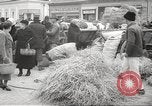
People gather and buy fruits from the market in Ruthenia, Hungary.
Life of the Jews in Ruthenia, Hungary (now part of Zakarpattia Oblast, Ukraine). The market of Ungvar (now known as Uzhhorod). People gather on the street. Ruthenian peasants shopping on the street. They pick up the hay stacks from the street. Buildings in the background. Horse-carts pass on the street. Cattle moving. Women discuss amongst themselves. Women seated near baskets with fruits or vegetables at a market on the street. People buy food from the women.
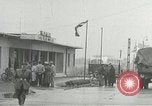
Hungarian people on streets with banners in hand in Hegyeshalom, Hungary.
Demonstrations in Hegyeshalom, Hungary during timeframe of Hungarian Revolution or Hungarian Uprising of 1956. The Hungarian border checkpoint with Hegyeshalom written on it. The Hungarian flag in front of the building. A man paints on a wall. Military officials shake hands with each other. Medical supplies being put in ambulances. Men load boxes and blankets in a truck. A dignitary shakes hands with a military official. People marching on a street with banners in hand.
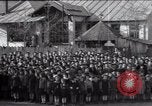
Jewish school children, in Munkacs, Hungary, sing the song: Hatikvah (The Hope)
Jewish children at a Hebrew school in Munkacs, Hungary. The children are assembled in courtyard of the school, arranged by age, with youngest in the front. A man conducts them in the singing of Hatikvah, (The Hope), a song considered a Zionist National Anthem.
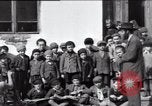
Jewish school children reciting lessons outside a Hebrew school in Munkacs, Hungary
Jewish children at a Hebrew school in Munkacs, Hungary. School children reciting their lessons in unison, outside the school. Rabbis and school staff leaving the school. Children standing by a table filled with books. A Rabbi and instructor stand behind the table. A woman brings two books and discusses them with the instructor. A commercial sign announcing Weavers of cloth and towels. The sign is is four languages: Czech; Hungarian; German; and Yiddish. In backyard of house, a family of weavers is busy making towels and cloths. The father keeps the various threads separated and weaves, while a woman operates a wheel by foot and a boy operates a wheel by hand. Another woman and a child watch.
Hungarian troops enter Uzhorod, Czechoslovakia after Hungary takes over the town as a result of the Munich Pact.
Hungary gains control over Uzhorod, Czechoslovakia after the First Vienna Award. Czech civilians load their belongings onto carriages and leave the town as they head towards the interiors of Czechoslovakia. Soldiers load equipment on to vehicles and move away on carts or on foot. Picture of Miklós Horthy, the Regent of Hungary. The Coat of Arms of the Kingdom of Hungary (1920–1946). Hungarian cavalry units enter the city.