


 Francais
 Deutsch
 Italiano
Refine Your Search
Budapest Hungary 1916 stock footage and images
- Showing 115 to 120 of 876 results more
more Hide
Hide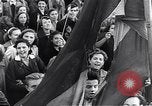
Various monuments during Hungarian Revolution, Hungary.
A huge gathering marches on the road during the Hungarian Revolution. A political building, people on a monument, views of various monuments. A huge gathering around a monument. One monument is to a person named Pazman. A funeral for Toth Dezso.

Hungarian revolution against Russian slavery in Hungary.
Major events of 1956. In an aftermath of Hungarian revolution against Russian slavery people flee from their homes. Civilian refugees loaded in trucks fled for freedom and safety. Man carries a child on his back as he moves to a safer place to escape the Red Army's atrocities. Views of men, women, and children refugees fleeing Soviet oppression.

Alexander Graham Bell at 1916 ceremony; Telephone manufacturing at Western Electric Company plant in Chicago
A film titled "The world's telephone workshop". Opening scene shows ceremony on March 10, 1916, with Alexander Graham Bell, inventor of the telephone, unveiling a plaque at the invention site of the telephone in Boston, Massachusetts, United States. The plaque, at 109 Court Street, states "Here the Telephone was Born, June 2, 1875" and it notes that it was placed by The Bostonian Society and the New England Telephone and Telegraph Company. Alexander Graham Bell tips his hat to the crowd as they celebrate the unveiling. View of Western Electric Company plant in Chicago as smoke emerges from chimneys. Turbines in coal power plant. Massive group of thousands of American workers gathered together, from all walks of life, who are employed in the telephone industry.
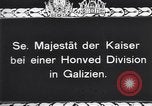
Kaiser Karl I of Austria, reviews troops of the Royal Hungarian Honved Division in Galicia during World War I
Kaiser Karl I reviews troops of the Royal Hungarian Honved Division in Galicia, Austria-Hungary, during World War 1.. Troops stand in formation. The Kaiser talks to a soldier. Soldier also replies. The Kaiser turns back to another soldier and salutes. (WWI; WW1)
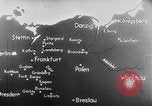
War-weary German soldiers returning from Budapest, during World War II
Map of Germany and Poland, with major cities marked. A German SdKfz 251 half-track armored personnel carrier (APC) enters a town in Germany, during World War 2. It is carrying about a dozen war-weary German soldiers that the narrator says just came from Budapest. They step down from the APC in front of a building displaying a sign identifying it as a refreshment hall for fighters back from Budapest, complements of the Waffen-SS. They receive hot cups of coffee (or some suitable refreshment). One soldier sits on a rock, eating a hot meal, in front of a sign telling vehicles to halt and report here. The weary fighters are mostly unshaven and a number have minor wounds covered by bandages. One has an eye patch. They converse and appear glad to get a rest. They board a bus. Others ride away in the back of an open truck. The road appears wet and icy. A large body of water is seen in the background.
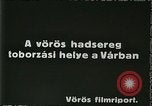
The red army's recruitment efforts in the Hungarian Soviet Republic following World War One
Slate refers to The Red Army recruiting place at the castle. Many Hungarian and some Russian men are seen. Most are in military uniforms. This is during the brief World War I post-war period when Hungary had a communist Government, the Hungarian Soviet Republic. Slate states that Red soldiers, one of them Russian speaking, appeals to patriotism of the recruitment candidates.