


 Francais
 Deutsch
 Italiano
Refine Your Search
Budapest Hungary 1916 stock footage and images
- Showing 499 to 504 of 876 results more
more Hide
Hide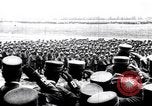
French officers review the French troops on Western Front in World War I..
A large group of French officers review French troops marching, approximately 20 abreast,on parade field in France, during World War 1. Officers salute the marching troops. There appear to be thousands more troops drawn up in formations in the distance, across the field. This is a very large assemblage of troops, perhaps Division size. (WWI; WW1)
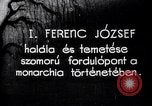
Horses pull casket carriage of Franz Joseph I of Austria
Men bring the casket of Emperor Franz Joseph I (Franz Josef) of Austria down the steps during his funeral. Casket placed in the carriage. Horses pull casket carriage of Franz Joseph out of the Hofburg Palace (1010 Vienna, Austria). Funeral cortege moves ahead through the streets of Vienna to St. Stephen’s Cathedral for the funeral. Crowds lined up to watch the funeral procession.
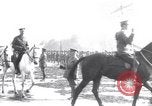
Lord French reviews mobilized London volunteers, during World War I
Commander-in-Chief, British Home Forces, Field Marshal John Denton Pinkstone French, 1st Earl of Ypres, reviewing London volunteer soldiers, during World War 1. He is seen on horseback, with staff officers. The London Volunteer units march past with shouldered rifles. Closeup of The Viscount French, as he was known.
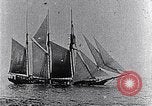
Germany undertakes U-boat campaign in North Sea and Atlantic Ocean to break Allied blockade in World War I
German World War 1 U-boat campaign accelerates in 1915. A three-masted schooner (the "Miss Morris Miss Morris, in route from Genoa to Malaga) slowly sinks in Mediterranean Sea after being attacked by the German submarine U-boat U-35. A German UB-III class submarine underway on the surface emitting smoke from a stack on the stern deck. A small one-stack merchantman sinking after U-boat attack. Slate refers to German food shortages due to allied blockade, and states U-boat warfare is Germany's answer. Another view of the German UB (coastal torpedo attack boat) submarine. Captain of a U-boat at his periscope. View from periscope of several Allied warships. A submarine slowly submerging to periscope depth. Naval guns in triple turrets of a British dreadnaught fire salvos. Explosion from depth charge raises large column of water. A torpedo leaving a bubble trail as it moves through the water. Starboard aft view of British battle cruiser underway. She has two turrets of heavy guns mounted on her aft deck and two smaller ones in sponsons on her aft starboard side. A British 4-stacker destroyer underway.
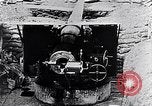
French artillerymen fire a 155mm long gun during World War I
View of a pedestal-mounted French 155mm long gun, in a well-fortified position during World War 1. The emplacement is protected all around with rows of sand bags. It is deep enough that the gun is not visible until raised to fire (and then only the barrel is visible). The French Army artillery gun crew loads the gun and the soldiers fire two rounds. The area around the emplacement is a desolate no-man's land.
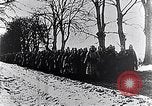
Austrian-Hungarian troops on the march and French infantry assault German-held hill, in World War I.
Austro-Hungarian troops march along a road during winter in World War 1. Snow covers the ground. Change of scene shows troops moving supplies (including a field kitchen) in horse-drawn wagons, along the crest of a hill. Next scene shows a mounted army bugler sounding a call in a snowy army camp field. Regimental lancers (Ulanen) ride into view leading a column of various kinds of troops. The lancers are seen galloping along a path, followed by troops and supplies in wagons pulled by teams of horses. A group of senior officers is gathered near one looking through tripod mounted periscopic binoculars. They see French columns on a hill held by German troops. Austro-Hungarian infantry move down a snowy hillside. In the distance, French troops are assembled and march in small unit formations across a flat snow-covered field to engage the German soldiers in trenches. The French infantry begin to run on their attack. Several are seen falling to German gunfire during the battle. Then they are seen retreating in formation. Fallen French soldiers lie in the snow. The French infantry reform and launch another attack, making a right flanking movement before moving forward, this time. In their final assault, they swarm uphill, leaving many dead and injured lying in the snow behind them. Later they are seen carrying the bodies of the fallen from the field. Austrian medics on skis come the the aid of a wounded comrade. They improvise a sled from skis and pull the wounded soldier on it.