


 Francais
 Deutsch
 Italiano
Refine Your Search
Chalons-en-Champagne France 1921 stock footage and images
- Showing 103 to 108 of 5759 results more
more Hide
Hide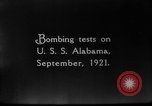
Bombs are dropped by aircraft on USS Alabama during bombing tests in the United States.
Development of air power. Bombing tests on USS Alabama in September 1921 in the United States. USS Alabama anchored in water. A soldier arms and works on fuse mechanism of a large bomb swung underneath a large bomber. A standard-Handley Page 0/400 bomber in flight to the right over water. A United States Army Air Corps Dayton Wright DH-4 aircraft in flight to the left dropping a bomb. The bomb explodes on the ship. A phosphorus bomb explodes on the ship and engulfs the entire ship in smoke. The ship explodes. Part of the superstructure topples off into the water. The ship lists over a side with one of the towers bent over and lying in the water.
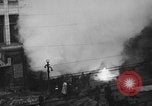
Firemen douse fire on three-story Woolworth building, and the front wall of the blazing building collapses, in Aurora, Illinois.
Firemen work to extinguish a fire at the Woolworth 5 & 10 store located at 19-21 Broadway Street in Aurora Illinois. Views of fire fighters spraying water through large hoses and working to bring the blaze under control. Body of a fireman killed in the blaze is covered. The firemen among the debris beside the wrecked building. The front wall of the blazing building collapsed killing three firemen.
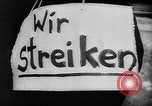
Strikes, hyperinflation, and food shortages in Germany. Germans march with shovels and Hitler launches Kraft durch Freude ship.
Scenes in Germany in 1920s and 1930s. Changes in Germany during Adolf Hitler's leadership. Workers on strike. Workers sitting with no work. Hyperinflation during the Weimar Republic 1921-1923 after World War I. Money, drafts and notes with huge values seen due to inflation. Woman buying from vendor with large prices posted. Band musicians playing jazz music, people dancing as inflation becomes uncontrollable. Men are given shovels to march with by Nazi official (likely early Reich Labor Service or RAD of NSDAP). Adolf Hitler speaks to a crowd about rebuilding of Germany. The launch of several ships. First is seen the launch of luxury ocean liner Wilhelm Gustloff in 1937, with Hitler present on a podium. (The MV Gustloff was the first ship built specifically for the German Labor Front’s Kraft durch Freude (“Strength Through Joy” program.) German officials give Nazi salutes. German flags on the ship.
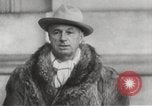
How turbo superchargers facilitate high altitude airplane flight. World War II warplanes equipped with superchargers
General Billy Mitchell wearing fur coat and western style hat. Animated illustration of U.S. Army Martin bomber operating at 15 thousand feet during the famous demonstrations of air power against battleships, in 1921. This was possible because the aircraft engines were supercharged, an outgrowth of Dr. Sanford Moss's developments at General Electric Company.World War 2 scenes of U.S. Army Air Forces aircraft that use supercharged engines: P-51s; P-47s; P-38s; B-24s; B-17s and B-29s. View of atomic bomb explosion.
Images pertaining to advance of communism during 20th century, especially in East Germany
Statue of Karl Marx on his grave stone in Highgate Cemetery, London. A picture of Karl Marx. Scenes in Russia around the time of the Russian Revolution circa 1917 and creation of the Soviet Union. Soviet soldiers walking slowly in loose formation. Bolsheviks standing with a large banner. Images spanning many years thereafter: Damaged shops on a street. "One way" street signs in several languages. Large gathering of people carrying signs reading: "Frieden" (Peace, in German). A sign reading: "HALT, Landesgrenze" marking a German provincial boundary. A sign in German, designating the customs border at Furth im Wald, Bavaria ("Zollgrenz-Bezirk, Furth i.Wald"). East German border guards setting obstacles and sentry paths at barbed wire barriers (constituting the Berlin Wall, early on). Picture of Günter Litfin, a twenty-four-year-old tailor, who swam across the Spree Canal to West Germany on 24 August 1961. View of him being fatally shot from across the border, by East German guards, as he is being pulled into West Germany (the first such fatality at the East West German border). Animated map of the world with label references to Berlin,1961; Havana, 1959; Budapest, 1956; Coyoacan, 1940; and Kronstadt, 1921.
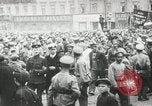
Post-World War 1 events in Russia
Crowd milling about in Kronstadt, West of Saint Petersburg,Russia, as group of Russian sailors, soldiers and civilians, marches in their midst carrying a Sign reading "Peace, Freedom, and Bread." On March 7, 1921, The Bolshevik government sends 60,000 troops under command of Mikhail Tukhachevsky to quell the disturbance. They are seen marching in the streets. Next scene shows women looking amongst the fallen for their relatives. View of Leon Trotsky (Commander of the Red Army) walking with some of his staff. View of human remains. Brief view of Lenin. Trotsky writing at his desk. Narrator mentions the State Security Agency called "Cheka," being replaced by the Joint State Political Directorate (AKA OGPU). Narrator calls it the Political Police. Vyacheslav Mikhailovich Molotov is seen walking with a group of Soviet workers and politicians ostensibly charged with overseeing the OGPU. Another scene shows Molotov conversing with Joseph Stalin (Iosif Vissarionovich Stalin). Mikhail Ivanovich Kalinin stands to Stalin's left. views of Stalin. Lev Kamenev, a leader in Moscow City politics. Russian families on a train platform preparing to travel in box cars (to Siberia?). farmers harvesting grain in Russia. A woman shopkeeper cuts a loaf of bread in pieces and weighs them on a scale for sale to a customer. American foodstuffs provided as aid to Russia. Some of the American food being unloaded at a pier. American Relief Administration Chief, Herbert Hoover, standing at a port. Food being distributed to Russian citizens, and to children. Newspaper of March 14, 1923, announces the Lenin suffers a stroke. In January, 1924, a newspaper headline announces that "Lenin is dead." Lenin seen in coffin. Funeral cortege, including principal Soviet leaders, carries the coffin outdoors in falling snow. Spectators watch and others follow in the solemn funeral march. Narrator states that "Stalin,Zinoviev, and Kamenev force Trotsky into exile." Soviet citizens are seen at hard labor under new "Five year plans."
CRITICALPAST.COM: About Us | Contact Us | FAQs - How to Order | License Agreement | My Account | My Lightboxes | Shopping Cart | Advanced Search | Featured Collections | Website Terms & Conditions | Privacy Policy ©2026 CriticalPast LLC.
License Agreement |
Terms & Conditions |
Privacy Policy
©2026 CriticalPast LLC.