


 Francais
 Deutsch
 Italiano
Refine Your Search
Chalons-en-Champagne France 1921 stock footage and images
- Showing 7 to 12 of 5759 results more
more Hide
Hide
French civilians work together in building a bridge across the Aube River in France.
French civilians build a bridge across the Aube River in France during World War II. A slate reads '80th Division to Chalons'. French civilians at work. Civilians carry a log of wood for the bridge. Two men carry a long pole across the bridge. French civilians walk across the bridge as they talk. A French flag flutters from a pole near the construction site. Few men work under the bridge. A civilian climbs down a ladder. A board reads 'Aube'. A man serves a drink to the workers. Men work under the broken bridge. A civilian with a cap drills a bridge block. French civilians build the bridge across the Aube River.
French civilians greet French 2nd Armored Division and open champagne bottles in Paris (WW2)
French 2nd Armored Division M4 Sherman tank “SROCO” driving into a hedge near Paris, France during World War II. Advertisement for “ORANGE” on a wall is seen. French civilians crowd the streets of Paris during the arrival of Free French soldiers into the city. Civilians greet French soldiers and a few US troops on Jeeps and vehicles. A group of young men and women waving at Allied troops. A French man opens a Champagne bottle. French civilians hold Champagne bottles and glasses to celebrate arrival of Allied troops into Paris shortly after the city's liberation from German forces.
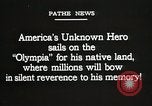
Casket of the Unknown American soldier of World War I is transported on the USS Olympia and received by dignitaries in the U.S.
The American Unknown soldier of World War I before burial in the Tomb of the Unknowns at Arlington National Cemetery. Remains of America's unknown hero sails aboard the USS Olympia (C-6) for America. A caisson carriage arrives at a harbor in France bearing the casket on October 25, 1921. Large crowd of soldiers and dignitaries present. France decorates the Unknown Hero as French officer reads citation for Legion of Honor medal. Officers crowd around the coffin. The ship USS Olympia (C-6) in the background. Sailors carry the coffin of the Unknown Soldier aboard the ship. French soldiers lay a wreath on the coffin. USS Olympia leaves the harbor. Next scene shows USS Olympia arriving in the United States at the Washington Navy Yard on November 9, 1921. Soldiers carry the casket off the ship. Unknown Soldier being received by U.S. Secretary of War John W. Weeks, U.S. Secretary of Navy Edwin Denby, U.S. Army General John J. Pershing, Commander of the U.S. Marines Major General John A. Lejeune. They salute as sailors carry the body past the military band. The flag draped casket is borne to the U.S. Capitol in Washington DC. A horse drawn caisson takes the body as officers and soldiers follow.
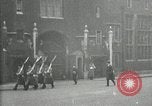
UK Prime Minister David Lloyd George, French Prime Minister Aristide Briand during London Conference
British Royal Guards march outside building in London. Two guards at attention flanking building entry. British civilian crowd lines up on the sidewalks. UK Prime Minister David Lloyd George, French Prime Minister Aristide Briand and other Allied officials leave the building during the 1921 London Conference on German Reparations, held in March and April of 1921. Hand drawn map shows German areas occupied by Allies after World War I. Written labels are added to it as the film continues. The labels include "Neutral Zone" line between Germany and France, "American Sector" called out along that line and showing the area near Dusseldorf "Occupied by Allied Troops" and at Essen the marking "Essen under range of French Guns." Next is seen a marking that says "Kiel, Hamburg, and Bremen dominated by British Fleet." The map is signed by illustrator "Bert Green".

Workers celebrate on the completion of the Mont Blanc tunnel in France.
The Mont Blanc tunnel being built in France. View of snow covered peak of Mont Blanc and gondola on steel cable ascending mountain. French and Italian workers inside the tunnel celebrate the completion of the tunnel from Chamonix, on the French side of the mountain, to Courmayeur, on the Italian side, cutting the road travel distance between Paris, France and Rome, Italy by 125 miles. Italian and French officials celebrate during the ceremony. Civil Engineer and Professor Loris Corbi, head of the Italian team, greets André Borie, the lead French Civil Engineer. Workers celebrate and drink champagne to toast the achievement.
Men and women working in a munitions factory in France during World War I
Men and women working in a munition factory in France. Men transporting artillery shells on the floor of the factory. Workers loading and moving shells from stacks with the aid of pulley lifting equipment. Hand carts are used to move projectiles. Data appears on the screen regarding the French artillery fired for every meter of enemy German trenches in the Main de Massiges area between the Champagne and Argonne fronts. A map showing the Main de Massiges area during the first World War.
CRITICALPAST.COM: About Us | Contact Us | FAQs - How to Order | License Agreement | My Account | My Lightboxes | Shopping Cart | Advanced Search | Featured Collections | Website Terms & Conditions | Privacy Policy ©2026 CriticalPast LLC.
License Agreement |
Terms & Conditions |
Privacy Policy
©2026 CriticalPast LLC.