


 Francais
 Deutsch
 Italiano
Refine Your Search
Chalons-en-Champagne France 1921 stock footage and images
- Showing 1603 to 1608 of 5770 results more
more Hide
Hide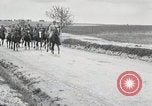
African American soldiers of 369th Infantry, 93rd Division, U.S. Army marching on road in Maffrecourt, France, during World War I
African American soldiers of the 369th Infantry Regiment, 93rd Division ("Harlem Hellfighters"), United States Army, march in formation along a road in Maffrecourt, France, in World War 1. They are led by mounted officers, and a brass band (likely under the direction of band leader Lt. James Reese Europe). Unit leaders salute as they pass the camera. Mules pull several artillery pieces and caissons. Several medics march with stretchers. The U.S. flag is the only one carried by the color guard. No unit colors are seen. The 369th Infantry soldiers wear French helmets because they were assigned to the French Army during the war, as the U.S. Army (American Expeditionary Forces) did not permit African Soldiers in combat.
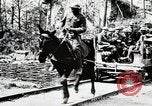
369th Infantry, 93rd Division United States Army African American soldiers occupy trenches and fire at Maffrecourt, France.
369th Infantry Regiment, 93rd Division United States Army African American soldiers occupy trenches near Maffrecourt, France during World War 1. They were also nicknamed the Harlem Hellfighters. Troops fire from trenches. Though American, the 369th Infantry soldiers are wearing French helmets because the U.S. Army (American Expeditionary Forces) did not permit African Soldiers in combat, so the unit was assigned to the French Army during the war. In one scene the African American soldiers are seen putting on gas masks during a gas attack drill. Soldier shows a document to Colonel. He ties a message to the carrier pigeon and releases it. African American soldiers rush from a trench toward the front with their rifles.
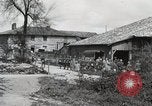
369th Infantry 93rd Division United States Army troops load provisions onto carts at Maffrecourt, France.
African American soldiers of the 369th Infantry Regiment, 93rd Division, United States Army, load provisions onto horse carts at a village near Maffrecourt, France during World War 1. African American soldiers carry a large milk vessel. African American soldiers on horseback and driving horse drawn carriages in the village. The division was also sometimes called the "Harlem Hellfighters."
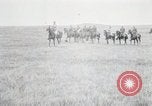
African American soldiers of U.S. Army 369th Regiment, 93rd Division, march in review near Maffrecourt, France, during World War I
African American soldiers of United States Army 369th Infantry Regiment, 93rd Division, Colored (sometimes called the "Harlem Hellfighters") on parade across an open field near Maffrecourt,France, during World War 1. They are led by their Commander, Colonel William Hayward, on horseback, followed by 8 other mounted officers. Several soldiers are walking bicycles behind them. Next is seen the famous 369th Regimental marching band, led by Bandmaster, Lieutenant James Reese Europe. Troops of the Regiment march with shouldered arms in formations of 30-man fronts. At the end of the film, the troops execute a right flank maneuver. A three-man color guard poses for the camera with the American flag. No other colors are displayed during the review.
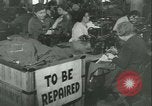
Women sew clothes for U.S. Army soldiers at Quartermaster Salvage Shop in Reims, France.
French, Italian, Lithuanian women liberated from labor camps sew GI 's (members of the United States armed forces) buttons and patch pants at Quartermaster Salvage Shop in Reims,France. Workers shred the un-salvaged GI clothing. After World War II.
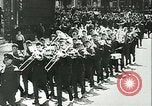
Legion Unit of France soldiers (LVF) march through streets of Versailles and board train bound for eastern front in World War II.
View of collaborationist French soldiers from the Legion of French Volunteers Against Bolshevism (Légion des volontaires français contre le bolchévisme, or, Légion des volontaires français, or LVF.) The LVF soldiers, made of of right-wing French and French prisoners, are marching through the streets of Versailles, in Vichy France, toward the Versailles Chantiers train station, to begin their trip to the Soviet Union where they will fight together with Germany against Soviet forces in World War 2. To the Germans they were known as Infantry Regiment, or Infanterieregiment 638. Led by a Band, the soldiers march through streets of Versailles and uphill toward the main arched entrance of the Versailles Chantiers station. Civilians line streets to bid farewell, and some women kiss soldiers goodbye. View of black locomotive leading the train. LVF board a train car with chalk inscription on the side "Paris - Moscow, LVF".
CRITICALPAST.COM: About Us | Contact Us | FAQs - How to Order | License Agreement | My Account | My Lightboxes | Shopping Cart | Advanced Search | Featured Collections | Website Terms & Conditions | Privacy Policy ©2026 CriticalPast LLC.
License Agreement |
Terms & Conditions |
Privacy Policy
©2026 CriticalPast LLC.