


 Francais
 Deutsch
 Italiano

Refine Your Search
Chalons-en-Champagne France 1921 stock footage and images
- Showing 3577 to 3582 of 5770 results more
 Hide
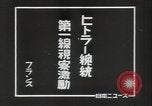
German Chancellor Adolf Hitler and German officers inspect Krupp K5 railway guns and Atlantic coastal guns in France during World War II
Opening scene shows Adolf Hitler with an entourage of military officers walking from a tunnel beside two steam locomotives parked on a railroad track, during World War 2. The group continues between to large berms lining the area. They approach a construction project of concrete with lots of wooden framing in place around it. Scene shifts to a Krupp 283mm K5 railway gun on rails in the sand. A large earthen berm is seen behind the gun. Hitler converses with officers at the site. Next, a closeup shows the gun barrel being elevated. Hitler looks at another K5 gun with its barrel down. He then proceeds into a sand-bagged revetment leading to a doorway and underground tunnel. Next, he is seen emerging from the tunnel onto the courtyard of what appears to be a church. A large body of German soldiers is assembled there. They render the Nazi salute. Closeup of Hitler atop the area defenses, where coastal guns of the Atlantic Wall are installed in sand-bagged revetments. Views of gun crews firing these coastal guns out to sea, in a demonstration.
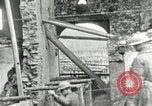
U.S. troops of the AEF entrenched in France during World War I.
U.S. troops of the American Expeditionary Forces (AEF) on their way to the front lines during World War 1. They descend a stairway beneath damaged bridge and proceed through a town. One soldier slogs into a trench filled with debris, mud, and water. Then more troops work to clear it of mud. One soldier smoking a cigar as he reads a letter from home. He has some care packages at his feet in brown paper wrapping. A view across No Man's Land, where Germans hold a hill nearby. U.S. soldier uses a periscope to look at the area. Closeup of the soldier and periscope. Other views of the U.S. troops in the trenches. One using a pair of binoculars. View of the German-held hill across No Man's Land. Barbed wire and obstacles outside the trench. Army cooks working at a field kitchen under camouflage nets. A cook stirs soup, stew, or a hot drink in large vats of a portable, wheeled kitchen. (World War I; World War 1; WWI; WW1)
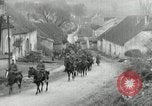
U.S. artillerymen of the AEF passing through a town in France on the way to the front in World War I
U.S. troops of the American Expeditionary Forces (AEF) passing through a French town on their war to the front during World War 1. Mounted Artillerymen accompany horse-drawn caissons and artillery pieces. View through archway of town building shows canvas covered Army wagons moving through the town.Teachers and school children watch as the American troops pass on a roadway.Closeup of the children waving at the soldiers. The artillerymen passing through a village. (World War I; World War 1; WWI; WW1)
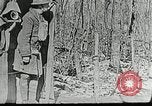
U.S. soldiers under gas attack in France during World War I
A U.S. soldier of the American Expeditionary Forces (AEF) standing near a hut, hears a gas alarm and dons his gas mask. View of a U.S. camp with huts. The soldiers assemble in response the the alarm and all don gas masks. They run up a hill. View from a trench, at a tree, line of gas shells exploding in a field. Soldiers crawling across the trench. Gas drifting across the tree line and soldiers walking through the area. Camera pans across the wooded area, showing the tops of most trees blown away and many trunks laying on the ground. Two couriers carrying messages run through the drifting gas. Scene shifts to a field hospital dug into a hillside. Several soldiers sit on benches. Two medical corpsmen carry a wounded soldier out of the hospital, on a stretcher. (World War I; World War 1; WWI; WW1)
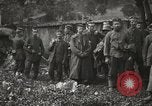
German prisoners of war under the guard of American soldiers and officers at a stockade in France during World War 1
U.S. soldiers during the Grand Offensive on the Western Front during World War I. Prisoners of war, mostly German, in a stockade. Close-up views of German prisoners of war. Buildings in the background. Medics, soldiers and officers standing. Carts passing across a field in the background.
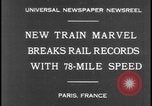
André Chapelon’s first locomotive rebuild for the Paris à Orléans (PO) railway in France on Paris à Orléans (PO) railway.
The Nord Pacific No 3566 locomotive as rebuilt by André Xavier Chapelon departs from a railroad train station in Paris along the Poiters-Angouleme route. Train's engineer, wearing goggles, looks through window as he operates train. View of exhaust as steam whistle is operated. Point of View shot toward back of train as it is underway. POV inside train, towards front of moving train as seen by train engineer. Speedometer indicates that train is running at 125 km/h, a bit higher than the French government speed limit of 75 mph (120 km/hr). Train passes by. Locomotive exhaust and whistle. This locomotive featured Chapelon's first major invention, the Kylchap exhaust, which was created with Finnish engineer Kyösti Kylälä, and produced less back pressure than previous designs. This modified prototype Pacific #3566 was originally 2000 indicated horsepower (IHP) but improved to a 3000 IHP with both fuel and water consumption reduced by 25% as a result of the rebuild process. Footage is from 1931, but first tests of this locomotive took place in November 1929.
CRITICALPAST.COM: About Us | Contact Us | FAQs - How to Order | License Agreement | My Account | My Lightboxes | Shopping Cart | Advanced Search | Featured Collections | Website Terms & Conditions | Privacy Policy ©2026 CriticalPast LLC.
License Agreement |
Terms & Conditions |
Privacy Policy
©2026 CriticalPast LLC.