


 Francais
 Deutsch
 Italiano
Refine Your Search
Chalons-en-Champagne France 1921 stock footage and images
- Showing 4069 to 4074 of 5770 results more
more Hide
Hide
U.S. Brigadier General Ira Eaker leads B-17 raid on Rouen, France, during World War 2
U.S. Army Air Force armorers ride atop bombs on trolleys, being pulled by a tug on an airfield in England during World War 2. Airmen gather around a bomb as one writes in chalk, "To Schicky (referring to Hitler family, Schickelgruber) this is only the start, Love, L.E.Z." Views of Airmen rolling bombs on carts under a B-17E aircraft. View from inside a B-17 as ground crews look up through open bomb bay doors. B-17 combat crewmen walking and riding bicycles, to attend a mission briefing. Inside the assembled aircrews are briefed by a British RAF officer, who says, "We're going to work. The target is XZ 462." He goes on providing details to be followed by aircrews. The crews leave the briefing room. Next, B-17s are seen taxiing out for takeoff. The lead aircraft is "Yankee Doodle" piloted by Brigadier General Ira Eaker. Another is "Stinky." Next is "Little Skunk Face."And the last one "Berlin Sleeper." Ground crews watch as the B-17 bombers take off and assemble into formation overhead. Views from inside a B-17 as bombs fall and its gunners fight off German fighter planes. Bombs seen falling and exploding on the ground and raising clouds of smoke. Glimpse of gunners firing at attacking German aircraft. Narrator states there is anti-aircraft fire all around them, that jolts the aircraft. The B-17s assemble in formation for the flight home. Back at the base, some wait atop the tower for the returning aircraft. General Ira Eaker, Chief of the U.S. VIII Bomber Command, steps from a returning aircraft, and greets Major General Carl Spaatz, Commander of the 8th Air Force. Final scene shows Brigadier General Eaker, smoking a cigar and surrounded by civilian and military reporters. ( Note: Reportedly, the B-17 "Stinky" crash landed in Athenry Co Galway Ireland on the 15th January 1943 with General Jacob Devers and a party of other Generals onboard, but none were injured and and all arrived safely at 2AM the same day, in Belleek, Northern Ireland.)
U.S. soldiers in England, install wire cutters on U.S. jeeps before shipping them to France, during World War II.
U.S. soldiers of the 87th Chemical Battalion (mortar) make field modifications by installing wire cutters on army jeeps, at the D-Day Marshalling Area Camp in Shiphay, Torquay, (Devon) England during World War 2. U.S. soldier paints an angle iron vertical post (wire cutter) fastened on bumper of a jeep. He pastes U.S. flag on the windshield and writes OK in chalk on the front bumper. Line of modified jeeps travel along road after completing check ups. Soldiers use hack saws to cut pieces of metal and hand drills to put holes in bumpers where angle iron wire cutters will be fastened. They use files to take sharp edges off the angle irons. A soldier slips washers and bolts on an angle iron and tightens them with an adjustable wrench. (Note: These angle iron vertical rods, mounted on a vehicle front bumper, were meant to protect jeep occupants by catching and cutting wires that might be strung across roads to injure or kill unprotected drivers of open vehicles, such as Jeeps.)
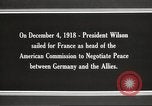
President Woodrow Wilson aboard USS George Washington heading from Hoboken Port in New Jersey to France for peace negotiations.
American President Woodrow Wilson heads for the Paris Peace Conference, following the armistice in World War I. USS George Washington leaves Hoboken Port in New Jersey. A board reads "US Army Transport Service'. Small boats along USS George Washington. (World War I; World War 1; WWI; WW1)
Passengers board an ocean liner in New York City, bound for France.
Passengers embark an ocean liner at a pier in New York City. Friends and family wave from the pier as tug boats guide the ship away from the dock. View of the New York skyline as the ship heads out to sea. View of 4-stacker ocean liner at sea (the Cunard Line's SS Aquitania). Ship's officers seen in the wheelhouse. Passengers stroll the decks; play deck games (shuffleboard); rest on deck chairs; and have drinks at the bar. Scenes of fancy food displays and chefs at work. One chef pours wine into food being cooked, and then takes a swig from the bottle, himself.
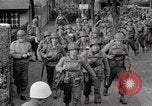
U.S. Army Rangers in Weymouth, England, prior to the D-Day invasion of France in World War II
Pre-invasion activities of United States Army Rangers in Weymouth, England during World War 2. The rangers walk past an American Red Cross tent, adjacent to Greenhill Gardens, Weymouth, where they receive coffee and doughnuts before sailing. A sign at the tent reads: "From the folks back home through the American Red Cross." A U.S. guard and a British guard patrol Weymouth Seafront, beside a gun emplacement on the esplanade in front of the Jubilee Clock Tower. An insignia on the ramp of Landing Ship Tank 357 (LST-357) reads '357' and shows a stork carrying a baby with the words 'We Deliver'. The ramp is raised.
U.S. 105th Field Artillery march up to the docks and on to USS America and Madawaska in Newport News, bound for France
U.S. 313th Labor Battalion troops, 105th Field Artillery and 2nd Battalion Pioneers embark from Newport News, Virginia for Europe in 1918 during World War I. The troops of U.S. 313th Labor Battalion at a pier. U.S. 105th Field Artillery and 2nd Battalion Pioneers march up to the docks and on to gangplanks by U.S. Navy transport ships USS America and USS Madawaska. The World War 1 American troops at dock. The covered artillery at the dock. The troops walk up the gangplank. A building and a ship at the dock.
CRITICALPAST.COM: About Us | Contact Us | FAQs - How to Order | License Agreement | My Account | My Lightboxes | Shopping Cart | Advanced Search | Featured Collections | Website Terms & Conditions | Privacy Policy ©2026 CriticalPast LLC.
License Agreement |
Terms & Conditions |
Privacy Policy
©2026 CriticalPast LLC.