


 Francais
 Deutsch
 Italiano
Refine Your Search
Chalons-en-Champagne France 1921 stock footage and images
- Showing 4423 to 4428 of 5770 results more
more Hide
Hide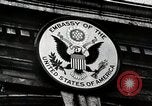
Beginnings of the Second Sino-Japanese war
Sign over American Embassy in China. Colonel William Mayer, former military attache in that embassy relates events precipitating Second Sino-Japanese war. Scenes of the Marco Polo bridge near Peking, on night of July 7, 1937, as Japanese artillery bombards the area. Animated map shows movement of Japanese forces out of Manchuria to occupy Peiping and Tientsin. Victorious Japanese troops stand atop a building, raising their flags and shouting cries of victory. Japanese army officers sit around a table smiling and contended and others walk in a group. Chinese artillery crews are seen retaliating as they fire field pieces at Japanese positions in Shanghai. Shells explode in background, and Chinese infantry advance through damaged buildings and rubble. Animated map shows Shanghai and other cities, and film transitions to view of the bustling city of Shanghai on the Yangtze River. In the seaport, large ocean liners and freighters, as well as tug boats and Junks, are seen. What looks like a Japanese Tachikawa Ki.54 Type 1 transport plane takes off over a Chinese pagoda. Double-decker buses travel through the streets. Rickshaws are also seen. Map outlines the foreign residential areas of the French Concession and the International Settlement. American, British and Japanese flags are shown in the International Settlement. Detachments of troops from Japan, Britain, France, and United States Marines are seen. A U.S. Marine is posted as a sentry at the Shanghai Power Company. Coolies carry heavy bucket on a long pole. British, French and Japanese troops also performed sentry duties. Japanese troops and armored cars are seen. A scuffle breaks out in August, 1937, and Japanese soldiers start moving in trucks, take up firing positions, and begin firing guns from their armored cars. Map shows Chinese counterattack pushing the Japanese contingent toward the Khangpoo River. Next it shows Japanese warships and reinforcements in the Yangtze River and their advance toward Woosung and Shanghai. Views of Japanese warships bombarding the shore and large explosions from their striking shells. Beachhead is shown South of Shanghai, where two divisions of Japanese infantry are seen arriving in landing craft. They advance across the fields toward Shanghai. Map shows Chinese withdrawals to West and South, toward Nanking and Hangchow. Chinese medics along with infantry march in retreat. Japanese pilots are seen being briefed. Next, Japanese Mitsubishi G3M bombers are seen in flight, and bombardiers and other crew in them. Bombs falling on the city. Civilians running for cover as bombs explode. Aichi D3A1 aircraft dropping bombs. The Shanghai waterfront being bombed and civilians running.
Third United States World Trade Fair at the Coliseum, in Manhattan, New York City, 1964
Scenes of fire works. New York city in America. Views of Manhattan skyline and 5th Avenue in New York City. The Third United States World trade fair at the Coliseum on Columbus Circle in New York city. Flags hang on walls in the building. Stalls from various countries around the world like France,Germany,Norway,Italy,India,Venezuela, Japan,Luxembourg and China. Two men ride up on escalator. Men greeted by a Japanese woman at Japanese stall. Japanese woman adjusts flowers kept in a porcelain vase. Japanese Noritake China crockery and furniture on display along with other Japanese merchandise like vase,bowls,scissors. American women check Japanese leather bags made by Matsutaki Company. Bamboo merchandise on display. Silk clothes made by Kanegafuchi spinning company are also on display. 1964-65.
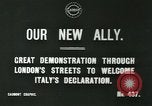
British people on streets of London celebrating Italy's decision to enter World War 1 on the side of the Triple Entente
Celebrations on London's streets following Italy's decision to join the Triple Entente– Britain, France and Russia -- and declare war on Austria-Hungary, during World War I. Crowd on street gathers for demonstration, vehicles also on road. Crowd stand in front of building with flags. Kingdom of Italy flag flies.
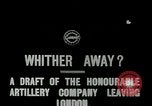
British Soldiers of Honorable Artillery Company board railroad train and leave London during World War I.
British troops of the Honorable Artillery Company Regiment leave London by railway train, bound for France to reinforce those already there. The railroad train station platform is filled with new recruits and reinforcement troops as they march toward the train. Soldiers on platform wave to those in the train. (World War 1; WWI; WW1)
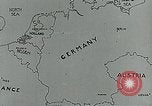
Battle line to which Germany must retreat and Kaiser Wilhelm II on horse.
Map shows the boundaries of Germany, France, Poland and Belgium. Animated arrow indicates battle line at the end of war and then line to which German must retreat across Rhine River. Shadowed portion of Rhine River as neutral zone. Kaiser Wilhelm II on horse.
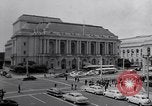
Primer Mr Shigeru Yoshida addresses and signs peace treaty with representatives of other countries in San Francisco, CA
San Francisco Peace Treaty conference with Japan, in San Francisco, California. Beginning shows the War Memorial Opera House and Van Ness Avenue. U.S. President Harry S Truman steps to a podium, at the Opera House, to address delegates at the conference. With him on the stage are Dr. Warren Kelchner, Temporary Chairperson of the Japanese Peace Treaty Conference, Governor Earl Warren of California, and Secretary of State Dean Acheson. Next, Dean Acheson is seen seated at the center of a table with Dr. Kelchner, at his right, as Soviet representative Andrei A. Gromyko steps to the microphone and speaks. (Narrator says he raises complaint about rules of procedure.) Dean Acheson removes his translating headset in frustration. Next, a representative of Poland comes to the microphone, and calls for delays. View of delegates in the audience. New Zealand representative, Sir Carl August Berendsen, takes the stand to renounce delaying tactics. Audience members applaud. Carlos P. Rómulo, of the Philippines, speaks in support of the treaty. John foster Dulles, of the United States, steps to the podium to speak for the treaty. Next, Japanese Premier, Shigeru Yoshida, referring to notes in a roll of paper, endorses the treaty. Audience applauds. Secretary of State Acheson is seen signing the treaty for the United States, followed by representatives of: Australia; Cambodia; Great Britain; Ceylon; France; Indonesia; Philippines; and Pakistan. Next, the Japanese delegation comes forward, and Prime Minster Shingera Yoshida, signs the historic document. Closeups of ordinary Japanese from all walks of life. Japanese people commuting to work.
CRITICALPAST.COM: About Us | Contact Us | FAQs - How to Order | License Agreement | My Account | My Lightboxes | Shopping Cart | Advanced Search | Featured Collections | Website Terms & Conditions | Privacy Policy ©2026 CriticalPast LLC.
License Agreement |
Terms & Conditions |
Privacy Policy
©2026 CriticalPast LLC.