


 Francais
 Deutsch
 Italiano
Refine Your Search
Chalons-en-Champagne France 1921 stock footage and images
- Showing 5599 to 5604 of 5759 results more
more Hide
Hide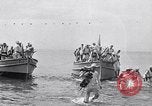
U.S. Navy battle fleet engaged in Fleet Problem maneuvers in the Pacific Ocean
The U.S. Navy battle fleet engaged in Fleet Problem (number 5) in 1925. Armed U.S. sailors wade ashore from whale boats. They assemble and march from the beach carrying the colors. Sailors and marines charge across a beach area and fire their rifles at targets from prone positions. They jump up en masse and repeat the process closer to the targets. U.S. warships anchored (possibly at Pearl Harbor).Martin SC-1 float planes take off on scouting mission. A formation of Martin SC-1s in flight. U.S. Submarine (SS-44) glides abeam a battleship. A line of submarines moving on the surface past a battleship in the background. A pair of light cruisers underway.
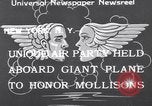
Newsreel "Unique air party held aboard giant plane to honor Mollisons"
A celebration aboard a giant airplane high over New York City, en route to Atlantic City. Interior views of cabin of the airplane, and cockpit, while guests are seated in the plane during flight. They are served refreshments. Aerial view of the city of New York including skyscrapers like the Empire State Building. Aerial view of the George Washington Bridge spanning the Hudson River. British aviators James Mollison and his wife Amy Mollison are among guest honored by famous woman American Aviator Amelia Earhart on the flight. Heavy weight boxing champion Gene Tunney (with bandage on left side of face), artist Howard Chandler Christy and the publisher George Palmer Putnam are also among the guests. Stewardess or flight attendant is seen talking to pilots during flight, and serving drinks to guests. Gene Tunney smiles on receiving a drink.
Amphibious forces carried by U.S. Coast Guard, at Guadalcanal and in North Africa during World War II
United States Coast Guard operations in World War 2. Underwater views of ship's anchors being weighed, Convoy of U.S. ships in Pacific Theater, in July, 1942. The Attack Transport, USS Hunter Liggett underway, with crews doing amphibious training. Members of the 1st Marine Division aboard USS Hunter Liggett with Coast Guardsmen. Officers confer aboard vessel. Marines read books on ship. August 7, 1942, U.S. Marines begin amphibious assault against Japanese on Guadalcanal. Naval guns bombard Guadalcanal Island. Marines descend from the USS Hunter Liggett, on nets and enter LCVPs (Higgins boats) operated by Coast Guardsmen, to assault the island. Marines hit the beach from the boats. Marines firing small howitzers and advancing on the island. November 7, 1942, convoy of eight hundred ships en route to North Africa. Warships bombard the shore. An officer observes through binoculars. British and American troops descend on nets into LCVPs from Attack transports: USS Joseph T. Dickman (APA-13);USS Leonard Wood (APA-12); and USS Samuel Chase (APA-26). Troops hit the beaches of North Africa, under fire.
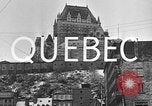
The Quebec and Tehran Conferences in World War II. German defenses in the Western Wall. The air war in Europe.
Allied strategic Conferences in World War 2. Opening scene shows Château Frontenac. Then President Franklin Roosevelt seated with Canada Prime Minister, McKensie King, and British Prime Minister, Winston Churchill. Scene shifts to their respective military staffs conferring at a table. Next scene shows the Russian Embassy in Tehran, Iran, with the Big Three (Joseph Stalin, FDR, and Churchill) seated on the portico, and their top ranking military officers standing behind them. Soviet Marshal Kliment Voroshilov stands behind Stalin. American officers are seen in next scene, including General George Marshall, Admiral Ernest King (lighting a cigarette) and General Henry H. ("Hap") Arnold. U.S. Ambassador to Russia, W. Averell Harriman, stands behind King and Arnold. Closeup of Churchill. Shift to an animated map of Europe. It illustrates the massive fortifications put in place by the Nazis along the coast of occupied Europe. Camera pans across heavy German coastal guns, Pill Boxes, and shore obstacles in place on the beaches. Marshal Erwin Johannes Eugen Rommel leads a group of German officers on an inspection tour of the "Atlantic Wall" defenses. Closeup of Rommel. British Bristol Blenheim bombers en route to attack targets in the German occupied areas. Views of Allied airmen inside cockpit of their bomber aircraft. A flight of five German fighters (appear to be Bf-109s) peeling off to attack an Allied bomber. View inside bomber of American gunner in bomber firing machine gun at attacking German fighter. Head on view of German Focke Wulf FW-190 fighter heading straight toward the camera, and point of view from gun camera as German aircraft zooms up over it. Gunner in bomber firing. An aircraft exploding inflight. View inside Allied bomber, through cracked windshield, of aircraft in a formation of U.S. Martin B-26 Marauder bombers. Next shot is rearward from bomb bay showing bombs away view as bombs are released from a B-26. Scene shifts to aerial view from rear of a U.S. B-17 bomber dropping bombs. View of the bombs striking a railroad marshaling yard. Another view of a B-26 bomber in flight.
VE-7 and JN-4 biplane aircraft land on flight deck of USS Langley during operations with the U.S. Pacific Fleet
Officers aboard U.S. Navy's first aircraft carrier, USS Langley (CV-1). View of the Langley passing through the Gaillard Cut in the Panama Canal, her deck filled with airplanes, en route to join the Pacific Fleet. Activities aboard the Langley as U.S. Navy works to refine carrier operations. Numerous views of Landing mishaps, including landing hook problems, nose-overs, wings striking deck, power-on stalls, and even a VE-7 ditching in water between the Langley and a U.S. Destroyer.
United States Air Force personnel drive in a jeep to the Monkey Mountain radar site in Vietnam.
United States Air Force radar site at Monkey Mountain in Vietnam. United States Air force personnel drive a jeep to the site. Jeep en route to the mountain. Jeep enters the radar site compound. A radar antenna on top of a building as jeep pulls near it. Antenna rotates. (Vietnam War period).
CRITICALPAST.COM: About Us | Contact Us | FAQs - How to Order | License Agreement | My Account | My Lightboxes | Shopping Cart | Advanced Search | Featured Collections | Website Terms & Conditions | Privacy Policy ©2026 CriticalPast LLC.
License Agreement |
Terms & Conditions |
Privacy Policy
©2026 CriticalPast LLC.