


 Francais
 Deutsch
 Italiano
Refine Your Search
China 1963 stock footage and images
- Showing 595 to 600 of 1923 results more
more Hide
Hide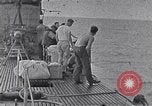
Australian survivors of Japanese prison ship Rakuyo Maru,aboard U.S. submarine in South China Sea during World War II.
Rescue of Australian prisoners who survived sinking of Rakuyo Maru, a Japanese prison ship, in South China Sea during World War II. American crewmen load supplies aboard a submarine from a boat alongside. A U.S. DD (destroyer) stands by in the background. The interiors of submarine showing survivors in bunks.
A boat rows from U.S. destroyer and delivers supplies to U.S. submarine in South China Sea during World War II.
Australian prisoners aboard U.S. submarine who survived sinking of Rakuyo Maru, a Japanese prison ship, in South China Sea during World War II. The crewmen aboard a U.S. submarine underway. A U.S. DD (destroyer) underway. A small boat rows from DD to submarine and unloads supplies.
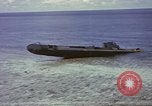
The Dutch submarine O 19 stranded on Ladd Reef in the South China Sea, near the end of World War II
Low altitude aerial views from an aircraft circling the Dutch submarine, O 19, stranded on Ladd Reef, in the South China Sea, with bow raised high above water and stern submerged. Note: According to Klaas van der Veen,of the Netherlands, whose father was second in command on the O 19, the boat went aground while on the way to Subic Bay, Phillipines, on July 8, 1945 (July 7th East of the International Date Line). After three days trying to free the O 19 using full reverse power at high tide, blowing air, firing torpedoes, and jettisoning ballast, the crew was rescued by the U.S. submarine, USS Cod, which torpedoed the O 19, after all critical equipment had been removed.
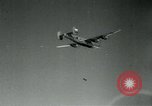
B-24 bombers of U.S. Army Air Force drop bombs on enemy positions, at China-Burma-India Theater in World War II.
U.S. Army Air Force combat operation in China-Burma-India Theater during World War II. B-24 bombers of the U.S. Army Air Force flying above enemy positions drop bombs on them. Bomb falls towards its target leaving smoke trail behind. Explosion and smoke on the ground. Planes among clouds. Each plane has a unique identification number.
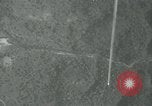
Dropped bomb from U.S. Army Air Force hits and explodes enemy positions, in China-Burma-India Theater in World War II.
U.S. Army Air Force in action in China-Burma-India Theater during World War II. B-24 bombers of the U.S. Army Air Force drop bombs at enemy positions . Bomb drops towards its target leaving smoke trail behind. Explosion at the target railroad or a bridge among dense trees.
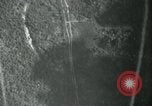
Array of smoke trails left by bombs dropped by the United States Army Air Force in China-Burma-India Theater in World War II.
U.S. Army Air Force attacks enemy railroads and bridges in China-Burma-India Theater during the World War II. Bombs dropped by the -24 bombers of the U.S. Air Force leave a smoke trail behind. An array of straight smoke trails left by the dropping bombs.
CRITICALPAST.COM: About Us | Contact Us | FAQs - How to Order | License Agreement | My Account | My Lightboxes | Shopping Cart | Advanced Search | Featured Collections | Website Terms & Conditions | Privacy Policy ©2026 CriticalPast LLC.
License Agreement |
Terms & Conditions |
Privacy Policy
©2026 CriticalPast LLC.