


 Francais
 Deutsch
 Italiano
Refine Your Search
China 1963 stock footage and images
- Showing 661 to 666 of 1923 results more
more Hide
Hide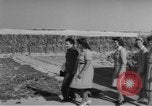
Madame Chiang Kai-shek with American Red Cross girls, boards C-54 Skymaster and leaves for Chongqing, China.
Soong Mei-ling or Madame Chiang Kai-shek, wife of Chairman of the Nationalist Government of China Generalissimo Chiang Kai-shek, leaves for Chongqing (Chungking), China from the United States. Madame Chiang with American Red Cross girls. She walks and speaks to the girls. Madame Chiang and the girls standing at the shore of a beach. Soong Mei-ling meets the U.S. officers and Generals. She is escorted by a Chinese official. Soong Mei-ling enters a car. She gets out of the car and climbs up a ladder. Soong Mei-ling boards C-54 Skymaster. The C-54 takes off for Chongqing. The aircraft in flight. A pilot and crew at controls. A crew member plotting a graph. The pilot at the controls talks. The crew members and the pilot talking.

U.S. civilians are freed by communists after imprisonment and brain washing by Communist China
The People’s Republic of China releases detained U.S. civilians in the Chinese border with British colony of Hong Kong. U.S. civilians cross "Bamboo Curtain," arriving to freedom in Hong Kong. U.S. civilians are freed by the Communist Chinese government after imprisonment and brain washing. Civilians include Catholic Church missionary Father Harold Rigney, Rector of the University of Beijing. A young naval intelligence officer and Fulbright Fellow student at Beijing University named Walter Allyn Rickett and his wife Adele are among the released prisoners. Former U.S. Flying Tiger pilot Lawrence Buol shows happiness after his release from China. Buol sits while Rickett drinks a bottle of soda after their release.
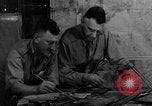
US General Joseph Stilwell with Major General Frank Dow Merrill; Allied soldiers in China Burma India Theater training in India during WW2
United States General Joseph Stilwell discusses plan with Major General Frank Dow Merrill during World War 2. Insignia of the China Burma India Theater (CBI). Nationalist Chinese soldiers march toward a United States Army Air Force transport plane to India. USA Army Air Force plane takes off, heading for India. At the U.S. Army Chinese Training and Combat Command at Ramgarh, India, Chinese soldiers train under the United States Army leadership. Aerial view of tents and buildings at Ramgarh. General Stilwell personally instructs Chinese soldiers as they shoot at targets while in prone position. Chinese troops charge out of a trench, crawl with guns under barbed wire, and avoid gun fire and explosions. India Command Formation insignia. British General Archibald Wavell inspects soldiers in formation. General Archibald Wavell shares a map with Field Marshal Claude Auchinleck, who was made Commander in Chief, India, for the British. British Indian soldiers seen in training, as they lift logs, jump over obstacles, climb ropes, and practice jumping from a parked airplane fuselage during parachute training. Next, soldiers are seen jumping out of an aircraft in flight with parachutes. British Indian soldiers descending with parachutes. United States soldiers unload supplies. Allied soldiers marching. Indian infantry marching in farmland. Gurkha soldiers from Nepal march with donkeys. Naga headhunters from Assam and northwestern Burma. East and West African soldiers. British colonial regiment, the Burma Rifles marching. Soldiers from the Kachin people of Burma and Southwestern China. Allied soldiers in India coming from various races- Scots, Irish, English, Welsh, Australian, New Zealander, Indian, Gurkha, Burman, African, Chinese and American. Multinational army from Allied countries.
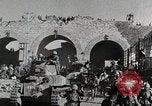
Rape of Nanking during 2nd Sino-Japanese war
Massacres in Nanking during second Sino-Japanese war. Japanese army troops and Type 89 I-Go tanks enter city gates to occupy Nanking, China. they break into a building and take away a Chinese man on a rope tether. Chinese inhabitants confined by the city walls are unable to escape brutal treatment by Japanese soldiers who are seen dragging men, women and children to be shot. Many are herded into a pit where Japanese soldiers standing above, execute them with rifle fire, as others fill the pit with earth, burying any survivors alive. Two Chinese kneeling with arms tied behind them are summarily executed by soldiers with rifles. A Japanese officer follows with a pistol to assure their death. Bodies of dead Chinese civilians litter an alleyway. Many scenes of Chinese killed by Japanese. (Narrator states that Japanese troops murdered 40 thousand men, women and children.) Japanese Field Marshal Count Terauchi Hisaichi is seen stepping from a transport airplane, followed by Field Marshal Shunroku Hata. Count Terauchi looks pleased as he is greeted and exchanges salutes with other officers. Next, the scene reverts, again to the horrors of Chinese peoples' suffering in Nanking, at the hands of the Japanese soldiers. Views of injured and wounded Chinese civilians, at a hospital, in pictures taken by an American Missionary, and smuggled out of china. A woman holding her injured husband as he lies against a cushion in a street. A small child stands near them. Scene shifts to a smiling Field Marshal Shunroku Hata, greeting local commanders, while photographers record the event in background. Views revert to the destruction and human tragedy in Nanking. A picture of Chinese leader, Sun Yat Sen. Chiang Kai-Shek speaking at a podium, and other Chinese political leaders speaking to gathered people, throughout unoccupied China, encouraging them to unite and resist Japanese aggression. Chinese people parading with banners to encourage resistance. Chinese soldiers and political leaders collaborating to raise armies. Chiang Kai-Shek ascending to Political leadership, exhorting Chinese to unite and fight the Japanese. Numerous scenes of rallies calling for unity and resistance. Chinese military officers standing as Chiang Kai-Shek enters a planning session. He sits and then they do. Behind him on the wall is a map of China. Closeup of Chiang as he outlines a strategy to slowly yield territory to Japanese invaders, to buy time for developing and arming Chinese forces. One of his staff goes to a wall map and gestures as he speaks. Next, Chinese soldiers are seen setting dynamite charges and blowing up lines of communication (roads). Chinese people pour petrol on grain fields and set them ablaze. Factory buildings being blown up and similar destruction as China pursues a "scorched earth" policy to hinder the Japanese invaders. Millions of Chinese people on the move to Western parts of China. (Narrator calls this the greatest human migration ever recorded.)
Contrast between Chinese and Japanese national aspirations before Second Sino-Japanese War and WW2
Film reviews China's four thousand years of history. Scenes showing mountains, woods, and a farmer plowing with oxen in rural China. A mass of Chinese people tightly packed together as they walk along a narrow alleyway in a town. Fleeting glimpses of two Chinese soldiers; a child; a woman; a woman and child; and numerous other Chinese people in a montage splayed across a background of moving crowds. An open book of Chinese characters. Mariners compass superimposed on an moving image of an ocean liner. Views of several large-scale astrolabes and world globes. A Chinese worker placing porcelainware in an oven for glazing. A man spooning gunpowder into a dish, followed by glimpse of a Chinese firework igniting. Chinese paper Dragon and street celebrations. A book entitled: "Analects of Confucius," in which, on page 105, is found the admonition: "What you do not want done to yourself, do not do to others." Ancient statues of two men and of two riderless horses behind them. Tall Chinese pagodas. Chinese artillery field pieces firing. Chinese troops advancing in several situations during conflict with Japan. Map of China and illustration of Japanese samurai warrior emblazoned across it. A book entitled: "The Tanaka Memorial, (Japan's Dream of World Empire)." A still photograph of Japanese Foreign Minister Baron Tanaka Giichi in military uniform, with other Japanese officers. Excerpts shown, ostensibly from this book. Emperor Hirohito is seen with Baron Tanaka, and other officers, all in military uniforms, in front of a tent, circa 1928. Automated map ostensibly illustrates the elements of a Japanese plan of conquest, starting with Manchuria for raw materials; the absorption of China for manpower; followed by a sweep South for riches of the Indies and Australia; and lastly a sweep eastward to crush the United States. More views of crowds of Chinese people are followed by an. animated map illustrating early World War II events, including Nazi Operation Barbarossa against Russia, approved by German leader Adolf Hitler in 1940, and the Nazi German occupation of Denmark, Norway, and other European countries. (Note: Actual existence of the so-called "Tanaka Memorial Imperialist Conquest Plan" is a subject of debate among historians.)
Japanese actions leading to 2nd Sino-Japanese war and attack on United States at Pearl Harbor in World War II
Japanese army officers examining foreign military equipment. A Japanese worker employing electric drill developed in a Western country. The Japanese freighter, Tatsuno Maru, loading scrap iron at a port in the United States. Other Japanese freighters loading coal and oil for shipment back to Japan. View of the Washington Naval Conference in Memorial Continental Hall, Washington, DC, held in 1921-22 and again in 1927 and 1930, to deal with several lingering issues. Glimpse of Japanese people holding flags while gathered near the Imperial Palace in Tokyo. Glimpse of Japanese army troops on parade. Japanese Navy warships at sea. A fleet of Japanese Mitsubishi G3M bombers and Nakajima Ki-27 pursuit planes, parked on an airfield. A loose formation of Ki-27s airborne. Animated map illustrates Japanese fortification of Mariana, Caroline, and Marshall islands in the Pacific. Animated map illustrating China's greater size and population vis-a-vis Japan. Animated map illustrating Japanese occupation of Manchuria in 1931. New York Times newspaper with headline "Japs Seize Manchuria" hovers over fires burning in Manchuria. Other newspaper headlines reporting on Mussolini's invasion of Ethiopia; the Spanish civil war; surrender of Czechoslovakia; invasion of Poland; assaults on France, Belgium, and the Netherlands by Nazi Germany; the London Blitz; and Nazi advances against Russia on the Eastern Front. Fnally, a Boston Hearald extra edition headline reports: "Pearl Harbor Bombed." A still photograph of Japanese Baron Tanaka Giichi (on left) with two other dignitaries, circa 1929. Japanese infantry streaming into Manchuria and then celebrating as they walk into local town. A busy street in a Chinese city. Japanese soldiers in Manchuria escorting local prisoners along a street. Animated map illustrating Japananese warships surrounding harbor of Shanghai, China. View from a Japanese ship bombarding Shanghai. Smoke rising from shell striking on Shanghai waterfront. View from land of severely damaged buildings on a street, and a shell exploding in background, as Chinese defenders move to successfully repel the Japanese forces. New map illustrates subsequent Japanese move, annexing Jehol, from occupied Manchukuo, and Korea. Japanese troops entering a town in Jehol. Sun newspaper headline: "League Censures Japan." Chinese diplomat protesting at League of Nations. Japanese troops exiting railroad trains in Jehol. Aisin Gioro Puyi aka Henry Pu Yi, Kangde Emperor (Kang-te Emperor) of the Japanese puppet state of Manchukuo, is seen saluting Japanese troops on parade. Closeup of Puyi wearing shaded glasses, looking directly into the camera. chiang Kai-shek, with other Chinese officers. Reenactment of barbarian forces riding against China and thwarted by the Great Wall. Many Chinese walking in a long line along the Great Wall. Map tracing the Great Wall across China. Aerial view of the Great Wall from overflying airplane. Japanese troops marching through a city gate; infantry climbing a sheer cliff; and helmeted Japanese soldiers marching past civilians in a city. Map illustrated progress of Chinese unification by year 1937. Japanese officers conferring during occupation. Japanese troops leave a barracks, riding in open trucks. A line of the troop trucks moving along the dirt street of a town. The troops climb from their trucks in the town.