


 Francais
 Deutsch
 Italiano
Refine Your Search
China 1963 stock footage and images
- Showing 727 to 732 of 1923 results more
more Hide
Hide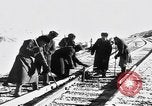
Ceremonies inaugurating new railroad link between Trans-Siberian Railroad to Jining, China, via Mongolia
Inauguration ceremony to open railroad link Southward, from Soviet Trans-Siberian Railroad, at Naushki, to Ulaanbaatar in Mongolia and thence to Jining (Tsining), China. Men connecting the two rail lines. They use levers and a screw jack device. Men push a rolling measuring device to check accuracy of rail track width. Mountains in the background. A railway station with pictures of Soviet leaders. A large crowd of local people gathered for the festivities. They carry flags and pictures of Chinese, Mongolian, and Soviet leaders, including Mao Zedong, Dashiin Damba, Voroshilov, Lenin, and Stalin. A large reviewing stand holding several dignitaries, and displaying pictures of Dashiin Damba, Voroshilov, and Mao. Several Soviet officers were seen. Chinese and Soviet spokesmen make short speeches, after which the Chinese spokesman cuts a ribbon to officially open the railroad link Behind him, in the background, is seen a map of the railroad connection going South, from the Soviet Union, toward Ulaanbaatar, Mongolia. A woman railroader waves a flag and gives a signal. A train decorated with pictures of Kliment Yefremovich Voroshilov, Dashiyn Damba, Mao Zedong, and the Soviet, Mongolian, and Chinese flags, moves over the tracks. Soviet rail line construction in snow: A crane places something into a truck. Field engineers refer to a map. A bulldozer levels the ground. A crane places a section of prefabricated track on the new roadbed. View of newly laid track.
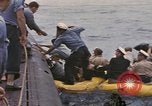
The USS Cod (SS-224) rescues crew of the Dutch submarine, O-19, from a reef, in South China Sea during World War II
Some of the Officers and men of the Dutch submarine, O-19, are brought to the U.S. submarine, USS Cod (SS-224) aboard yellow inflatable life rafts, after their boat ran aground on Ladd Reef, Spratly Islands, South China Sea, in final days of World War 2. They are helped from the life rafts by U.S. sailors. Dutch crewmen smile as they walk along the deck of USS Cod. More crew from the O-19, close by the Cod, step into life rafts. Crew of the Cod pull a raft in close with lines as the Dutch crew members throw personal belongings to deck of the Cod, and climb aboard. Officers and men of the O-19 standing on deck of the USS Cod.

Attack on Chinese positions by Japanese forces during the Second Sino-Japanese War
The invasion of China during the Second Sino-Japanese War. A map showing Chinese cities. Imperial Japanese Army soldiers stand at attention. Japanese soldiers moving equipment and supplies across China. Japanese soldiers running and pulling rickshaws. They push a cart full of sacks. IJA cavalries move on horseback. Aerial view of Japanese fighters. Troops digging trenches. A Japanese light tank. Tankette covered in camouflage moving. A Japanese officer leads troops to advance in forest. A medic treats a wounded soldier. Japanese artillery attack Chinese positions as they march toward Canton, China (Guangzhou, China). Japanese soldiers cross a river. Officers cross the river on horseback. Infantry soldiers and horses wading the water. Japanese troops approach Canton. An abandoned car near Canton. Japanese soldiers shooting in prone position with rifles and machine guns.
Second Sino-Japanese War
Opening scene shows formation of Japanese Mitsubishi G3M bombers in flight. View of bombardier at bomb sight inside a bomber. Bombs falling from the aircraft, upon the Chinese city of Shanghai, on a day in September, 1937. Ground level view of bomb exploding and Chinese civilians running for cover. A huge explosion throwing earth up. Aerial view of smoke rising from bomb strikes below. More ground views of bombs destroying structures. Chinese people fleeing across a bridge. Cluster of bombs falling from a Japanese airplane. More explosions and destruction. view from a G3M bomber, of others with bombs falling from them. View from above of civilians filling a street as they run for shelter. People on the ground rushing in all directions. Some are in horse-drawn carriages with luggage on top and other in rickshaws, apparently fleeing the city altogether. Bombing victims lying on the ground near destroyed structures. Heavy dark smoke rising from the attacks. Scene shifts to Japanese army officers entering the Yasukuni shrine in Tokyo. Behind them is A Shinto Tori (Gate) and behind that, the monument (statue) of Omura Masujiro. Scene shifts again, to view of the Temple of Heaven, an ancient Imperial Sacrificial Altar in Peking (Beijing) China. Chinese agriculture. Crowds of Chinese people. Stone statue of traditional Chinese lion. Picture of 1851 oil-on-canvas painting by the German American artist Emanuel Gottlieb Leutze, of Washington crossing the Delaware. Drawing of 15th century ship similar to one in Columbus'1492 voyage to America. Drawing of Roman Empire era building. Michelangelo’s statue of Moses. Drawing of ancient Egyptian pyramid and statue. Drawing of Chinese city and environs representing 4 thousand years ago. Extant ancient Chinese shrines and statues. Animated Relief map of China and surrounding countries of U.S.S.R., India,Burma,Thailand, Indo-China, Philippines, and Japan. Animation outlines China Proper. It also shows Manchuria and scenes from there of desolate mountainous land, with miners at work extracting raw materials. Mongolia and Sinkiang are outlined. The Gobi desert is seen with a long camel caravan crossing it. Closeup of nomads transporting animal skins by camel. The last region outlined is Tibet. The ice covered Himalayan mountains are shown. Buddhist monks praying in the courtyard of a shrine in Tibet. The Yellow, Si Kiang, and Yangtze Rivers are shown on the map. Views of Chinese sailing vessels.
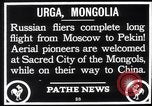
Pioneering Russian flight from Moscow to Peking by way of Mongolia (Known as the Great Flight).
Early historic aviation event: Air expedition from Moscow to Peking. The aircraft and aviators are welcomed in Mongolia and Peking. Russian fliers in pioneering flight from Moscow to Peking. They are welcomed in the sacred Mongol city of Urga, on their way to China, A Junkers commercial F.13 monoplane, of the expedition, taxis to left. Russian DH-4 support biplane , taxis to right. Officials pose in front of the DH-4. Pilot seen standing in rear cockpit in background. Mongolian red army band plays. A Mongolian giant seen standing in the crowd, with small children in front of him. Crowd of Mongolian people sits and watches the event. Idol bearers to bring good luck to the fliers. Mongolian lamas display small images of Buddha. Mongolian troubadour plays a morin khuur (two-stringed instrument). Four Mongolian children stand. Yurts in the background Mongolian women stand in full traditional dress. Mongolian men in stands with fancy hats with peak. Next sequence takes place in Peking, China, at the end of the 3,500 mile flight, where the aviators are feted with a reception. Crowd waves Chinese flags. One of the Junkers J.3 airplanes of the expedition taxis ahead. Russian crew steps from another Junkers J.3 of the expedition. Lev Mikhailovich Karakhan, Russian Ambassador to China, and Marshal Duan Qirui (AKA Tuan Ch'i-jui), Provisional Chief Executive of Republic of China, pose with five Russian aviators, on steps of Government house in Peking.
The Battle of Shanghai and Chinese history, 1937.
The Battle of Shanghai, September 1937. Japanese planes in flight over Shanghai. Pilots in the cockpit. A hand dials a control to drop bombs on the underlying city. Explosions as bombs hit the target. The citizens flee. A plane drops bombs on a bridge as people are crossing it. The bridge collapses. Citizens in the streets. Vehicles on the streets of Shanghai. People in runner pulled rickshaws. Dead Chinese people on the streets. A cloud of smoke rises over the city. Gate to the Chinese Forbidden City opens to reveal the Temple of Heaven. A Ming Lion statue. A time line shows the advent of different civilizations-- A milestone with 1776 written on it indicates the time when Washington crossed the Delaware River. Another milestone shows 1492. A picture of Columbus's ship. Yet another milestone reads 476. Pictures of ancient Roman Empire. A milestone reads 1440 B.C. A statue of Moses. A milestone reads 1880 B.C. A scene of the pyramids depicts the Egyptian civilization. Another milestone reads 2200 B.C. Shows a road leading to Chinese civilization. . A man carrying two baskets on a pole walks by a statue of Confucius and a horse. Ancient Chinese temple in background. A wall shows Chinese statues of Buddha. An animated map of China. Laborers mining coal in Manchuria. Coal cars filled with coal. In the Gobi desert nomad tribes move with their camel caravan. Himalayan mountains in the Tibet region. Animated map of China shows rivers. Sampans in the Yangtze river. A Chinese farmer plows his field. Chinese soldiers in China. Montage shows the people of China against a crowd of Chinese people.