


 Francais
 Deutsch
 Italiano
Refine Your Search
China 1963 stock footage and images
- Showing 817 to 822 of 1923 results more
more Hide
Hide
Ashes of Japanese General Mineo Osumi are flown to Tokyo from China during World War II.
Funeral services for Japanese General Baron Mineo Osumi in Tokyo during World War II. A man carries a box, containing ashes of Japanese General Osumi, followed by other men at an airfield in Tokyo. All men dressed in black. Japanese pilots salute. A Japanese Buddhist monk bows in front of the pictures of Japanese Generals (killed along with General Osumi after their plane was shot down by Chinese guerrillas) with boxes of ashes placed in front of them. Portrait of General Mineo Osumi. Japanese General Hisaichi Terauchi leads relatives and officers.
Chinese people parade in Toronto, Canada during World War II in honor of China's new Ambassador to Canada.
Newly appointed Chinese Ambassador to Canada visits Toronto, Canada during World War II. Chinese people parade along the streets of Toronto in honor of the new Chinese Ambassador. Chinese people attend Chinese ceremonies and watch a traditional Chinese dance.
U.S. Submarine (USS Cod) rescues crew from Dutch Submarine (O-19) in South China Sea during World War II
Wind-driven surf engulfs the Dutch submarine, O-19, aground on Ladd Reef, Spratly Island, as viewed from the U.S. submarine, USS Cod (SS-224) during rescue operations in World War 2. Dutch sailors paddle yellow rubber life rafts filled with crew members from the O-19, on their way to the USS Cod. They climb aboard the Cod with help from U.S. sailors. Two officers confer. A Dutch sailor poses on deck with a doll rescued from the O-19. Some crew still aboard the Dutch submarine appear to be moving cargo on her deck with help of small improvised derrick.

Imperial Japanese Army (IJA) soldiers commit war atrocities and murder during World War II
Atrocities committed by Imperial Japanese Army (IJA) soldiers in China and other parts of Asia during World War II. War workers in offices, factories, and mills shift their attention to the narrator. Smoke rises from factory smokestacks and chimneys. American workers manufacture war materiel in factories. Factory workers shovel coal to the furnace. Japanese soldiers abuse elderly Chinese women. A Japanese soldier toss an infant before striking with a bayonet midair. A Chinese woman watches with shock. IJA troops drag and bury Chinese civilians alive. IJA troops burn cities and shoot victims at close range. Soldiers place the remains of dead Chinese men, women, and children in truck. Japanese soldiers torture and kill Chinese civilians and are depicted killing American Prisoners of War (POW). Aerial views of San Francisco, Chicago, Pittsburgh, and New York. A dead Japanese soldier with flies covering his face. A newly built M4 Sherman tank moves inside a factory. Body of a Japanese soldier wearing round glasses. Dead Japanese soldiers seen with repeating American wartime propaganda message that every piece of wartime production "kills a Jap." Tanks, trucks, planes, shells, guns, and artillery are manufactured in United States factories and plants during World War II. Americans urged to take war jobs to help win World War 2.
Japanese expedition finally reaches the Yellow River after traveling in a camel caravan across the Ordos Desert
A Japanese expedition finally reaches its destination – the Yellow River or the Huang He River --after days of travel, by camel caravan, across the Ordos Desert in Northwestern China. They water their camels at the river's edge. Views of the Yellow River. Animated map shows the route followed by the expedition all the way from Japan, and then across the vast Chinese desert to the Yellow River.
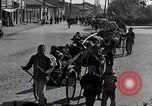
Chinese people migrate towards west in advance of Japanese forces during the 2nd Sino-Japanese war
Millions of Chinese people migrating west and invoking a "scorched earth" policy to slow advance of Japanese forces invading from Shanghai and Nanking, during the second Sino-Japanese war. Long line of Chinese refugees making the trek on foot and transporting their belongings on hand-pulled carts. Chinese entering a library, a school, and a hospital to salvage contents and take them west. Chinese people pulling amazing large loads on carts. Narrator says they salvaged hundreds of millions of pounds of machinery from factories. Trucks and oxen being employed to move goods and equipment on a two thousand mile journey westward. A huge crowd of refugees gathered along a railroad, all rise up from the ground as a steam locomotive appears in the distance. Closeup of Chinese people climbing into rail cars. A glimpse of some intrepid travelers climbing atop the cars. Next, the crowd works to dismantle the railroad, placing rails and ties aboard the train for future use and to deprive the Japanese of them. View of the train, moving slowly, with people occupying every imaginable place. Many crowd the front of the locomotive, itself. Scenes of other trains show many persons riding on tarpaulins that have been tied across the tops of rail cars. Some simply sit on the car roofs. Others are Jam-packed together on open air flat cars. Sampans and barges loaded with refugees and supplies are seen moving westward on China's rivers. Closeups of vessels filled with people. Passengers rowing and working to move the boats. Lines of Chinese crewmen pulling their boats upstream through narrow river gorges. Closeups of gangs of men pulling on tow ropes, as men on the boats assist using long poles to push the boats forward. People walking with backpacks. Narrator speaks of 30 million people moving westward. More scenes of the masses of humanity on the trek.