


 Francais
 Deutsch
 Italiano
Refine Your Search
China 1963 stock footage and images
- Showing 871 to 876 of 1923 results more
more Hide
Hide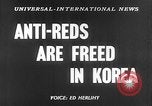
Freed Chinese and Korean prisoners of war in trucks driving along streets of Seoul, Korea are cheered by a crowd.
Liberated Chinese and Korean prisoners arrive in South Korea after the Korean War. The group includes 14,000 former communist Chinese (People's Republic of China) soldiers who are defecting to Taiwan (Republic of China) and are welcomed as "anti-Communist Heroes." The liberated prisoners leave stockades of Neutral Nations Repatriation Commission. Freed prisoners carry flags and get into trucks which pass along streets of Seoul. A crowd cheers for the prisoners.
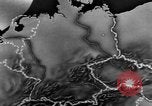
The Soviet Union walls off East Germany from the rest of the world post WW2.
Animated map shows the four different zones of Germany after World War II.: British, Soviet, French and American Zone. Animated map focuses on the Soviet zone and shows the Iron Curtain rising along the Soviet Border. Russian troops march through streets in Berlin. Civilians board trains on streets. Russian woman directs traffic. Damaged buildings in the background. Russian officers enter and leave Headquarter in Berlin. East German men and women workers on farms. Russian soldiers and East German civilians pull heavy machinery for shipment to Russia. Interior of the Dresden China Works. Civilians mold and paint china articles.
Presidential election debate in Washington DC. Richard Nixon, debating John F. Kennedy, speaks about the spread of Communism.
The second Kennedy-Nixon Presidential Debate in Washington DC, United States. Moderator Frank McGee introduces the candidates - Republican candidate U.S. Vice President Richard M. Nixon and Democratic candidate Senator John F Kennedy. The Moderator tells the rules to the candidates regarding questioning by the reporters. The reporters include Paul Niven, Edward P. Morgan, Alvin Spivak, and Harold R. Levy. Paul Niven asks Nixon to comment on whether Truman Administration was responsible for the loss of China to the Communists. Nixon answers and says that he disagrees with Senator Kennedy's statement that Cuba is lost and certainly China was lost because of Truman Administration. He talks about the decrease in the number of dictators in Southern and Central America in the past years. He speaks about Kennedy's book 'The Strategy for Peace' which prohibits the Americans from interfering in internal affairs of any other state. Kennedy presents his views and says that he never suggested that Cuba was lost. He criticized Nixon because in his press conference in Havana in 1955, he praised the competence and stability of the Batista dictatorship. He criticized the failure of the administration to use its great influence to persuade the Cuban government to hold free elections. He hopes that some day Cuba would rise if the U.S. changes its policies towards it.
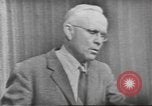
Vice President Nixon and Senator Kennedy debate over a fight against communism prior to presidential elections in the U.S.
The fourth presidential election debate held between Democratic nominee Senator John F. Kennedy and Republican nominee U.S. Vice President Richard Nixon in New York, United States on 21st October 1960. ABC News correspondent Quincy Howe speaks during the debate and allows correspondent Walter Cronkite to ask Senator Kennedy a question. Mr. Cronkite asks Senator Kennedy that in what areas the United States might take offensive against communism rather than being defensive to the Soviet Union. Senator Kennedy replies to the question and says that the eastern Europe is very vulnerable area according to him. He says there should be policies which make it possible to establish closer relation with a country like Poland and he also mentions the Hungarian Revolution. Senator Kennedy speaks about the relations between the Soviet Union and China. He says that India represents a great area for affirmative action by the free world. India started from about the same place that China did. India under a free society has been making some progress. But if India does not succeed, Communism can take over. He says that in Africa, Asia, Latin America, eastern Europe, the great force on their side is the desire of people to be free. Correspondent Howe asks Vice President Nixon to comment on the topic. Nixon speaks about Poland and says that Poland in not in a position to take any independent position under Soviet control. He talks about aids being sent to Poland from the U.S. and says that the U.S. can have more exchange with Poland or with any other Iron Curtain countries.
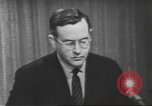
Vice President Nixon and Senator Kennedy debate over Quemoy and Matsu issue prior to presidential elections in the U.S.
The fourth presidential election debate held between Democratic nominee Senator John F. Kennedy and Republican nominee U.S. Vice President Richard Nixon in New York, United States on 21st October 1960. ABC News correspondent Quincy Howe speaks during the debate and allows NBC correspondent John Chancellor to pose a question to Richard Nixon a . Correspondent Chancellor asks a question about Quemoy and Matsu issue. Vice President Nixon points out inconsistency of Senator Kennedy. He further explains it by saying that Senator Kennedy signed a resolution in 1955 which gave the president the power to use United States forces to defend Formosa (Taiwan) and offshore islands. But he also voted for an amendment which was lost, an amendment which would have drawn a line and left out those islands. Vice President Nixon supports President Eisenhower's position. Correspondent Howe asks Senator Kennedy to comment on the topic. He speaks about President Eisenhower sending a mission to persuade Chiang Kai-shek in the spring of 1955 to withdraw from Quemoy and Matsu because they were exposed. The President was unsuccessful. He refers to the fact that in 1958, as a member of the Senate Foreign Relations Committee, he was very familiar with the position that the United States took in negotiating with Communist China (PRC) on these two islands. He further that the U.S. was unable to persuade China's Chiang Kai-Shek to withdraw and thus it was decided by the U.S. to defend the islands.
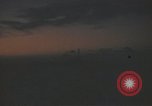
A signalman aboard a U.S. ship underway at sea sending blinker signal at night in the United States.
U.S. submarines at a harbor in the United States. A ship underway at sea off the coast of United States. Using signal lamp, Signalman aboard the ship is sending morse code blinker at night (though first dawn light of sunrise is visible). Low mountains in the background. Men aboard a boat underway. The sunrise view. (Unrelated: Clip ends with brief view of Kodak "china girl" for color timing. Lettering beside this "china girl" or "leader lady" indicates Kodak 79 ECO and she is wearing a 1960's fashion shirt or blouse.)