


 Francais
 Deutsch
 Italiano
Refine Your Search
China 1963 stock footage and images
- Showing 889 to 894 of 1923 results more
more Hide
Hide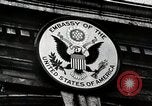
Beginnings of the Second Sino-Japanese war
Sign over American Embassy in China. Colonel William Mayer, former military attache in that embassy relates events precipitating Second Sino-Japanese war. Scenes of the Marco Polo bridge near Peking, on night of July 7, 1937, as Japanese artillery bombards the area. Animated map shows movement of Japanese forces out of Manchuria to occupy Peiping and Tientsin. Victorious Japanese troops stand atop a building, raising their flags and shouting cries of victory. Japanese army officers sit around a table smiling and contended and others walk in a group. Chinese artillery crews are seen retaliating as they fire field pieces at Japanese positions in Shanghai. Shells explode in background, and Chinese infantry advance through damaged buildings and rubble. Animated map shows Shanghai and other cities, and film transitions to view of the bustling city of Shanghai on the Yangtze River. In the seaport, large ocean liners and freighters, as well as tug boats and Junks, are seen. What looks like a Japanese Tachikawa Ki.54 Type 1 transport plane takes off over a Chinese pagoda. Double-decker buses travel through the streets. Rickshaws are also seen. Map outlines the foreign residential areas of the French Concession and the International Settlement. American, British and Japanese flags are shown in the International Settlement. Detachments of troops from Japan, Britain, France, and United States Marines are seen. A U.S. Marine is posted as a sentry at the Shanghai Power Company. Coolies carry heavy bucket on a long pole. British, French and Japanese troops also performed sentry duties. Japanese troops and armored cars are seen. A scuffle breaks out in August, 1937, and Japanese soldiers start moving in trucks, take up firing positions, and begin firing guns from their armored cars. Map shows Chinese counterattack pushing the Japanese contingent toward the Khangpoo River. Next it shows Japanese warships and reinforcements in the Yangtze River and their advance toward Woosung and Shanghai. Views of Japanese warships bombarding the shore and large explosions from their striking shells. Beachhead is shown South of Shanghai, where two divisions of Japanese infantry are seen arriving in landing craft. They advance across the fields toward Shanghai. Map shows Chinese withdrawals to West and South, toward Nanking and Hangchow. Chinese medics along with infantry march in retreat. Japanese pilots are seen being briefed. Next, Japanese Mitsubishi G3M bombers are seen in flight, and bombardiers and other crew in them. Bombs falling on the city. Civilians running for cover as bombs explode. Aichi D3A1 aircraft dropping bombs. The Shanghai waterfront being bombed and civilians running.
Japanese officers review the troops after their triumphal march into the city of Nanking.
Japanese troops fight outside the walls of Nanking in China during the Second Sino-Japane War. Triumphal march of Japanese troops into Nanking. Japanese troops march into the city. Buildings and hills in the background. Cars parked on the roadside. Soldiers with Japanese flags. Aircraft in flight over the city. A soldier atop a tank. Troops march on the streets. The military band marching. Soldiers with the Japan Empire and Imperial Japanese flags. Troops stand by the roadside as more troops march in. Soldiers on horses and on foot. They march past houses and shops. They line up at attention. Officers on horses march between the troops lined up on either side of the road. Wounded soldiers. Officers and troops salute.
P-51 planes of the U.S. Army Air Forces drop bombs over Japanese held hills near Burma border during World War II
P-51 planes of the U.S. Army Air Forces in a combat operations over Wanling, China, near the Burma border, during World War 2, as photographed from a B-25 Mitchell bomber. Close view of the B-25 bomber's right engine nacelle and empennage shadow on the runway, during takeoff roll. Some soldiers and parked aircraft in the background. The B-25 takes off. . P-51 aircraft seen in flight over Japanese occupied positions in hills. Aerial view of a meandering river. Smoke rises from ordnance dropped by P-51s.

The Battle of Changsha at the end of the Second Sino-Japanese war (WW2)
Japanese infantry, accompanied by several Type 95 Ha-Go tanks, wade across shallow rivers East of Dongting Lake in Hunan Province, China, during World War II. Closeups of soldiers with their field packs and rifles. They reach a bluff where they encounter heavy resistance from Chinese defenders.View of Japanese soldiers spread out in defensive positions overlooking the top of the bluff. The sound of machine gun fire is heard continuously. The Japanese forces fire type 3 heavy machine guns from positions in woods and marshes. Some fire mortars. A flight of three aircraft is seen briefly overhead. A bomb bursts in the midst of the Japanese forces. Infantry are seen through barbed wire as they move single file across a grassy field in the distance. Closer view of Japanese soldiers in a field of tall grass bounded by some trees. in Closeup of Japanese soldiers under heavy Chinese fire. A bomb or artillery shell bursts close to them. Closeup of Japanese gunners firing a Type 91 10-cm-howitzer,with wooden spoked wheels. Next view shows the same gun firing with a group of Japanese soldiers behind it, some using binoculars to observe the shells striking. The final scene shows numerous shells striking in a line with white smoke rising from each in the distance.
Newsreel 'Chinese troops drive Japs from Changteh'
Chinese troops defeat the Japanese at Battle of Changde in China (spelled as Changteh in this footage flate). Chinese troops firing at Japanese enemy positions. Dead Japanese soldiers seen. Chinese General with other troops gathered. Japanese rifles and other military equipment is captured and examined by Allied military representatives. Japanese prisoners seen under guard by Chinese soldiers. Chinese civilians return to the ruined city. The civilians are given financial aid to buy food. A group of civilians gathered in front of a temple in Changde. (World War II period).
UN Secretary General Dag Hammarskjold meets Premier Zhou Enlai in Beijing to seek release of imprisoned airmen.
People’s Republic of China officials at an airfield. A DC-3 passenger aircraft taxis in and parks. United Nations Secretary General Dag Hammarskjold hurries down steps of the aircraft and is greeted by Chinese officials. Hammarskjold shakes hands with many of them, and then drives off in a car. The Secretary General is on a mission to secure the release of fifteen American fliers being held by the Chinese, who do not consider them Prisoners of War to be repatriated, following the Korean War. He is seen later at a dinner reception in a hall with many Chinese officials in attendance. Chinese Premier Zhou Enlai and Secretary General Hammarskjold spend considerable time conversing, with help of translator. They toast with several other officials and appear to have a relaxed and pleasant meeting.