


 Francais
 Deutsch
 Italiano
Refine Your Search
China 1963 stock footage and images
- Showing 985 to 990 of 1923 results more
more Hide
Hide
Signing of the surrender note aboard the USS Missouri after the surrender of Japan to the Allied Forces in World War II.
Signing of the instruments of surrender formalizing the capitulation of Japan to the Allied Forces in World War II. The Battleship USS Missouri in the Tokyo Bay. The U.S. Destroyer, Buchanan, pulls alongside bringing representatives of the Allied Powers to participate. U.S. General of the Army, Douglas MacArthur, Supreme Commander of Allied Forces boards the USS Missouri and is welcomed by Fleet Admiral Nimitz and Admiral Halsey. They proceed to the ship's Veranda deck for the signing ceremony. Japanese delegation led by Foreign Minister Mamoru Shigemitsu, accompanied by General Yoshijiro Umezo arrives in a boat. Speech by MacArthur as Japanese delegation looks on. Japanese representatives sign the surrender instruments. General MacArthur then signs using several pens that he presents to U.S. General Wainwright and British General Percival and others. Admiral Chester Nimitz signs for all U.S. forces, followed by Admiral Halsey. Allied representatives then sign for China, the United Kingdom, Soviet Union, Australia, Canada, France, Netherlands, and New Zealand. MacArthur gives closing comments. Allied aircraft fly overhead after the ceremony.
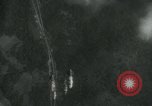
Bombing by the 7th Bomber Group (H) Squadron and the 4934 Bomber Group of the U.S. Army Air Force in Burma during World War II.
U.S. Army Air Force attacks enemy positions in China-Burma-India Theater during World War II. The 7th Bomber Group (H) Squadron and the 4934 Bomber Group of the U.S. Army Air Force target railroad and road bridges to drop bombs. Four bombs dropped simultaneously on a bridge. Bomb destroys with an explosion.
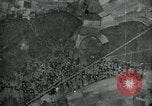
7th Bomber Group (H) Squadron and 4934 Bombardment Squadron of U.S. Army Air Force over Moulmein in Burma, WWII
U.S. Army Air Force attack enemy positions of Burma in China-Burma-India Theater during World War II. The 7th Bomber Group (H) Squadron and the 4934 Bombardment Squadron of the U.S. Army Air Force during a mission on railroad bridges in Moulmein in Burma. Smoke rising from bombed places in farms and railroads.
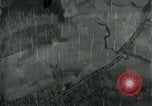
Bomber aircrafts of the U.S. Army Air Force flying over farms, railway tracks, roads and river bridges in Moulmein Burma.
U.S. Army Air Force attacks enemy positions in Burma in China-Burma-India Theater during the World War II. Agricultural farms, railway tracks, roads and river bridges as seen by the 7th Bombardment Group (H) Squadron and the 4934 Bombardment Squadron of the U.S. Army Air Force flying over Moulmein in Burma.
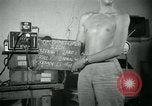
U.S. Army Air Force technicians perform laboratory tests and check control systems of an Azon Bomb at a laboratory in Burma.
China-Burma-India Theater during the World War II. U.S. Army Air Force Technicians perform laboratory tests and check the working of control systems of an Azon Bomb at a laboratory in Burma. Technicians check an Azon Bomb's tail section kept on a test bench with various control equipment and instruments at a laboratory. Meters and indicators display results of the test.
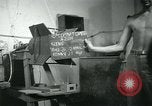
Demonstration by 7th Bombardment Group of U.S. Army Air Force on controlling and directing Azon Bombs at a laboratory in Burma (WW2)
China-Burma-India Theater during the World War II. A technician checks the working of control systems of an Azon Bomb at a laboratory in Burma. He turns the transmitter filament pilot light switch on, turns antenna, checks frequency. He controls the rudders of the tail with a control lever.