


 Francais
 Deutsch
 Italiano
Refine Your Search
China 1963 stock footage and images
- Showing 1015 to 1020 of 1923 results more
more Hide
Hide
The Rise of Japanese militarism in the 20th Century
Film opens showing reenactment of Japanese attack ostensibly against Formosa, in 1894. Japanese troops and artillery are shown. The event is depicted in a critical political cartoon. Next, Japanese Admiral Heihachiro Togo is seen in 1904, standing with other naval officers. Then, Japanese warships are shown, firing barrages of naval gunfire at the Russian fleet in Port Arthur, Manchuria. Huge black clouds arise from burning ships. Scenes of Japanese people celebrating their naval victory. Date shifts to 1910. Cartoon depicts Japanese annexation of Korea. Cartoon illustrates Japanese actions in World War I when, siding with the Allies, Japan acquired the German-held Shandong (Shantung) Peninsula of China, as well as German-held Marianas, Carolines, and Marshalls islands in the Pacific. Japanese representatives are seen participating in Post World War 1 international activities. They signed the so-called Five-Power,Four-Power, and Nine-Power treaties, and participated in the League of Nations. Glimpse of two Japanese officers, followed by cartoon depiction of the Mariana, Caroline, and Marshall Islands, that Japan insisted on keeping. Cartoon shows them being fortified. A Japanese military marching band parades down a city street while being cheered by spectators on the sidewalks. Next, Japanese military General, Baron Tanaka Giichi, is seen in uniform with other officers. Cartoon illustrates the so-called Tanaka Memorial document that Baron Tanaka allegedly presented to the Emperor, in 1927, outlining a strategy to conquer the world. Cartoon then illustrates plan of conquest by acquiring Chinese manpower; Manchurian iron and coal; Siberian timber, coal, wheat, and metals; Tin,oil and rubber from Malaysia and the East Indies. The United States is shown as the last conquest. Views of ordinary farm and factory activities in the U.S. Cars parked in the Ford Motor Company factory lot. Japanese officials and legislators meeting in the Diet (Parliament). Japanese theater patrons and a Japanese woman singing with an American-style band, are shown as examples of activities the Japanese Government sought to discourage. A Japanese female ensemble in traditional dress, playing traditional instruments, is shown as more desirable. Western dancing and western hollywood movies are shown and narrator states they were forbidden by the Japanese government. Japanese movie scene depicts ancient martial arts. A musical production on stage displays German Nazi swastika flag , Japanese rising sun, and symbol of Kingdom of Italy, celebrating the axis alliance. Japanese men are shown playing the ancient game of Chu Shogi, instead of playing Western card games. People are shown in a library, where Western books are replaced by more militaristic tomes, such as: "If we fight" by Admiral Shinsaku Hirata, March 15, 1930 (shown on film slate). Slate goes on to quote about attack on Hawaii as the first battle in war of the Pacific. Film cites another approved Japanese publication: "Arguments Against American Policies" by Kawashima Seichiro, Christmas Day, 1924. It discusses distruction of the American fleet and subsequent landing on the U.S. West Coast.
Charles Augustus Lindbergh with his wife Anne Lindbergh prepare to fly to Tokyo
Colonel Charles Augustus Lindbergh with his wife Anne Lindbergh prepare to fly to China and Japan. Both sit in the plane. A map shows the route from New York to Tokyo over uncharted route to Tokyo. The plane takes off from New York.
Role of the Jeep in U.S. military operations during World War II.
A U.S. Army Air Forces (USAAF) Waco CG-4A-WO glider is seen descending and landing in a grass field. Upon touchdown, its front pops open and and an army jeep drives out. USAAF C-47 aircraft are seen next, offloading jeeps pulling small artillery pieces, and infantry who move rapidly from the parked aircraft. Jeeps traversing a high hump in a dirt road. A jeep towing an M-3 Antitank Gun 37mm, and others driving through underbrush and bouncing over rough road while towing 37mm guns and trailers. Soldiers stepping from jeeps to set up machine guns. American soldiers playing a game of horse and rider, during a break in duties. Soldiers setting up mortars. Jeeps driving through bodies of water. Two M4A1 (76)W Sherman tanks, with cast steel hulls, drive into a stream. Troops setting up several 37mm guns on a river bank. Two soldiers in a communications jeep. Army officers perusing a map laid out on the hood of a jeep. U.S. field artillerymen using periscopic binoculars on tripods, to spot and direct gunfire. Military vehicles, including jeeps, moving across desert terrain. Artillery crews firing M59 (M2 Long Tom) 155mm guns. A Douglas A-26 Invader aircraft flying overhead. Jeeps in various roles, bouncing along in the desert and laying smoke screens. Jeeps equipped with M3 anti-aircraft guns and others with stretchers for wounded affixed to their sides. U.S. Army Ford GPA "Seep" amphibious jeeps plunging into water and continuing on as boats. A jeep production and assembly line in a U.S. factory showing stages of assembly and finished jeeps driving out of the plant into yards containing hundreds of them. A convoy of jeeps driving over a bridge, and others carrying a U.S. military brass band in a parade in England. A Hollywood actress (Gloria Swanson?) being lifted into a jeep by several men. Glimpse of an unidentified actress with an American soldier, in a jeep. Hollywood stars, Stan Laurel and Oliver Hardy clowning in the front seat of a jeep with Desi Arnaz and two women riding in the back. Several jeeps carrying these and other Hollywood personalities during a war bond parade in Washington DC. The Capitol looming in the background as the jeeps move away from it toward the camera. Jeeps being prepared for transport to overseas destinations. Jeeps being partially disassembled and loaded into wooden crates and placed on rail cars for transport. Jeeps being hauled by cranes and placed aboard ships. Landing crafts mechanized (LCMs) transporting infantry and vehicles, including jeeps. An M4A1 Sherman tank driving out of a landing craft into surf. A jeep being driven onto beach at Adak,in the Aleutians,from a landing craft of the USS J.Franklin Bell (AP-34), in 1942. In 1943, this transport ship was reclassified as APA-16.) American troops with jeep on a South Pacific island in World War 2. A soldier on motorcycle, skids in mud on road in North Africa, and jeeps drive past him. American soldiers ride camels and some drive in a jeep near the Great pyramid and Sphinx in Egypt. Jeeps seen in China, with Generals Joseph Stilwell and Claire Chennault. One parked next to a Flying Tiger P-40 airplane. Soldiers in a jeep in Alaska, next to a tent and sign pointing to "Tokyo." Local tribesmen literally carrying a jeep, on long poles, across a river in Timor. General Douglas MacArthur, accompanied by staff officers, being driven in a jeep along a jungle road in New Guinea, past a line of local tribesmen. Wendell Wilkie, serving as Ambassador-at-large, during the war, speaks to U.S. officers in a jeep. Britain's King George VI in a jeep followed by another carrying Queen Elizabeth. President Franklin D. Roosevelt riding in a jeep to review troops. He removes his hat as they pass the American flag. Sign on a building in North Africa reads "Bizerte." General George S. Patton, standing in a jeep during a victory parade in North Africa. Soldiers at an outdoor religious service during the war with the hood of a jeep serving as a make shift altar.Various views of jeeps driving with soldiers in them.
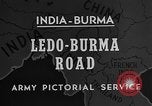
Chinese engineers construct the Stilwell road and build bridge in Burma.
The Ledo-Burma road shown on animated map of China and India. The Ledo Road or Stilwell road (named after General Joseph Stilwell) under construction. Chinese man takes picture. Workers fall trees. Crane uproots tree and clears the area of debris. Rocks blasted and bridge built. Chinese engineers work inside a large pipe.
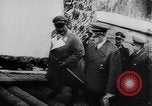
Adolf Hitler's plans and actions for conquest of Austria and Czech Sudetenland; events leading up to and through Munich Pact
Film opens showing Adolf Hitler ascending stairs to the Bergfhof, accompanied by Marshal Hermann Goering, and followed by other high ranking Nazi officers. Inside, General staff officers begin briefing Hitler about plans for German expansion Eastward. Finger points to Austria on map. Next, on March 12, 1938, Border Guards are seen dismantling barriers at the border as German troops march into Austria. German aircraft fly overhead. Hitler stands in his open touring car as it drives into Vienna, where local people line the sidewalk, and welcome him with the Nazi salute. Maps depict the fall of Austria and illustrate the anticipated conquest of Czechoslovakia. Brief overlay image of Bismark as narrator quotes him about Bohemia being key to control of Europe. German troops advancing up steep mountainous terrain. German soldiers on horseback and wagons passing road sign pointing to cities of Karlovy Vary and Cheb, in the west Bohemia region of Czechoslovakia. Czech troops marching in formation with shouldered arms. View of Czech Avia B-534 warplanes at an airfield. Interior of a Czech Skoda works munitions factory. President of Czechoslovakia, Edvard Beneš, signing papers at his desk. French lancers marching in formation, on parade. (Narrator comments on French military alliances with Czechoslovakia and Great Britain.) View of warships in British fleet. Hitler outdoors, surrounded by German military officers, looking over large maps. Animated map highlights the "Sudetenlands" bordering Germany, including districts of Bohemia, Moravia, and parts of Silesia inside Czechoslovakia, where use of German language was common. Street scene from that area showing some youths in uniforms, marching. Hitler giving speech about bringing the German people together again. The uniformed youth marching at a camp. Sign erected on stone wall at the camp reads: "Die Faune ist mehr als der..."(the flag is more than ...) Youth in Naval garb march on a street with a Nazi flags. Spectators give Nazi salutes. Young men in Khaki uniforms march with Nazi symbols. Scenes shift to similar parades in Norway, Sweden,China,and the United States. Back in Czechoslovakia, Hitler reaches down from his podium to shake hands with parading youth. Images of Admiral Chester Nimitz, Lieutenant General Walter Krueger, Senator Robert Wagner, Wendell Wilkie, Henry J. Kaiser, and American military members, superimposed on American flags. Sudentenland Nazi supporters marching. Konrad Ernst Eduard Henlein, Sudeten German politician, with a Nazi officer. More views of Sudeten Nazi supporters. Nazis in an office showing blackjacks. Hospitalized Czechs who suffered at hands of Nazi supporters in street fights. Hitler speaking before the Bundestag. Closeup of Joseph Goebbels.Foreign minister Maxine Lichtenhof speaking to League of Nations meeting announcing Russia's readiness to back action against Germany. Czech borders being closed. British Prime Minister Neville Chamberlain arriving by plane in Munich. Benito Mussolini, Adolf Hitler, and Hermann Goering with Chamberlain, at the meeting to sign the Munich Agreement. View of protests by people in the streets of Czechoslovakia. French Prime Minister Edouard Daladier and Chamberlain, both being praised by countrymen upon their respective returns from Munich. (Chamberlain seen arriving just before giving famous "peace for our time" speech.)
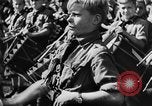
Fascism growth despite pre-World War 2 disarmament efforts including Washington Disarmament Conference, Nine-power treaty.
The background of World War II. German Hitler Youth children march with rifles, flags and a band beneath a camp entrance named Nordmark Lager 1935. Flag with Nazi symbol. Japanese flag and Japanese youth march in military exercises, followed by teenage Japanese forces. Italian fascist troops in uniform march in Torino Italy led by a band. Views of various German and Nazi forces parade and goose step in various cities. Units include brownshirts, goosestepping Storm Troopers, Wehrmacht. Civilians give a salute. Mostly sad looking men women and children watch the parades. The world globe. U.S. Capitol Building in Washington DC. French, Japanese and United States dignitaries attend the Washington Disarmament Conference or Washington Naval Conference at Memorial Continental Hall in Washington DC in 1921. View of the Washington Naval Treaty naval fleet reduction treaty book with signatures on it. Officials sign the Nine-Power Treaty that guarantees the integrity of China (per the John Hay "Open Door Policy"). Japanese delegation is shown at signing ceremony for the Nine-Power Treaty. Next scene shows 1928 signing ceremony in Paris of the Kellogg-Briand Pact renouncing war as a means of settling international disputes. French Foreign Minister Aristide Briand is seen speaking, and American Secretary of State Frank Kellogg is also seen at the treaty signing which was signed by 47 nations including Germany and Japan. In a 1930 scene, U.S. Secretary of State, Henry Stimson hands the London Naval Treaty to President Herbert Hoover. Scene of a U.S. Navy ship being blown up and scrapped in accordance with the treaty terms. View of American citizens in small town parades with floats marching as anti-war and isolationist groups.