


 Francais
 Deutsch
 Italiano
Refine Your Search
China 1963 stock footage and images
- Showing 133 to 138 of 1923 results more
more Hide
Hide
Several vessels in the Huangpu River and views of the Shanghai Bund along the western bank of the river in Shanghai, China.
The Huangpu River in Shanghai, China. A vessel in the Huangpu River. A sail boat and junks on the water. Several buildings in view on the shore. Several sail boats in the river. A paddle wheel steam boat on the water. Boats anchored to the shore. Views of the Shanghai Bund along the western bank of the Huangpu River. Several vessels in the river. The Camelback Truss Waibaidu Bridge (world's first all steel bridge) also known as the Garden Bridge, spanning Suzhou Creek at the Huangpu River. Several buildings at the Shanghai Bund in view including the Headquarters of the Shanghai Branch of the Hongkong and Shanghai Banking Corporation (now known as the HSBC Building or the Municipal Government Building) at number 12, The Bund, and the Customs House at number 13, The Bund, and the China Bank of Communications Building at number 14, The Bund. Also the China Merchant Bank Building and the North China Daily News Building (now the AIA building). Other Bund buildings also seen.
Reforms and their consequences under Mao Zedong's 'Great Leap Forward' plan in China.
Living conditions in the People’s Republic of China under the Communist regime of Mao Zedong photographed by Indians visiting the country. Mao Zedong implements the economic and social plan titled 'Great Leap Forward' with Soviet help in 1958. People on the streets of China. Chinese women and children. Elderly Chinese revolutionaries pose. Cars and buses on the streets. Industries, factories, and plants. Young men and women participate in a festive parade. Men holding flags. The excessive population of China. Military leaders review a parade. An officer salutes. Tanks and artillery in the parade. Smoke from to an explosion during a war.
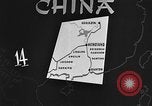
Japanese attack Kunming and American Forces carry supplies to the victims in China.
American Forces in China. An animated map of China shows attack by the American 14th Air Forces from two fronts. Chinese men use a roller and dig a ditch. United States B-24 aircraft in flight. Pilots shake hands. An aircraft in the background. Supplies being loaded onto a plane. A house on fire as a man runs in the foreground. Houses burn and smoke rises from the area as a result of a Japanese attack. Damaged houses and a deserted city in China. An explosion occurs and a pillar of smoke rises. Bomb craters on the ground. An American flag being lowered and removed from a flag post by men. Men load supply boxes in an aircraft. A plane takes off. Chinese people eat food. Chinese children being fed chow by women. People lie down to rest. (World War II period).
People's Republic of China successfully conducts second nuclear test at Lop Nur
People’s Republic of China Premier Zhou Enlai announces the news of China's first successful nuclear test. People cheer. Preparations for China's second atomic test is done. Men prepare trucks and equipment. Combat team briefed. Troops chant communist slogans. Troops and their horses wear protective clothing before entering the radioactive zone. Troops take cover at a safe distance before the blast and cover their eyes with protective glasses. Nuclear explosion at the horizon. Mushroom cloud rises high in the air. The blast wave destroys everything in its path. Tanks and troops enter the radioactive zone. Cavalry advances on ground. Troops move behind tanks. English translation narration overlays Chinese narrator in background.
U.S. President Nixon with First Lady Patricia view the Great Wall of China during Nixon's visit
United States President Richard Nixon and First Lady Mrs Patricia Nixon on their tour to People's Republic of China. President Nixon accompanied by First Lady Patricia, members of Nixon's staff, and other dignitaries visits the Great Wall of China with Vice Premier Li Hsien-nien. An American wearing overcoat and fur cap watches the mountains from the Great Wall of China at Badaling. Other members of the U.S. delegation. A man takes video recording as President Nixon speaks to reporters.
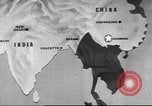
U.S. 10th Air Force B-24 Liberator bomber planes in flight over Japanese territory in China during World War II.
U.S. 10th Air Force operations in China during World War 2. An animation shows the way American supplies are to be taken into China. U.S. 10th Air Force B-24 Liberator bomber planes in flight over the Himalayan Mountains from India to China. An aerial views of the mountains. A B-24 lands. Parked P-40 Warhawk fighters. An officer briefs his crew. Formation of B-24s over enemy territory. An aerial view of the Japanese targets.