


 Francais
 Deutsch
 Italiano
Refine Your Search
Colombey-les-Belles France 1918 stock footage and images
- Showing 631 to 636 of 6520 results more
more Hide
Hide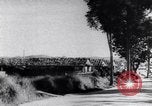
British war prisoners perform drill exercise at a Japanese camp (WW2)
A prison official rings a bell and all allied prisoners come out of their cells at a Japanese POW camp in World War II. Prisoners perform a drill exercise under the supervision of an instructor. Most of the prisoners are British.
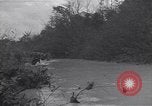
U.S. and South Vietnamese troops engaged in combat against Viet Cong in the Vietnam War
U.S. Army Special Forces troops wade along a stream, carrying M-16s and one carrying a .30 caliber M1919-A6 Browning machine gun. C-119 transport aircraft dropping paratroopers. Troopers on the ground gather up their chutes. Supplies being airdropped. U.S. forces firing small arms. U.S. Army operations in South Vietnam. Closeup of weary Vietnamese Army soldiers. U.S. Army Bell UH-1 Iroquois (AKA Huey) helicopters flying low over jungles and over a bridge along a river. Soldiers in a CH-47 Chinook helicopter. They exhange gunfire with enemies below. On the ground, U.S. Forces in firefight with Viet Cong. U.S. troops jumping to the ground from a helicopter and wading in a river. South Vietnamese and American Wounded being placed aboard an evacuation helicopter. Chopper taking off amidst ground fire. U.S. troops seeking cover as they run from downed helicopter, under fire.
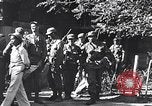
U.S. Rangers and Filipino guerrillas rescue Allied prisoners from Japanese prison camp in Philippines during World War II.
On January 30, 1945, 121 members of the 6th Ranger Battalion and 286 Filipino guerrillas are seen setting out on a 30 mile trek behind Japanese lines, to free Allied prisoners of war (POWs) and civilians from a Japanese camp near Cabanatuan City, in the Philippines, during World War 2. They stretch out in a long, informal column as they traverse low flat lands and ford a wide shallow river. The men carry weapons and supplies (some on their heads) as they move along, almost like a Safari. Scene shifts to rescued prisoner, Major Emil P. Reed, U.s. Army Medical Corps,26th Cavalry. He was the senior officer among prisoners at the Cabanatuan prison camp number 1. He recounts being told by the Japanese Commandant that commencing January 7th, they were free at their own risk, but also assured them they would not be molested by the Japanese if they stayed within their regular camp area. Sergeant Samuel E. Goldy, Signal Corps, also speaks a few words about that period when Japanese were departing. Next the camera records the Rangers and Filipino guerillas returning with the approximately 500 freed POWs. Some Filipino women and children watch them return. At one point, the cadre climb aboard army trucks and continue their journey in a convoy. The POWs climb down from their trucks at the 92nd Evacuation Hospital, in Guimba, Luzon. Some take pleasure is simply lying down on the grass at the site. Many gather around hospital staff handing out packages of treats, including cigarettes, candy and the like. A couple of them express pleasure as they smoke cigarettes. Two frail and injured are seen hobbling with canes. Some appear seriously malnourished. A group are seen trying on new clothes. A British prisoner, Sergeant Robert Bell, Manchester Regiment, British Army, speaks of his experience. He was taken prisoner in Singapore and sent to Thailand where he worked to build a railway for the Japanese. Many prisoners died there from disease and malnutrition. He was one of a small number who survived after being on a Japanese ship with other prisoners when it was sunk by American dive bombers. Sergeant Walter Ring, of San Roque, Luzon, is seated, relaxed on a chair, as he recounts his experiences. Two young Filipino boys sit on the grass at his feet. He reaches to one, whom he says is his son Louis and to the other, his son Sam. His captivity began on Bataan in 1942. Finally, after rest and rehabilitation, the former POWs are seen heading away from the battle fronts to be transported back to the U.S.A.
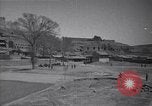
Yungang Grottoes Buddha statue in Datong, China
A Buddhist monastery is seen in China. A bell hangs from the roof of the monastery. The Yungang Grottoes in Datong, Shaanxi, China. A statue of Buddha at the Yungang Grottoes. A man bows down to offer prayers in front of the statue. Cracks on the statue are seen.
Adolf Hitler addresses many thousands of Hitler Youth in Nuremberg during the Nazi 6th Party Congress
Camera zooms in slowly on a the bell of a trumpet sounding. Scene shifts to boys of Hitler Youth beating drums and others blowing trumpets. Closeups of several boys playing fifes. Next, a very large drum and bugle corps of Hitler youth is seen. Closeup of boy drum major. The legs of boys, in Khaki shorts and stockings, seen from the rear as they watch the proceedings. Boys in the stands start jostling for a view and some raise Nazi salutes as Adolf Hitler, enters the stadium, accompanied by Hitler Youth leader, Baldur von Schirach. Trumpets silhouetted. One observer clinging to a flag pole. Boys cheering and saluting as Hitler walks past their seats. Hitler waving, more than saluting, and the boys, likewise, as they cheer him with calls of "Heil." Glimpse of Joseph Goebbels entering the stadium. Hitler in the center of a huge throng of youth. Stands filled with youth, all waving their arms in salute and shouting "Heil." Waves of sound. Hitler chatting with Rudolf Hess, at his side. Boy drummers playing again. Closeups of Hitler, quietly taking it all in, as montage of views ensues, with boys watching; playing cymbals; beating bass drum; Goebbels and Hess conversing and enjoying the event; trumpeters blowing instruments; Goebbels watching events through binoculars; boys holding various symbolic paraphernalia; Swastika banners streaming in the breeze from high flagpoles; Hitler with von Schirach and Hess, high in the stands under the overhang; view from there to the packed stadium;and thousands of saluting participants. Baldur von Schirach walks to a microphone and addresses Hitler (my leader) and the crowd (my comrades) extoling the virtue and importance of the youth present here. Glimpses of boys faces. Von Shirach concludes his remarks, presenting Adolf Hitler, the leader of the German youth and people. The entire stadium erupts in salutes and Heils. When the sound subsides, Hitler addresses the assembly of German youth, specifically including girls, and calls upon them to be honorable, peace-loving, but courageous; to eliminate class and status differences and become unified in every way. His remarks are essentially an appeal for the youth to develop German unity and patriotism that will be carried on beyond the current generations. His speech is punctuated with images of youth and of Hitler, himself. As he steps back from the podium, the place erupts in sound and salutes, which Hitler enjoys, standing with Hess and von Schirach. Next, Hitler is seen standing in his car as it slowly makes its way among the masses cheering, saluting, youth. View from rear of the departing car of the many thousands of youth saluting, as their anthem song is sung in the background.

Prime Minister Levi Eshkol of Israel visits Independence Hall in Philadelphia, Pennsylvania
A film titled 'Prime Minister Eshkol visits the U.S.' shows Prime Minister of Israel on a visit of United States. Prime Minister Eshkol and others pay a visit to Independence Hall (520 Chestnut Street between 5th and 6th Streets, Philadelphia, Pennsylvania, U.S) in Philadelphia, Pennsylvania. A man shows the Liberty Bell to Eshkol.
CRITICALPAST.COM: About Us | Contact Us | FAQs - How to Order | License Agreement | My Account | My Lightboxes | Shopping Cart | Advanced Search | Featured Collections | Website Terms & Conditions | Privacy Policy ©2026 CriticalPast LLC.
License Agreement |
Terms & Conditions |
Privacy Policy
©2026 CriticalPast LLC.