


 Francais
 Deutsch
 Italiano
Refine Your Search
Colombey-les-Belles France 1918 stock footage and images
- Showing 697 to 702 of 6520 results more
more Hide
Hide
Eugenio Maria Giuseppe Giovanni Pacelli elected as new Pope after the death of Pope Pius XI, in Rome, Italy..
Cardinal Eugenio Maria Giuseppe Giovanni Pacelli being acclaimed as Pope Pius XII in Vatican City, Rome. Rites being performed at Saint Peter's Basilica in Rome to mark the passing of Pope Pius XI. The new Pope stands in a balcony with other dignitaries. Pope Pius XII wearing the papal tiara. Bells ringing in the Vatican. View of Saint Peter’s Basilica and Saint Peter’s Square. Italian women and a boy wearing black kneel in prayer at Saint Peter’s Square. Altar servers and Swiss Guards leading a procession inside the Saint Peter’s Basilica. Pope Pius XII carried on the sedia gestatoria blessing the crowds. Pope Pius XII seated while being flanked by the papal flabella (ostrich feather fans) in the balcony of Saint Peter’s Basilica. A priest crowns Pope Pius XII with the papal tiara. Pope Pius XII blesses the large crowd gathered in Saint Peter’s Square (00120 Vatican City) to greet him.
Londoners celebrate VE Day, the end of World war II, in Europe
With the surrender of Germany, World War 2 in Europe ends, on VE (Victory in Europe) Day, May 8, 1945. Scene opens with church bells ringing and view of west front of St. Paul's Cathedral, on Ludgate Hill, in London, England. Crowd is celebrating in the square. around the statue of Queen Anne. Amongst the crowd are men and women in uniform. Here and there Union Jack flags are seen, one held by a little girl hoisted upon a man's shoulder. Camera pans across various parts of the celebrating crowds. View from above, of several couples dancing within a circle of people. Several uniformed U.S. Air Force officers in a jeep celebrate with the crowd. High altitude view of Trafalgar Square in London, England. 'Victory over Germany 1945' banner draped on base of Nelson's Column. Crowd of British citizens celebrating on streets of Whitehall and closeup of the Cenotaph with inscription "The Glorious Dead".
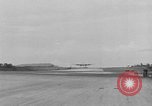
U.S. Brigadier General Emmett O'Donnell, Vice-Admiral John Hoover and Brigadier General Haywood Hansell arrive on Saipan
Us Army Air Forces B-29 Super Fortress of the 73rd Bomb Wing (Tail Code: "V Square 29") comes in for landing. Plane parks on the ramp. U.S. Brigadier General Emmett O'Donnell, Vice-Admiral John Hoover and Brigadier General Haywood Hansell study a map, leaning it against one of the plane's propellers. General O'Donnell walks over to converse with Major Robert Morgan, who is well-known as the pilot of the B-17 "Memphis Belle" that flew 25 missions over Germany in the European theater. He now flies B-29s with the 73rd Wing in the Pacific theater. (World War II period).
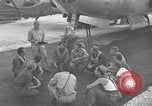
Major Robert Morgan, Aircraft Commander, briefs his B-29 crew as they sit on the tarmac prior to takeoff on a mission
Major Robert Morgan (well-known as the pilot of the B-17, "Memphis Belle," first to complete 25 missions over Germany, in the European Theater and now a B-29 Aircraft Commander with the 73rd Bomb Wing) briefs his crew. They sit on the tarmac near their aircraft, the B-29, "Dauntless Dotty," which was lead aircraft on the first B-29 bombing mission over Japan, on November 24, 1944. The Crew enters the aircraft after the briefing. (World War II period).
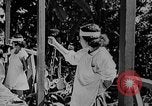
Children file into an open dining room in a camp setting and eat a meal in San Juan, Puerto Rico.
A girl wearing an apron and a head band, rings a dinner bell, and children in groups, by age, file into a wooden open porch dining room in a camp-like area, surrounded by plants and trees. Other girls, wearing headbands, appear to be monitors. The children stand at their respective tables, on which food is served, and say grace in unison, before sitting down to eat. Views of the children eating at different tables. (There appear to be adults in another part of the complex, in the background. )
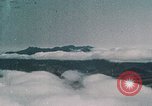
Heavy artillery attack by North Vietnam during Battle of Khe Sanh. U.S. Marines fire at enemy forces.
Battle of Khe Sanh between January 1968 to April 1968, during the Vietnam War. Aerial view of battlefield terrain in valley of Khe Sanh surrounded by mountains and ridges. Military jeep moves on road. Wounded marine carried on litter. Bomb explodes near plane. Supplies at airbase. The American flag on a mountain. David E Lownds, Colonel, U.S. Marine Corps, Commanding Officer, Khe Sanh, speaks. The Colonel explains the location of battle with help of a terrain model. Bombs dropped on mountains. Marines fire artillery. An African American marine loads a mortar and another Marine fires it. Airfield prepared at Khe Sanh. Marines dig trenches. Marines patrol in woods. American military aircraft in flight. U.S. officers look at map on light table. General William Westmoreland gets into helicopter at airbase. Bell UH-1B Iroquois Huey helicopter lands after short flight. U.S. officers leave the helicopter. General Westmoreland and marines check the location. Marines examine aerial reconnaissance photo images on light tables. Sign reads 'Welcome to Khe Sanh Matcu 62 Airfield'. Reinforcing Marines arriving at Khe Sanh airfield and exiting rear of C-130 aircraft with barracks bags and supplies. Supplies dropped by small parachutes from planes in flight. Flashback scenes of French paratroopers landing in the same area during 1954 in the Indochina War. French forces in battle. French advance with heavy artillery but did not win the war. Armistice signed by leaders in Geneva. Scenes return to 1968 with Marines in sandbag bunkers at Khe Sanh. Wide view of terrain at Khe Sanh. U.S. marines in trenches during battle. African American marine eating a ration. Colonel Lownds speaks. White and African American Marines move through jungle terrain. Marines firing artillery at North Vietnamese forces. Aircraft on bombing run. Explosions at Khe Sanh as ammunition dump is hit and explodes in multiple heavy explosions. Heavy artillery attack by North Vietnamese at Khe Sanh and smoke rises from explosions during battle. U.S. Marines in series of trenches firing back at enemy. Explosions on American base airfield near parked helicopter and near a moving C-130 aircraft as it taxis and prepares to take off from runway.
CRITICALPAST.COM: About Us | Contact Us | FAQs - How to Order | License Agreement | My Account | My Lightboxes | Shopping Cart | Advanced Search | Featured Collections | Website Terms & Conditions | Privacy Policy ©2026 CriticalPast LLC.
License Agreement |
Terms & Conditions |
Privacy Policy
©2026 CriticalPast LLC.