


 Francais
 Deutsch
 Italiano

Refine Your Search
Colombey-les-Belles France 1918 stock footage and images
- Showing 73 to 78 of 6533 results more
 Hide
Color Sound

World War 1 Anti-aircraft bursts near a French observation balloon in flight at Souain in Marne, France.
A film on the development of air power. A French observation balloon in flight at Souain in Marne, France on October 2, 1918 during World War I. Anti-aircraft bursts near the observation balloon. Wreckage of a bombed village in the background.

Montage of scenes depicting America in World War I, from 1917 to 1919.
U.S. President Thomas Woodrow Wilson signs the declaration of war during World War I. U.S. ships sink after torpedo attacks. United States troops aboard a troop carrier ship bound tor France. Assistant Secretary of the Navy, Franklin D. Roosevelt. U.S. troops disembarking on docks in France. Navy ships being built in U.S. shipyard. Allied troops attack across no man's land. Allied rail gun firing. U.S.Soldiers fire howitzers. Smoke pours out of Allied biplane aircraft after being shot down. German troops fighting in trenches. A horse falls into a trench after being shot. Tanks in action. Tanks advance and fire. German machine gunners. German prisoners walk in a line. American troops in France celebrate the end of hostilities with the Armistice on the 11th hour of 11th day of 11th month, 1918. The American flag flies on a pole as a symbol of victory. Huge crowds of Americans celebrate in Manhattan, New York city, waving newspapers with headlines announcing German surrender. In 1919, President Wilson and General John (Black Jack) Pershing review victorious American troops marching in Chaumont, France (Pershing's headquarters). Franklin D. Roosevelt, Assistant Secretary of the Navy with Secretary of the Navy, Daniels, in France. U.S. troops board transport ships to return home after war. Returning U.S. Armies hold a victory parade in Manhattan, New York City, where they parade through a temporary Victory Arch constructed expressly for the purpose in Madison Square. Hydrogen balloons decorate the Arch. New York City mounted police monitor the crowds.
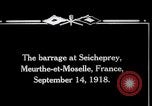
U.S. 16th infantry troops advance at Seicheprey in Meurthe-et-Moselle, France during World War I.
U.S. 16th infantry troops at Seicheprey in Meurthe-et-Moselle, France on September 14th,1918, during World War 1. The troops take cover in a hole left by an exploded shell. Then they advance through the barbed wire fences and enemy fire. U.S. Medical Corps men tend to the wounded.
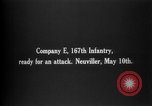
Company E of the U.S.167th Infantry Regiment (A.E.F.) at their base in France during World War I
Soldiers of Company E, U.S. 167th Infantry Regiment, American Expeditionary Forces (A.E.F.), 42nd Infantry Division (Rainbow Division) at their base in Neuviller-la-Roche, France,on May 10, 1918, during World War 1.They demonstrate readiness to defend against attack, entrenched behind barbed wire defenses set up in a grove of birch trees. Sentries, of Company E, walk their posts and occupy lookouts at an established outpost constructed of logs and masonry.

Chief of U.S. Army Air Service Colonel Frank P. Lahm talks to an officer in Toul, Meurthe-Et-Moselle, France.
A film on the development of air power. Chief of U.S. Army Air Service Colonel Frank P. Lahm in Toul, Meurthe-Et-Moselle, France on November 8, 1918 during World War I. Col. Lahm speaks to an officer.
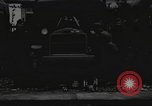
General Officer visits AEF Motor Transport Corps Reception Park in France during World War I
View of soldiers with automobiles in an American Motor Transport Corps Reception Park, in France, during World War 1. A general, in a trench coat, is being escorted by another officer as he examines automobiles in the park. atop the main garage, the letters, "M.T.C." and "Motor Reception Park" are painted. The general's car sits with driver, awaiting him. It appears to be a Locomobile touring car, and bears the identification number: 1111. (Note: The American Expeditionary Forces Motor Transport Corps (M.T.C.) was formed out of the Quartermaster Corps on 15 August 1918. As the name implies, Reception Parks were where newly arrived vehicles were uncrated, assembled, and made ready for service.) (World War I; World War 1; WWI; WW1)
CRITICALPAST.COM: About Us | Contact Us | FAQs - How to Order | License Agreement | My Account | My Lightboxes | Shopping Cart | Advanced Search | Featured Collections | Website Terms & Conditions | Privacy Policy ©2026 CriticalPast LLC.
License Agreement |
Terms & Conditions |
Privacy Policy
©2026 CriticalPast LLC.