


 Francais
 Deutsch
 Italiano
Refine Your Search
Colombey-les-Belles France 1918 stock footage and images
- Showing 871 to 876 of 6520 results more
more Hide
Hide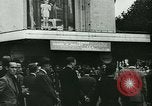
An anti-Communist demonstration at a Paris cinema during World War 2.
An anti-Communist demonstration at a Paris cinema theater in German-occupied France during World War 2. People wait outside the venue. Sign reads 'Le Peuple Russe Contre le Bolchevisme.' A large crowd inside the cinema hall including civilians and some German military officers. The crowd applauds as a French speaker takes the stage. Vichy French speaker addresses the crowd. School girls and flags behind him on the stage.
Cinemas and theaters including the Moulin Rouge at night in Paris.
Night time in Paris, France. Cars on a lit bridge in the night time. Street lamps near the Obelisk in Place de la Concorde. Lit up buildings and towers. Mannequins and apparel on display in a store window. 'Le Berry' sign lit up. Vehicles pass by the Moulin Rouge Cinema. Various cinemas and theaters, including the Cineac Le Jour. At the Follies Bergere, dancers perform on stage. A huge decorative stage and curtains.
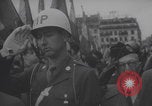
Presentation of the Cross of Liberation (Croix de la Libération) to the city of Paris by General Charles de Gaulle (WW2)
General Charles de Gaulle presents the French Cross of Liberation (Croix de la Libération) to the city of Paris after liberation from Nazi Germany in World War 2. At the entrance of the Paris City Hall (Paris Hôtel de Ville Place de l'Hôtel de Ville, 75004 Paris, France), soldiers, Republican Guards, and civilians gather to witness the ceremony. Representatives from the United States Army stands beside the United States flag. A Military Policeman salutes. As the Grand Chancellor of the Order of Liberation, General Charles de Gaulle delivers a speech beside the Paris coat of arms. French politician André le Troquer holds the Paris coat of arms as General de Gaulle talks. Allied generals watch the ceremony. A giant Cross of Liberation, illuminated by spotlights, is unveiled on the pediment of the Hôtel de Ville. Troops salute and sing “la marseillaise”. Major General Jacques Philippe Leclerc smiling during the ceremony. General Charles de Gaulle, with the Paris City Committee, important French politicians such as André le Troquer and Admiral Georges Thierry d’Argenlieu (also known as Father Louis of the Trinity, O.C.D.), the chancellor of the Ordre de la Libération, pose in front of the Hôtel de Ville.
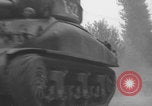
United States soldiers advance on foot, capturing German soldier in Normandy (WW2)
M4 Sherman tanks and other military vehicles moving through country road in Normandy, France during World War II. Two United States soldiers crouch while advancing alongside road tanks pass by. United States infantry soldiers moving through a village and a forest. Soldiers climb over a fallen tree trunk. Soldiers pass by a dead cow. Soldiers moving in a field. A German prisoner places his hands behind his head after his capture by a United States soldier. United States soldiers walking beside a road. A damged road sign reads “Le Dese … Le Hommet "
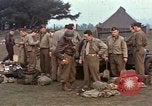
War correspondents gather in South England preparing to head to France, immediately before D-Day invasion in World War II.
War correspondents gathered in England, awaiting D-Day and preparing to enter France after the upcoming D-Day invasion in World War 2. War correspondents and soldiers at a camp on the South Coast of England. Jeeps, tents and men near baggage. Various correspondents meet up with each other. A correspondent walks amidst rows of tents with an officer. An officer gives a correspondent a shovel to defend himself. Correspondent Larry LeSueur smokes a cigarette. Various correspondents including Jack Thompson of the Chicago Tribune, Scripps-Howard Newspapers' Ernie Pyle, Associated Press' Larry O'Riley and Wharton Becker. They bid farewell to each other. A correspondent wearing a leather jacket with "War Correpondent" labeled epaulets on the shoulders. Clark Lee of INS and Chicago Daily News' William Stoneman next to a trailer attached to a military jeep. The war correspondents climb into a military truck. The truck passes through small British towns. People shop for vegetables in a crowded market place or a British town. Destroyed buildings in the town of Plymouth seen as the correspondents exit the rear of the Army vehicles.
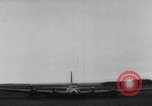
Numerous wrecked Allied warplanes. German ace Adolf Galland and other pilots. FW-190s and ME-109 airplanes in flight (WW2)
German soldiers climbing over a crash-landed B-17 bomber of the USAAF 96th Bomb Group, 337th Bomb Squadron, with tail number 42-3353. Its props are all bent and skin is peeled off its rudder and horizontal stabilizer. (This aircraft, named "Tar Fly," was hit by flak on September 9, 1943, and crash-landed west of Evreux, at Beamont-Le Roger, France. Two crew were killed and 8 taken as prisoners of war.) Smoking wreckage of an Allied aircraft in a field with two dead fliers lying on the ground about 50 yards away. Engines of a downed U.S. aircraft. Numerous views of wrecked American and British airplanes. Sign painted on one piece of wreckage reads: "When I go sightseeing in Tokyo, Tojo's gonna be my Ricksha Boy!" Piles of scrap alumunum from crashed airplanes piled up at a railroad siding, where German workers load it into rail freight cars. German army workers using tools to dismantle parts. Sequence shifts to a Messerschmitt Bf 109 that lands in a field. German airmen run to greet the pilot, who steps from the cockpit and describes some aerial maneuvers to a surrounding audience. Next, German ace, Adolf Galland is seen discussing tactics with other pilots. Several camouflaged Me Bf-109s lined up on a grass field, where ground crews are repairing and maintaining them. Closeups of German pilots climbing into cockpits of planes. Ground crews hand crank their starters. Next sequence shows Focke-Wulf FW-190 aircraft taxiing and then making a formation takeoff from grass field. Then an Me-Bf-109 is shown right after takeoff. FW-190s and Me-109s buzz the field. (World War II period)
CRITICALPAST.COM: About Us | Contact Us | FAQs - How to Order | License Agreement | My Account | My Lightboxes | Shopping Cart | Advanced Search | Featured Collections | Website Terms & Conditions | Privacy Policy ©2026 CriticalPast LLC.
License Agreement |
Terms & Conditions |
Privacy Policy
©2026 CriticalPast LLC.