


 Francais
 Deutsch
 Italiano
Refine Your Search
Colombey-les-Belles France 1918 stock footage and images
- Showing 121 to 126 of 6520 results more
more Hide
Hide
World War 2 film promoting public investment in War Bonds and stamps to aid the war effort and temper inflation
World War 2 era film that also includes some World War 1 scenes. Show girls or chorus girls in follies-like show, costumed as U.S. silver dollars and marching to tune and lyrics alluding to dramatic increase of currency in circulation, over the years. Animation with stacks of coins shows increase in national income from $46 billion,in 1933, to $71 billion, in 1939, and $142 billion in 1943. Back to the "follies dollars," a boy asks why, and then scenes of the Japanese attack on Pearl Harbor,are shown, with U.S. battleships being sunk. Wartime arms plants are shown. An M2A3 Light Tank rolls off a production line. Ships being constructed in a shipyard. B-24 Liberator bombers being built in a factory. Artillery shells being produced. Defense workers receiving their pay. The "follies dollars" group themselves to illustrate the fractions of income devoted to taxes and savings. But other spending is curtailed by wartime shortages. A woman talking with clerk in a drug store. U.S. Army troops crossing a pontoon bridge in open trucks, towing 75mm M1A1 howitzers. Infantry on the march. Animation showing industrial production devoted to war materiel and lots of dollars chasing few civilian goods. A grocery clerk offers to sell a woman customer butter for more than the established price, and she agrees. The "follies" performers then introduce the idea of an "inflationary dollar," and some history of past U.S. inflations. Animated examples of price inflation are shown. Glimpses of World War I scenes are seen, circa 1917 -1918, including: a 12-inch railway gun firing; a huge explosion from shell bursting near the camera; various scenes of United States infantry soldiers and French soldiers in battle action, running to bomb craters for cover and emerging from trenches to go up "over the top" into no-mans land during combat. Meanwhile, singing narration refers to the home front inflation due to competition for limited civilian goods. Map shows Europe and singing narration cites rising prices for food in occupied France and other countries suffering ravages of World War II. Montage of scenes showing needy civilians obtaining food in those countries. Animation shows increases, by 1944, in cost of U.S. civilian goods since the Pearl Harbor attack. "Follies" character called "Double-duty dollar," appears explaining he serves the war and curtails inflation on the home front by being saved through investments in War Bonds and stamps.
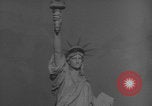
United States Army and Red Cross volunteers prepare Camp Kilmer in New Jersey for arrival of Hungarian refugees from the Hungarian Revolution
View of the Statue of Liberty. View of New York City and the Statue of Liberty. Sign saying “Camp Kilmer named in honor of Sgt. Joyce Kilmer Soldier Poet. Born December 6, 1886, New Brunswick, N.J. Killed in action World War I in France June 30, 1918”. A United States military jeep approaches the entrance of Camp Kilmer. Soldier at Camp Kilmer entrance allows Jeep to enter. Soldiers march and then sprint inside Camp Kilmer. Using crane attached to truck, soldiers unload crates containing furniture for incoming Hungarian refugees who will stay in Camp Kilmer. Soldiers carry mattresses into the barracks. Two soldiers carry a crate to a barrack. Soldiers carry a cabinet to the barracks. Inside the Camp Kilmer paint shop, soldiers prepare signs in Hungarian such as “Varás és asztalos munka (sic.)” (“Sewing and Carpentry”) and “fö üzlet” (“main shop”). Camp Kilmer dentists disinfect clinic. Camp Kilmer pharmacists prepare medicine for incoming refugees. An army pharmacist pour medicine into a bottle using a funnel. An army pharmacist grounds with using mortar and pestle. Pharmacists stack medicine such as aspirin in shelves. Army nurse making hospital bed with freshly laundered white bed sheets. Red cross volunteers filling comfort bags containing toiletries for refugees. Soldiers unload piles of second-hand clothes donated by Americans through the Red Cross. Red Cross volunteers organize second-hand clothes by type and size. African American woman Camp Kilmer staff enter the Recreation Center, with sign in English and Hungarian. African American staff at Camp Kilmer hang paintings and arrange furniture in the Recreation Center.
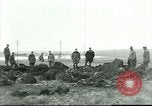
U.S. soldiers of the 18th Infantry examine huge bomb crater. U.S. occupied trenches and defenses.
Elements of the U.S. 18th Infantry in France during World War I. Soldiers gather around huge bomb or shell craters. A soldier inspects the crater. Barbed wire barriers. Troops in lattice-reinforced trenches and dugouts. A soldier stands in trench. An alarm bell seen next to him. (World War I. World War 1. WWI. WW1)
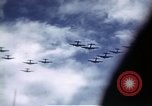
U.S. Army Air Force B-17 planes relax on way home from combat missions in France.
Outtakes from the Memphis Belle documentary movie. B-17 planes returns after conducting combat missions in France. Large formation of B-17s in sky. Various crew members relax on way home from mission. B-17 taxis on airfield in England. Tower operator operates flash signal gun. B-17s taxis on runway.
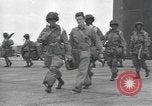
U.S. paratroopers board C-47 airplanes in England for the D Day invasion of Normandy, France in World War 2.
Paratroopers of the U.S. 502nd Parachute Infantry Regiment, 101st Airborne Division, at RAF Station, Greenham Common, proceed, in full battle gear, to board C-47 aircraft for their flight to Normandy, France, on June 5, 1944, during World War 2. Camouflage is seen on their helmets and their faces are blackened. One group is seen boarding C-47, tail number 43-15296. An officer reads briefing notes to them.They don life vests. A Captain and two Sergeants discuss briefing notes.Paratroopers help others who have difficulty climbing aboard the aircraft because of their heavy and ungainly equipment. Ninth Air Force Commander, Lieutenant General Louis H. Brereton speaks to Chaplain, Lieutenant Colonel Louis R. Goodrich, and shakes hands with some of the troopers, wishing them well, as they board C-47 number 42-92847, named, "That's All...Brother."(This was the lead aircraft for the airdrop, just behind the C-47s dropping pathfinders. It was piloted by the commander of the 438th Troop Carrier Group, Colonel John Donalson, and 87th Troop Carrier Squadron Commander, Lieutenant Colonel David Daniel.) The C-47s taxi out for takeoff, as senior officers watch them depart. (Note: There has been confusion about the name of the lead aircraft, C-47, 42-92847, because Colonel Donalson normally flew one named "Belle of Birmingham. " Research, including information from his daughter, indicate that he chose 42-92847, as lead aircraft, because it would have to be cut open to accommodate SCR 717C radar equipment, and he didn't want that done to his favorite airplane.)
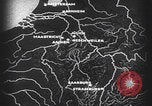
German Wehrmacht troops recapture village, British and Free French prisoners of war are led away (WW2)
German propaganda film with English dubbing. Wehrmacht troops enter a recaptured town during the Battle of the Bulge during winter of World War II. A map showing cities in the Netherlands, Belgium, Germany, and Eastern France. German Wehrmacht infantry march through the snow on the Western Front. German troops arrive at a village after the Rundstedt-Offensive allowed Germany to regain some territories from the Allied forces. German soldiers find a woman hiding in a cellar or basement. Wehrmacht troops pass by burning wreckage of American Jeeps and debris. Sign reads “Civilian travel beyond this point is forbidden” in English, French and German. German soldiers carry supplies to areas restricted to civilians. British and French prisoners of war (POWs) are captured by Germans. The prisoners of war are led away through snow covered streets. Some men carry injured prisoners. A French soldier holds a small pennant of Free France. British and Free French Prisoners of War (POWs) are marched to the rear. A destroyed church and its bell tower. A Roman Catholic relic lies among wreckage. Upturned chair and cabinet with scattered papers on the floor. A damaged statuette of Jesus Christ with hands missing. Wreckage in German homes and churches allegedly caused by United States occupation forces is shown. German Panzer tanks roll into a village, pushing aside a cart that is blocking the road.. German troops arrive with horse-drawn carts, passing by a dead white horse. Closeup view of faces of German soldiers marching through village.
CRITICALPAST.COM: About Us | Contact Us | FAQs - How to Order | License Agreement | My Account | My Lightboxes | Shopping Cart | Advanced Search | Featured Collections | Website Terms & Conditions | Privacy Policy ©2026 CriticalPast LLC.
License Agreement |
Terms & Conditions |
Privacy Policy
©2026 CriticalPast LLC.