


 Francais
 Deutsch
 Italiano
Refine Your Search
Colombey-les-Belles France 1918 stock footage and images
- Showing 151 to 156 of 6520 results more
more Hide
Hide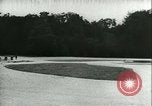
World War 2 German soldiers demolish memorial dedicated to Marshal Ferdinand Foch and the German surrender of 1918.
Germans demolish memorial dedicated to Marshal Ferdinand Foch and the German surrender in 1918. The memorial with Ferdinand Foch's statue at the center. A soldiers stands near an engraved stone on the ground. German soldiers dig with shovels and pickaxes. The memorial and a building there are blown up. Smoke from the explosions.
Images showing interests, culture, lifestyle and events involving Americans, including World War 1, in the period 1915 -1918
America in the World War 1 years, before and during the U.S. involvement in the war. View of Woodrow Wilson in academic robe and cap, as President of Princeton University. Steel mill with stacks belching smoke. Workers tap an open hearth furnace in steel mill. Children on a city street dancing and being sprayed with a fire hose to keep cool in summer. Boy hopping over the backs of his friends. Boys seated on a bench. Scenes from early motion pictures, interposed with images of Uncle Sam from Army recruiting poster: They are rapid montage comedy and stunt scenes, including Keystone Cops chasing fugitive; cars racing, gangster shootouts from cars; automobile hijinks; men raising barrier at railroad level crossing while a woman is left dangling from the raised crossing gate; car races and crosses railroad track in front of rapidly approaching locomotive; comic car chase down; line of 3 open top cars racing over an edge into a deep ditch, a motorcycle taking flight off of a road and into a river; a man waving warning flag frantically at a blasting site; The Cunard Ocean Liner ship, RMS Lusitania, underway; Newspaper front page about torpedoing of the Lusitania. American soldiers boarding troop ship for France in World War 1; View of the troop ship deck filled with U.S. soldiers. Various scenes of U.S. troops in the American Expeditionary Forces (AEF) in France during World War I: amid war torn ruins and destroyed buildings in France; firing French 75s and heavier artillery; soldiers charging across no-man's land; French and American soldiers caring for wounded behind the lines and in trenches of the battlefields; soldiers placing helmets and identification cards of fallen soldiers on rifles that are inverted, bayonet into ground.
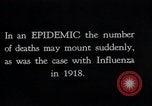
A graph shows a sudden increase in the deaths in New York City due to 1918 influenza pandemic and other diseases.
A graph shows a sudden increase in the deaths due to influenza in New York City during the 1918 Spanish flu epidemic. Spike in the graph is shown for the 1918 influenza outbreak. Slide states "A steady decline of the death rate is shown by communities in which an intelligent public uses the results of scientific knowledge." A strata chart shows the deaths per one thousand people during the period from each of pneumonias, tuberculosis, and cerebro-spinal meningitis, and then deaths from the diseases summed. A chart at the end reads, "What sciences hope to do" and then it reads "Reduce all transmissible diseases to 0 - With the cooperation of an intelligent public."
Various "firsts" in U.S. aviation history from 1918 through 1924; early history of flight and vintage flight scenes
Shows several aviation "firsts" accomplished by U.S. Army Air Service aviators in the period from 1918 through 1924. A close formation of biplanes in flight. President and Mrs. Woodrow Wilson chat with Major Fleet, Officer in charge, on the occasion of the first air mail flight, inaugurated on May 15,1918 between Washington DC and New York.The mail is loaded into the Curtis JN-4 aircraft. Pilot in the cockpit. The aircraft takes off and in flight. Air Service. Mention of aviators helping spot forest fires. Smoke rising from forest fires and mountain ranges. In 1920, U.S. Army Captain St. Clair Streett is seen with some of his Squadron who flew four De Havilland DH-4 aircraft 9,000 miles, from New York City to Nome, Alaska. Two of the men play with pet dogs. Their itinerary is painted on the side of one of the aircraft, along with the names of pilot and mechanic (C.E. Crumline and J.E. Long). In 1923 the first non stop coast-to-coast flight was made in the Fokker T-2 aircraft. . A sign on the aircraft reads 'Army Air Service non stop coast to coast'.First Lieutenants Oakley O.Kelly and John A. Macready board the aircraft, at Roosevelt Field, Long Island, New York, on May 2, 1923. Their Fokker T-2 in flight. Their arrival at Rockwell Field, on Coronado Island (San Diego) California. In 1924, Lt. Russell Maughan is seen boarding his P-1 Hawk airplane at Mitchel Field, on Long Island, New York, and taking off , bound for Crissy Field at the Presidio, San Francisco, California. His goal is the first dawn-to-dusk, coast-to-coast flight. Views of his P-1 Hawk airplane flying over Manhattan, New York City.
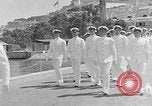
Dedication of memorial to lives lost on U.S. Coast Guard Cutters Tampa and Seneca, in 1918
U.S. Coast Guardsmen parade in dress whites, at pier in Gibralter harbor, and assemble in formation for ceremony to dedicate a memorial. The Coast Guard Ensign hangs over, and hides a memorial plaque on wall of building. Participants include British and American officers and British and American civilian officials, several dressed formally, with top hats. A number of ladies are seated for the event. After brief invocation by clergyman, A British military brass band plays, Coast guardsmen, with rifles, present arms, and the Coast Guard ensign is removed, unveiling the memorial plaque. The plaque honors those lost when the Cutter Tampa was torpedoed by an enemy submarine, in Bristol Channel, on September 26, 1918, with loss of all 115 souls on board. It also honors 11 officers and men of the Cutter Seneca, who volunteered, and were lost attempting to salvage the torpedoed British Steamer, Wellington, in the Bay of Biscay, September 17, 1918. The American flag is displayed above the new plaque, and Coast Guard officers place four wreaths at the base of the memorial. .
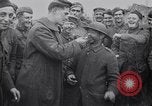
Armistice Day 1918, on the Western Front; in Paris; and in Washington DC. The Kaiser in Holland
American and German troops sharing a smoke on Armistice Day on the Western Front in World War 1. Pittsburgh Press newspaper headline reads: "Kaiser finds refuge in Holland." He is seen at front steps of his house there, standing with two pet dogs. The German flag flies over the house. Scene shifts to a crowd celebrating in Paris France. Several French tricolor flags are seen. Next, crowds are seen celebrating in Washingtion, DC, where some in front of the old Executive Office Building, raise up an effigy of the Kaiser, holding a white flag of surrender. Finally, members of the German military high command and members of the German diplomatic corps and politicians are shown. (World War I; World War 1; WWI; WW1)
CRITICALPAST.COM: About Us | Contact Us | FAQs - How to Order | License Agreement | My Account | My Lightboxes | Shopping Cart | Advanced Search | Featured Collections | Website Terms & Conditions | Privacy Policy ©2026 CriticalPast LLC.
License Agreement |
Terms & Conditions |
Privacy Policy
©2026 CriticalPast LLC.