


 Francais
 Deutsch
 Italiano
Refine Your Search
Colombey-les-Belles France 1918 stock footage and images
- Showing 217 to 222 of 6520 results more
more Hide
Hide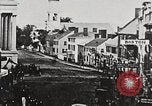
Bell Telephone advertisement chronicles costs for telephone calls reducing from 1915 to 1970.
Bell Telephone television advertisement depicts the cost of telephone calls over years from 1915 to 1970. Pictures of streets and houses in Boston. Portrait of Alexander Graham Bell. The cost of telephone from 20.70 dollars in 1915 reduced to 70 cents in 1970. Rapid paced montage of images (some still and some motion) from 1915 to 1970. Poster reads 'Japan at War'. Man and woman dance. Missile launched from launch pad. Aircraft parked on runway. The cost of long distance telephone charges reduced over the years. Different types of telephones seen in 1970.

View of banks, church, public park, Belle Isle, busy streets and Bob-Lo steamship SS Columbia leaving dock in Detroit, Michigan
In Detroit Financial District, people in front of First State Bank Building at 751 Griswold at Lafayette in Detroit, Michigan. (The building was designed by Albert Kahn and Corrado Parducci, and later housed the Olde Discount Corporation). Interior of First State Bank Building, Detroit. Street view of First National Building under construction at 660 Woodward Avenue in Detroit (for First National Bank and other tenants). Automobile traffic on streets of Detroit. People leave Sweetest Heart of Mary, Roman Catholic Church, located on Russell Street at the corner of East Canfield avenue, in a historic Polish parish. (The neighborhood at the time was predominantely Polish.) In the distance is another Polish parish and Saint Josaphat Church located on East Canfield at the corner of Hastings Street (which is now the I 75 freeway). Heavy traffic on a main boulevard. Children play in playground on swings and slides. People and pigeons in a park. Heavy traffic on a street. Large crowd on shore and others in canoes in water at Belle Isle. Crowd streams through gate at dock to board the steamship ferry "Columbia" of the Detroit, Belle Isle and Windsor Ferry Company, with sign "Bob-Lo Route" on the side. Boblo Steamship SS Columbia (designed by Frank Kirby) filled with passengers underway on the Detroit River bound for Bob-Lo Island in Ontario Canada.

Early Bell Laboratory technology in computer art and computer animation for communication, advertising, motion pictures.
Computer screen showing animation of a silhouette of a man running. Narrator states that the first such image was generated at Bell Telephone Laboratories in New Jersey in the early 1960s. More views of the so called "Olympic Runner" graphic design generated by the Bell Laboratories newest digital computer. Colors like pink, blue and red are used in the early, historic computer art and animation technology. Men seated in a control room, interacting with the digital computer and other animation and recording hardware. Views of computer monitor screens and discussion by narrator about various visual forms created by computers. Various computer generated images are shown on the screen. Engineer stands in front of video tape machine where the images are being recorded. More computer and animation hardware is shown including an Animation Aid. Narrator describes process of photographing analog computer art work onto motion picture film and then enhancing it with color choices. Engineer is seen operating camera, and then a close up view of motion picture film running on machines and on reels. Animation and color consultant in discussion as they stand over some frames of the film that they have isolated. Sample work of early computer artists is shown, with moving animated art seen on screen, combining color and motion in new ways that were not possible before the digital computer. Another view of the video tape machine operating. Narrator discusses use of the computer also in development of computer generated music that accompanies the visual images. Animated clock is seen. Different kinds of animations are seen.
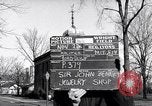
Still figures of Medieval Bell Ringers above doorway of Sir John Bennett Jewelery Shop, in United States.
Sir John Bennett Jewelery Shop near a road, in United States. Still figures of Medieval Bell Ringers above doorway of shop. The mechanical figures ring bells. Top of building sign 'Sir John Bennett' inscribed on a stone. Clock on top of tower, above the still figures of clock ringers.

Alexander Graham Bell at 1916 ceremony; Telephone manufacturing at Western Electric Company plant in Chicago
A film titled "The world's telephone workshop". Opening scene shows ceremony on March 10, 1916, with Alexander Graham Bell, inventor of the telephone, unveiling a plaque at the invention site of the telephone in Boston, Massachusetts, United States. The plaque, at 109 Court Street, states "Here the Telephone was Born, June 2, 1875" and it notes that it was placed by The Bostonian Society and the New England Telephone and Telegraph Company. Alexander Graham Bell tips his hat to the crowd as they celebrate the unveiling. View of Western Electric Company plant in Chicago as smoke emerges from chimneys. Turbines in coal power plant. Massive group of thousands of American workers gathered together, from all walks of life, who are employed in the telephone industry.
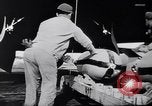
Final bombing mission of the B-17 "Memphis Belle" during World War 2
Ground crew loads bombs into a B-17. Pilot, Captain Robert K.Morgan and his crew, arrive by jeep and jump off in front of their aircraft, the "Memphis Belle." at an airfield in England during World War II. Captain Morgan gives final briefing to the crew as they stand in front of their aircraft. He and his crew then climb aboard, take up their positions and start engines. View of the nose and fuselage of the "Memphis Belle" shows artwork, including 24 bombs painted on its side. Views of other B-17s included in this mission shows names and artwork on their fuselages. Among them are: 'Dame Satan',' Hitler's Gremlin','Heavyweight','Royal Flush','Old Bill' ,'In Der Fuehrer's Face','Helno Gal' , 'Peggy my little Waaf', and 'Desperate Journey'. Group of B-17s take off, one at a time, for the mission. View from the undercarriage of one B-17 as it takes off and the landing gear is raised. Aerial views of English countryside and of several British airbases, as the B-17s fly at relatively low altitude on their way toward the English Channel.
CRITICALPAST.COM: About Us | Contact Us | FAQs - How to Order | License Agreement | My Account | My Lightboxes | Shopping Cart | Advanced Search | Featured Collections | Website Terms & Conditions | Privacy Policy ©2026 CriticalPast LLC.
License Agreement |
Terms & Conditions |
Privacy Policy
©2026 CriticalPast LLC.