


 Francais
 Deutsch
 Italiano
Refine Your Search
Colombey-les-Belles France 1918 stock footage and images
- Showing 2857 to 2862 of 6521 results more
more Hide
Hide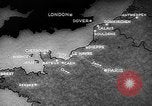
German soldiers respond to the front in Normandy, France, following the Allied invasion in World War II
Map shows French coast and principal cities of interest, during the Allied invasion in World War 2. Truckloads of German troops, including one filled with German woman in uniform, drive rapidly along a dirt road to confront the Allied invasion at Normandy, France, during World War 2. An improvised sign in a tree reads, "Einhahnstrasse Z. Front," identifying the road to the front lines. A German soldier hands out newspapers to others passing on bicycles. A headline in the paper reads:"Eisenhower hat uns nicht überrascht" (Eisenhower didn't surprise us). German soldiers on bicycles ride past the camera. A Sign in large letters reads:"Feindeinsicht" (Enemy in sight) and adds precautionary comments. German army vehicles camouflaged with foliage drive past destroyed Allied armored vehicles. Closeup of a German soldier with foliage on his helmet, looking about as he rides along in an open vehicle. Formations of allied warplanes appear overhead. German troops on the road scurry to the sides of the road and take cover as precaution against Allied air attack. German antiaircraft batteries in action. One Allied aircraft is hit. The pilot bails out. His chute is visible. A U.S. B-17 bomber falls, with part of its left wing blown off. Smoke rising from wreckage of two Allied aircraft on the ground.
Allied paratroopers board planes, bombers and ships fire Nazi targets in Normandy, France during D-Day Invasion (WW2)
Allied forces raid the coast of Normandy in France on the D-Day invasion during World War II. United States Army paratroopers board transport planes and gliders to land on enemy areas. Infantry soldiers prepare to reach for aid of paratroopers. Armada of Allied warships, boats and landing crafts sail in sea to reach the coast. Guns on ships fire shells at the coast. Fired empty shells on the ships. Allied bombers raid Nazi air bases and headquarters in Normandy. Nazi German warships in a canal destroyed by Allied bombers.
Allied soldiers exit landing crafts on Normandy beaches facing open German fire, in France during D-Day Invasion, World War II
Allied forces raid the coast of Normandy in France on the D-Day invasion, during World War 2. North Shore Regiment (3rd Canadian Division) soldiers land at the Nan sector of Juno beach. The Canadian soldiers aboard a landing vehicle approach gutted coastal houses and Nazi bunkers on the Normandy beach. The gates of landing craft open and soldiers advance facing intense open fire by the Nazis. Soldiers carrying their weapons run in shallow sea waters to reach the land. One soldier pats the back of the next in front of him as they prepare to wade ashore. Several other beach landings shown by Allied soldiers. Some wrecked boats and dead bodies of Allied soldiers in the sea. Injured American soldier tended by a medic, and infantrymen take guard close to sea wall to protect themselves from German gun fire. Paratroopers including 101st Airborne land ten miles inside the coast, free French villages and talk to natives about whereabouts of Nazis. American soldiers talk to a French boy and girl and French women and men indicating German soldier whereabouts.
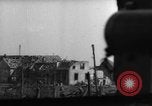
Soldiers of 410th Regiment, 103th Division of Allied forces with German prisoners in Gudershoffer, France during World War II.
Houses and buildings destroyed during battle in Gudershoffer, France during World War II. Smoke arises from burnt houses and burnt crops. Infantrymen of the 410th Regiment, 103th Division of Allied forces run in woods carrying their weapons towards town. German prisoners marched in by Allied soldiers. Red Cross servicemen carry wounded on litter, from woods. Soldiers enter a town with signboard 'Gudershoffer'
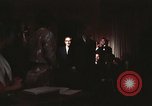
The U.S. Secretary of State Dr Henry Kissinger addresses a press conference after signing a peace agreement in Paris, France.
The U.S. Secretary of State Dr Henry Kissinger addresses a press conference after signing a peace agreement in Paris, France. Dr Kissinger arrives at a press conference and takes his chair. He talks to press photographers about the happenings of the peace talks, ceasefire in Vietnam and troops withdrawal from Laos and Cambodia. He expresses satisfaction on the progress of treaty and resuming peace conditions in Vietnam. Press photographers take photos and make notes of Kissinger's speech. He speaks about the cease fire agreement, need for free elections and resumption of peace. (Vietnam War period).
The U.S. Secretary of State Dr Henry Kissinger addresses a press conference about the peace talks in Vietnam, Paris, France.
The U.S. Secretary of State Dr Henry Kissinger addresses a press conference after signing a peace agreement in Paris, France. Dr Kissinger addresses at a press conference about the happenings of the peace talks and ceasefire in Vietnam. He details about various proposals about the number of parties communication for initiating peace talks. He refuses to provide the details of the talks during the meetings.
CRITICALPAST.COM: About Us | Contact Us | FAQs - How to Order | License Agreement | My Account | My Lightboxes | Shopping Cart | Advanced Search | Featured Collections | Website Terms & Conditions | Privacy Policy ©2026 CriticalPast LLC.
License Agreement |
Terms & Conditions |
Privacy Policy
©2026 CriticalPast LLC.