


 Francais
 Deutsch
 Italiano
Refine Your Search
Colombey-les-Belles France 1918 stock footage and images
- Showing 3241 to 3246 of 6521 results more
more Hide
Hide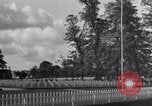
United States soldiers and officers at a military cemetery in France for Memorial Day services in 1945.
American soldiers and officers at a military cemetery in Ste Mere Eglise, France. Flags on grave markers. Soldiers stand with flags in hand. Officers stand. They pay respect to the graves of the American soldiers killed in World War 2 in the invasion of France. They place wreath on a grave. Children watch the officers paying respect to the graves. Soldiers stand with flags. Soldiers band. They fire in the air. They march with the band.
U.S. Army soldiers stand in front of a house in Saint Mere Eglise, France and enjoy coffee from a French civilian woman.
Soldiers of U.S. Army 1st battalion, 8th infantry regiment, 4th division in the days after invasion of France. The U.S. Army soldiers stand in front of a house in Saint Mere Eglise, France. A French woman pours coffee into canteen cups held by soldiers. Soldiers drink coffee and several smile and enjoy the coffee. They talk amongst themselves. (World War II period).
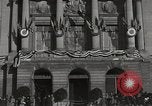
Citizens, soldiers and officers gathered to pay homage to American unknown soldier in Chalons-en-Champagne, France.
Tribute paid to an American soldier in Chalons-en-Champagne, France. People gathered in the city hall (Pl. du Maréchal Foch, 51000 Châlons-en-Champagne, France). The American flag on the building. Officers salute as soldiers carry the coffin of the American soldier who is the selected unknown American soldier, chosen to be represent all such soldiers in the tomb of the unknown soldier in the United States. Officers on horses in the background. The soldiers place the coffin of the unknown soldier on a horse driven caisson. The coffin is carried on the cart. The soldiers and the officers march in the background. An officer addresses people. The soldiers carry the coffin on a dock followed by the officers. People place wreaths on the coffin. The French and the American flag on the ship USS Olympia. The ship leaves the dock. People stand and watch from the dock, bound for the United States and final burial ceremonies at Arlington National Cemetery in Washington DC.
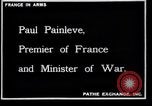
French leaders Paul Painleve and Monsier Ribot noted as leaders in World War 1 effort
Shows men who have contributed to greatness of France in the war. Paul Painleve, Premier of France and Minister of War talking to a man in a field. Other people stand in the background. Monsieur Ribot, former Premiere and now Minister of Foreign Affairs walking with two other persons in front of a house.
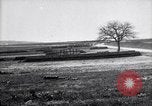
U.S. Army First Division infantry deploying during World War I
Outdoor munitions depot in France, during World War 1. Stacks of heavy artillery shells are seen lined up in a field. American 1st Division troops prepare defenses near a road in the French countryside. They dig between a long trench and the road. Scene shifts to First Division troops drawing rations at a Quartermaster Supply Depot in Maron, France. The soldiers fill their arms with items set out for them. Change of scene shows 28th Infantry Regiment troops marching along a road between a river and a railroad, where they begin to board rail cars. Several soldiers receive hot beverages from two women volunteers. The troops wave from the cars as the train begins to pull out. (WWI. WW1)
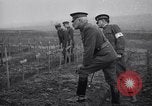
General Pershing visits cemetery; Australian, British and New Zealand troops in a wrecked French town during World War I.
Opening few seconds show American General John J. Pershing viewing a grave marker at a fresh cemetery in France during World War I. Next scene shows Australian troops dig trenches in France during World War 1. Australian troops at a destroyed railroad yard. Group of French men and women and children civilians pose for the camera, while British troops stand in background. Close up of an old French woman. The elderly French woman is talking and appears to be expressing thanks to the Allied troops and potentially grief from the devastation of the war. Soldiers on foot pass by a bomb wrecked French town with buildings reduced to piles of rubble from shelling. British troops and supplies on horse carts pass by the streets of the demolished town. British lancer cavalry regiment passes by on horseback, with lances raised. New Zealand soldiers march on railroad tracks to board a train.
CRITICALPAST.COM: About Us | Contact Us | FAQs - How to Order | License Agreement | My Account | My Lightboxes | Shopping Cart | Advanced Search | Featured Collections | Website Terms & Conditions | Privacy Policy ©2026 CriticalPast LLC.
License Agreement |
Terms & Conditions |
Privacy Policy
©2026 CriticalPast LLC.