


 Francais
 Deutsch
 Italiano
Refine Your Search
Colombey-les-Belles France 1918 stock footage and images
- Showing 3499 to 3504 of 6521 results more
more Hide
Hide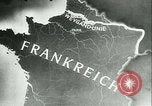
German troops advance through Hangest while German Stukas bomb Allied positions and dogfight with French airplanes.
The German assault on France during the Battle of France in World War II. A map depicts the location of Somme, Paris and the Weygand Line in France. Germans advance into France. German forces move through Hangest-en-Santerre, France. A bullet ridden sign for Hangest-en-Santerre. German soldiers take cover. Smoke due to several explosions. Bomb damaged buildings and rubble strewn on the streets. German soldiers in a 5 cm sIG 33 (Sf) auf Panzerkampfwagen I Ausf B, sometimes called a Sturmpanzer I Bison self-propelled gun as it makes its way through the streets amidst enemy fire. Machine gun fire. Tanks advance on the streets. German soldiers run for cover. Bomb damaged buildings and ruins. Soldiers amidst rubble. German Junker Ju 87 Stukas, He-111 and Ju-88 medium bombers bomb Allied positions in France. German pilots release bombs. The bombs descend to the ground and explode causing huge clouds of black smoke. View of bombing and smoke rising from targets as seen point of view from inside plexiglass nose section of German bomber aircraft. French MS-406 fighters and German Me-110 and Me-109 fighter aircraft dogfight. The crew inside a Stuka in flight. A French aircraft is hit and is seen nosediving toward ground. It crashes with a large explosion. German aircraft bomb the Weygand Line. German artillery bombards the Line.
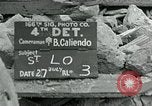
View of town of Saint Lo in France shortly after allied bombings of World War II during Invasion of France by the allies.
View of a wrecked and ruined Saint Lo town after the allied bombings of World War II. Damaged buildings of the town. Two United States soldiers of the 60th Engineer Combat Battalion, 35th infantry division enter the block house.
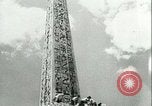
Adolf Hitler and Albert Speer visit various monuments after the fall of Paris during World War II.
German occupation in Paris France following Battle of France in World War II. French prisoners of war (POWs) remove protective coverings from the Obelisk at the Place de la Concorde. The POWs remove sandbags from around the Obelisk and Napoleon's Tomb. German Fuhrer Adolf Hitler and Nazi Minister of Armaments and War Production Albert Speer tour the city by car. Hitler and Speer arrive at the Church of Sainte-Marie Madeleine (Place de la Madeleine, 75008 Paris, France). French policemen salute as Hitler drives by. They visit the Place de la Concorde (75008 Paris, France) and Arc de Triomphe (Place Charles de Gaulle, 75008 Paris, France). Hitler, Speer and others view the Eiffel Tower(Champ de Mars, 5 Avenue Anatole France, 75007 Paris, France).
Parisians, monuments, and public places in Paris prior to its occupation by the Germans during World War II.
The city of Paris prior to German occupation during World War II. A large crowd of Parisians during a celebration near the Madeleine Church (Place de la Madeleine, 75008 Paris, France). The Notre Dame de Paris gargoyles. The Eiffel Tower (Champ de Mars, 5 Avenue Anatole France, 75007 Paris, France). A gargoyle is perched from the Notre Dame Cathedral (6 Parvis Notre-Dame - Pl. Jean-Paul II, 75004 Paris, France), overlooking Paris. People dine in a restaurant. Neon signs and lit up shops at night. Parisians seated at sidewalk cafes. Shops on a street. People drink at bars and in night clubs. Fireworks at night. The lit Obelisk and Place de la Concorde (75008 Paris, France). Sellers with their goods in a vegetable market. People shopping for fruits and vegetables. A man sells bread on a cart. Pedestrians and cars at the Paris Metropolitan. A Metropolitain subway sign atop the steps of a metro entrance. Monuments, buildings, and the Seine River. A ferry in the Seine. Pedestrians and vehicular traffic on the streets. Workers use a delivery van to distribute newspapers. The Eternal Light, Tomb of the Unknown soldier, and sculptures at the Arc de Triomphe (Place Charles de Gaulle, 75008 Paris, France).

Bomb damaged Place de la Concorde and unscathed Champs Elysees, Eiffel Tower, Arc de Triomphe, Notre Dame in Paris after WWII.
Results of selective strategic bombing by the British Royal and United States Eighth Air Forces in German-occupied Paris and surrounding areas during World War II. September 1944: Pont de Grenelle bridge over the Seine river. Eiffel Tower (Champ de Mars, 5 Avenue Anatole France, 75007 Paris, France) in the background. The Statue of Liberty replica on the Ile aux Cygnes Island (Pont de Grenelle, 75015 Paris, France). Shell blast damaged buildings and the Obelisk at Place de la Concorde (75008 Paris, France). Cyclists and motorists at the Place. Military cars pass the Arc de Triomphe (Place Charles de Gaulle, 75008 Paris, France) at Champs Elysees. Civilians around the Eiffel Tower. The French flag atop the undamaged tower. Unscathed Notre Dame de Paris (6 Parvis Notre-Dame - Pl. Jean-Paul II, 75004 Paris, France). United States military vehicles in the square before the cathedral. U.S. Army soldiers and French civilians crowding in front of the Cathedral. An FFI (French Forces of the Interior) flag at Notre Dame.
U.S. Signal Corps employ the Eureka/Rebecca transponder system during the American airborne landings in Normandy, France.
The role and contribution of the U.S. Army Signal Corps in combat and war. Parachute drop-markers with radio signals guide an airborne operation in the European Theater. U.S. airborne troops board a U.S. Army Air Forces Douglas C-47 Skytrain or Dakota transport aircraft. A woman soldier greets the paratroopers as they prepare to board the aircraft. The paratroopers jump out and descend towards the ground. The paratroopers are furnished with markers for every dropping point. A paratrooper with a radio beacon hooked onto his belt. The beacon is the ground section of the Eureka/Rebecca transponder system. The paratrooper fixes the Eureka extension including the cable and the receiver transmitter. Animation depicts the working of the Eureka-Rebeca system. An aircraft unloads paratroopers over Normandy in France during World War II. Allied troops, landing crafts, landing ships arrive at Normandy on D-Day (6 June 1944). Soldiers wade through the water towards the shore and advance inland across the beach during Allied invasion of France.
CRITICALPAST.COM: About Us | Contact Us | FAQs - How to Order | License Agreement | My Account | My Lightboxes | Shopping Cart | Advanced Search | Featured Collections | Website Terms & Conditions | Privacy Policy ©2026 CriticalPast LLC.
License Agreement |
Terms & Conditions |
Privacy Policy
©2026 CriticalPast LLC.