


 Francais
 Deutsch
 Italiano
Refine Your Search
Colombey-les-Belles France 1918 stock footage and images
- Showing 367 to 372 of 6520 results more
more Hide
Hide
Wright brothers preparing for first public demonstration flight in Le Mans, France
August 8, 1908 newspaper front page story about the Wright Brothers first public demonstration flight completed in France. Wilbur Wright adjusting a launching wheel for their airplane. Horses pull the airplane across a field. Two men turn the propellers of the Wright's airplane to start the engine. Men maneuver the Wright airplane on a steel takeoff rail.
Allied forces hold air superiority in battle of Saint Mihiel during World War I.
This film shows numerous types and models of World War One aircraft in operation. It opens showing Allied airplanes preparing for a maximum air campaign in the battle of Saint Mihiel. View from inside a hanger as its flap opens and men push a Sopwith Camel airplane out onto airfield. Map of St Mihiel. American planes warm up on flight line in predawn, with flares burning at wingtips. Huge numbers of allied airplanes are marshaled on airfields throughout the theater of operations and begin taking off. Among them is a French Morane-Saulnier low wing monoplane. German fliers are seen loading small hand held bombs into the cockpit of their Albatross aircraft. Soldiers in combat on ground in "no man's land" during the battle of St. Mihiel. They take refuge in large shell and bomb craters and try to advance running between them.. Germans fliers dropping bombs, by hand, from airplane. Numerous Allied and German airplanes in aerial dogfights. American planes over clouds. American Observation balloon attacked in sky. Balloon in flames, and trailing black smoke as it falls to the ground. French flag flies at an airfield, where a nosed-over airplane sits, by a hangar, as airplanes fly overhead. Aircraft taxiing about in close quarters at airfield. Large formations of American airplanes flying overhead in a grand formation, following the Armistice, November 11, 1918 Then the film shifts dramatically from World War One to the post-WWII year of 1947. It illustrates the dramatic advances in warplanes since WWI by showing U.S. B-36 bombers and straight-wing F-84 Thunderjet fighters is formation.
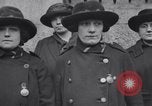
Women join ranks of police reserves in New York City, during World War I.
Closeup of women in the New York City Police reserve, during World War 1. They stand outside the 23rd Police Precinct ("Tenderloin") Station House on West 30th Street, Manhattan, New York City. Their uniforms include round-brimmed hats and overcoats, and they have round badges topped with eagles, pinned to their coats. Next, about 15 are seen, walking two abreast. All wear white gloves and badges, but otherwise, their uniforms are not identical. One supervisor woman walks beside the group, wearing a slightly different badge. Walking casually, a short distance behind the group is a woman (probably Mary Noonan) in the uniform of a captain (with "railroad tracks" insignia on her collar). Scene shifts to a street filled with a traffic mix of horse-drawn and motor vehicles, all staying fairly clear of trolley tracks visible in the center of the road. A police reserve woman stands in the center of the street, directing traffic. Next, a large group of school children is seen standing on a street corner, accompanied by a woman police officer. They begin to cross the street under the watchful eye of another woman reserve police officer, directing traffic in the street. Some adults cross behind the children. (Note: On May 9, 1918, the New York City Police Department announced formation of a new Police Reserve, that would include a women's contingent. This was the idea of Special Deputy Commissioner Rodman Wanamaker, who reasoned, since New York women had received the vote, on November 6th 1917, they should have a role in enforcing the laws. Over 3,000 women were recruited. Their Captain was Mary Noonan. Their duties did not involve direct dealings with criminals. According to the New York Times of May 10, 1918, "If need arose for use of the nightstick or other instrument for curbing crime,the work would be referred to the men members of the force.")
Chemists experiment with chlorine gas for influenza immunizations at Chemical Warfare Service in the United States.
Experiments with chlorine gas for influenza immunizations in United States. A World War I tank sprays gas in a field. View of American soldiers during 1917 to 1918 period of World War I, in a trench, wearing gas masks, and firing rifles at enemy positions. Post war tests on use of Chlorine gas to control the flu (emerging from 1918 Spanish Flu epidemic), inspired by low rate of influenza among United States soldiers exposed to chlorine gas during the war. Man enters a chlorine chamber at the Chemical Warfare Service. A chart on the wall showing results on symptoms after exposure in chlorine chamber. A woman in 1920s hat carrying a tissue is treated with chlorine gas. A testing apparatus on a table. Group of patients sit together in a chlorine chamber being exposed to the chlorine gas. A business man in a suit receives a portable chlorine gas treatment in his office as he is too busy to visit the chlorine chamber.
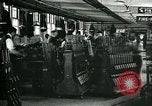
World War I United States arms factory
A U.S. arms manufacturing in World War 1. Hundreds of war production workers seen at shift change, waiting for their respective trolley cars passing on tracks between arms manufacturing plant's buildings. Women at work on metal working machines in an arms factory. Racks of Browning Automatic Rifles (Rifle, Caliber .30, Automatic, Browning, M1918) are being moved about. Assemblers are seen hand fitting parts for the Browning M1917 water cooled machine gun. One man makes final assembly adjustments to one of the machine guns set up on tripod in the factory. He enjoys firing the Browning M1917 machine gun. (Note:The M1917 and M1918 BAR were manufactured by numerous American arms makers. Colt, Remington, Marlin, Royal typewriter, Winchester. Most of the M1917 machine guns were manufactured by New England Westinghouse.)

British artillerymen fire 18 pounders and 8 inch howitzers, near Monchy-le-Preux, France, during World War I
British Army gunners fire 18 pounder field artillery pieces as they set up camp in a field near Monchy-le-Preux in France. Shells explode in field in front of them. A battery of hidden 18 pounders fires. A battery of 8 inch heavy howitzers in operation. Gun crew soldiers step back as a howitzer fires. They return to the gun after it has finished recoiling.
CRITICALPAST.COM: About Us | Contact Us | FAQs - How to Order | License Agreement | My Account | My Lightboxes | Shopping Cart | Advanced Search | Featured Collections | Website Terms & Conditions | Privacy Policy ©2026 CriticalPast LLC.
License Agreement |
Terms & Conditions |
Privacy Policy
©2026 CriticalPast LLC.