


 Francais
 Deutsch
 Italiano
Refine Your Search
Colombey-les-Belles France 1918 stock footage and images
- Showing 3907 to 3912 of 6521 results more
more Hide
Hide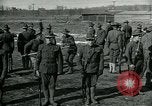
British and French soldiers share lessons learned, with U.S. soldiers training in France, during World War I.
A British officer, in uniform and another British soldier, in white sweatshirt, both wielding long wooden poles, engage U.S. soldiers, at random, in exercises for bayonet training. Numerous positions for firearms training are seen in background. Some snow seen on the ground. A long line of U.S. soldiers in kneeling position with their rifles. Their instructor stands in front of them as they dry fire their weapons. U.S. troops on a firing line in prone positions. Instructor behind them checks on individual soldiers. U.S. soldiers in a sandbagged position on training field. A French officer demonstrates correct way to throw a hand grenade, as the U.S. soldiers practice.
U.S. 7th Army and French FFI during the recapture of Metz, Strasbourg and Belfort in France during World War II.
U.S. 7th Army and French troops recapture French cities during World War 2. French troops parade in Metz. The troops march in formation through the city streets. U.S. Army Major General Walton H. Walker, who led the U.S. Army and the FFI (French Forces of the Interior) in the capture of the city from the Germans. General Walker with other officers walks out of a building. French soldiers stand in a formation during a ceremony in which the city is to be returned to the French. In the official ceremony, General Walker returns the city to French Lieutenant-General Andre-Marie-François Dody, acting for his country.The crowd cheers. The Generals walk away. Scene shifts to Strasbourg, where Provost Marshal McIntyre, of the U.S. 7th Army, accepts the surrender of Two German Battalions (5 thousand troops) from their commanding General. The surrendered German soldiers are lined up in the street. German officers waiting to get into trucks. In another sequence, a sign on a street in Belfort reads 'N.463 Montbeliard'. French 1st Army troops on tanks advance through the streets in Belfort. A sign showing the direction to Belfort Castle. French troops fire at the castle in Belfort. Soldiers behind a wall and an M-3 Stuart tank and an anti-tank gun fire from behind the Theatre Granit building at the Belfort Castle. Explosions occur at places in the castle. An underground tunnel of the Belfort Castle is inspected by a French General. Several officers walking with the General. The French flag hoisted on the castle. U.S.Major General Walker proceeding with officers over a bridge. The officers on a path on a hill. Aerial view of buildings.
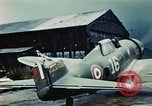
A French Air Force P-47 Thunderbolt aircraft with damaged tail on an airfield in France.
A French Air Force P-47D Thunderbolt aircraft on an airfield. Damaged tail of the aircraft. A pilot in the cockpit of the airplane. Aircraft taxis short distance with wrecked tail, as debris near a wrecked hangar blows about from the prop wash. French and American soldiers examine the wrecked tail of the aircraft. (World War II period).
German Chancellor Adolf Hitler and German officers inspect Krupp K5 railway guns and Atlantic coastal guns in France during World War II
Opening scene shows Adolf Hitler with an entourage of military officers walking from a tunnel beside two steam locomotives parked on a railroad track, during World War 2. The group continues between to large berms lining the area. They approach a construction project of concrete with lots of wooden framing in place around it. Scene shifts to a Krupp 283mm K5 railway gun on rails in the sand. A large earthen berm is seen behind the gun. Hitler converses with officers at the site. Next, a closeup shows the gun barrel being elevated. Hitler looks at another K5 gun with its barrel down. He then proceeds into a sand-bagged revetment leading to a doorway and underground tunnel. Next, he is seen emerging from the tunnel onto the courtyard of what appears to be a church. A large body of German soldiers is assembled there. They render the Nazi salute. Closeup of Hitler atop the area defenses, where coastal guns of the Atlantic Wall are installed in sand-bagged revetments. Views of gun crews firing these coastal guns out to sea, in a demonstration.
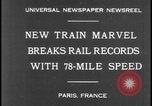
André Chapelon’s first locomotive rebuild for the Paris à Orléans (PO) railway in France on Paris à Orléans (PO) railway.
The Nord Pacific No 3566 locomotive as rebuilt by André Xavier Chapelon departs from a railroad train station in Paris along the Poiters-Angouleme route. Train's engineer, wearing goggles, looks through window as he operates train. View of exhaust as steam whistle is operated. Point of View shot toward back of train as it is underway. POV inside train, towards front of moving train as seen by train engineer. Speedometer indicates that train is running at 125 km/h, a bit higher than the French government speed limit of 75 mph (120 km/hr). Train passes by. Locomotive exhaust and whistle. This locomotive featured Chapelon's first major invention, the Kylchap exhaust, which was created with Finnish engineer Kyösti Kylälä, and produced less back pressure than previous designs. This modified prototype Pacific #3566 was originally 2000 indicated horsepower (IHP) but improved to a 3000 IHP with both fuel and water consumption reduced by 25% as a result of the rebuild process. Footage is from 1931, but first tests of this locomotive took place in November 1929.
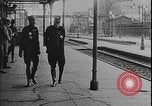
French Commander-in-Chief Marshal Joseph Joffre and Lord Kitchener inspect the frontline in France during WW1
French Commander-in-Chief, Marshal Joseph Joffre, waits at train station platform for the arrival of Lord Herbert Kitchener, the British Field Marshal during World War 1. Lord Kitchener arrives at train station, possible Gare Compiègne. Marshal Joffre, Lord Kitchener, and retinue walk into a trench in a battle ground. Lord Kitchener and Marshal Joffre inspect the frontline using binoculars under a trench. Lord Kitchener and Marshal Joffre walking together in frontline field. British soldiers fire mortar rounds in a snowy trench before Christmas. British soldiers exit a snow-covered tunnel, walk through snowy trenches. Artillery fires in winter battlefield. British soldiers, with pith hats, charges out of snow-covered trench moments before a support beam collapses. Artillery cannon fires in the snow. Explosions from artillery fire throw soil into the air in winter battleground covered with snow. British soldiers charging on snow covered battlefield.
CRITICALPAST.COM: About Us | Contact Us | FAQs - How to Order | License Agreement | My Account | My Lightboxes | Shopping Cart | Advanced Search | Featured Collections | Website Terms & Conditions | Privacy Policy ©2026 CriticalPast LLC.
License Agreement |
Terms & Conditions |
Privacy Policy
©2026 CriticalPast LLC.