


 Francais
 Deutsch
 Italiano

Refine Your Search
Colombey-les-Belles France 1918 stock footage and images
- Showing 421 to 426 of 6533 results more
 Hide
Color Sound

Electric operations at the Hoosac Tunnel, Massachusetts. in the United States.
A film concerning railroad electrification in the United States. A westbound Boston and Maine Railroad steam train at East Portal, Hoosac Tunnel, where the railroad was electrified in 1911. An electric locomotive approaches the steam engine. ( Note the carbide headlamp on the electric locomotive--which were outlawed by the ICC circa 1918. ) The motor pulls the steam engine and its train West. Next: a 'cab ride' from North Adams, Massachusetts to West Portal and subsequently exits the East Portal of the 4.75 mile long Hoosac Tunnel.

Warships returning to America after World War I, participate in Naval Fleet Review in New York City
U.S. Navy Fleet Review on Christmas Day, 1918, in New York City harbor. View from stern of a ship flying large American flag. Behind it are several other vessels, including a small ship flying the American flag. The wind is strong causing the flags to stand out sharply. Barrage balloons are seen in the sky overhead. The battleship USS Nevada (BB-36) passes nearby, with the ship's company lining her deck in formation around her railings. Sailors loading a deck gun to fire salutes from the camera ship, as a ferry boat passes in the background. A transport ship in camouflage is in far background. Army and Navy officers aboard the camera ship salute colors on passing ship (unseen). A Florida class battleship passing nearby with her company assembled on deck. A New York class battleship passing in review. Sailor firing deck gun in salute from camera ship. Another New York Class battleship passing in review. U.S. Secretary of the Navy Josephus Daniels, and Secretary of War, Newton Baker, both in top hats, standing on deck of camera ship. The Statue of Liberty on Bedloes Island, in New York Harbor. The USS Texas (BB-35) passing in review, with a Camel Sopwith airplane on a launch platform installed atop her gun turret number 2. More battleships making way in trail formation. Aerial view from low altitude of the USS Arizona (BB-39).
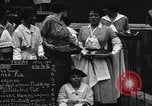
Women run a food kitchen in Britain, during World War I
A Group of women pose, holding trays and dishes, next to a slate chalk board, containing a menu and pricing for food items on Friday, May 17th, 1918. The items are priced in British pennies. In a change of scene, women customers are seen leaving the building with food purchases.(one has a small dog on a leash.) Several stand and chat while they sip cups of tea. Back inside the building, three women smile as they hold food and empty dishes.

U.S. President Woodrow Wilson aboard the United States ship George Washington heading for Europe after World War 1.
United States ship George Washington leaves the harbor in Hoboken, New Jersey. Men on a building at the port look on as the ship pulls away from the port. A sign on the building reads ' U.S. Army transport service '. Boats along the side the George Washington. A view of the harbor with boats and ships anchored. Smoke being emitted by the vessels and buildings in the background. President Woodrow Wilson talks to men aboard the ship as he heads to Europe on December 4th, 1918, for the Paris Peace Conference, following the armistice ending World War I.
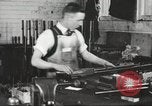
Workers assemble and check operation of Browning Automatic Rifles at Winchester Repeating Arms Company in World War I
Manufacture of M1918 Browning Automatic Rifles (BAR) at the Winchester Repeating Arms Company in New Haven Connecticut during World War 1. A worker assembles rifles on a bench. Another worker checks their operation by placing them into a mechanical holder and firing them. View of a black circular target showing grouping of hits during firing. View of the factory floor with movable racks containing rifles. Workers move the racks.
Bolshevik leader Lenin, Commander of the Red Army Leon Trotsky and Russian soldiers during the Civil War in Russia.
Scenes from the Russian Revolution and years immediately after in Russia, roughly 1918-1921. Troops moving in the snow. Vladimir Ilyich Lenin, the Bolshevik leader, makes peace with the Germans. The Civil War breaks out in Russia. White Russians continue war with World War 1 allies, against Germany. Czarist Cossacks seek to restore the monarchy of Nicholas II. Photograph of the Russian Czar and family sitting outdoors on the ledge of a wooden building. Secret police seen arresting people. Bolshevik firing squad executes three prisoners, who fall dead into a mass grave behind them. Lenin, holding a kitten in his hand, seated at a table. March 7, 1921: Workers and sailors gathered on the streets, in Kronstadt, demanding peace, freedom, and bread. Red Army Troops disperse the crowd, shooting many of them. Leon Trotsky, Commander of the Red Army, states that the slaughter was necessary. Trotsky seen walking with other officers. People on the sides of a path watching Trotsky. Families looking over dead workers and sailors in a field.
CRITICALPAST.COM: About Us | Contact Us | FAQs - How to Order | License Agreement | My Account | My Lightboxes | Shopping Cart | Advanced Search | Featured Collections | Website Terms & Conditions | Privacy Policy ©2026 CriticalPast LLC.
License Agreement |
Terms & Conditions |
Privacy Policy
©2026 CriticalPast LLC.