


 Francais
 Deutsch
 Italiano

Refine Your Search
Colombey-les-Belles France 1918 stock footage and images
- Showing 4465 to 4470 of 6533 results more
 Hide
Color Sound
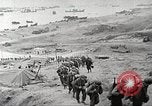
U.S. Army troop reinforcements arriving at Omaha Beachhead during World War II
U.S. Army troop reinforcements arriving at Omaha Beachhead and moving inland, during invasion of Normandy, France, in World War 2, in the days immediately following D-Day. (They are moving along a gradual rise overlooking the beach, that appears to be near Colleville Sur Mer, coordinates WN-62.) U.S. LST-281 discharging cargo of Army vehicles, including trucks and halftracks. A DUKW amphibious vehicle driving out of the surf. Sherman M4 tanks with deep wading kits; one named, "Goldie." Troops unload supplies from a beached Rhino Barge. More landing craft approaching the beach. Coast Guardsmen manning antiaircraft guns. Barrage balloons aloft. Antiaircraft guns firing, at night,from the beachhead, at German bombers, overhead.

Allied resupply operations at beachhead of Omaha Beach, are affected by bad weather, during Normandy invasion in World War II
Broad view of Allied beachhead, at Omaha Beach, in Normandy, France, during the invasion in World War 2. Numerous supply vessels, offshore, are making use of Mulberry A artificial harbor created from Phoenix caissons and sunken Gooseberry blockships. Vehicles driving ashore from a landing craft. A Coast Guard Officer looks from shore, through binoculars. In a later sequence, stormy seas are seen pounding Mulberry A Harbor. A sailor moves hand-over-hand, above a sunken section, by means of a line, to LCI(L) 492. After the storm, damaged ships are seen. An 83 ft. Coast Guard Cutter (rescue boat) number 20, is beached,along with landing craft , barges, and other vessels.
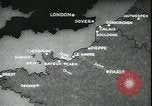
German forces fire at Allied vessels. Battle of Villers-Bocage in World War II
German soldiers in France during the Battle of Villers-Bocage of World War 2. A pictorial map showing cities along French coastline. A German soldier looking through binoculars. Allied ships at sea. German soldiers prepare artillery and fire. Smoke rising from explosions. German soldiers beside artillery. Smoke rising from Allied vessels at sea. Explosions on land and smoke rising. Two German soldiers talking. A wrecked landing craft at a beach. Debris of wreckage spread on the beach. A bomb wrecked U.S. LST (Landing Ship, Tank) on the beach and armored vehicles aboard the ship. Vehicles moving along a road. recked British Cromwell tanks and M3 Halftracks along the side of a road. A German soldier beside a damaged tank. Wide shot of a Stuart light tank. A damaged signboard which reads 'Villers Bocage'. Damaged buildings on the street of Villers-Bocage and a wrecked Tiger tank beside the buildings. Debris strewn on the ground and a damaged tank among the debris. A damaged tank with its front part into a building. A British helmet in the debris on a Cromwell tank. (Note: During this battle, On June 13th, 1944, German tank commander, Michael Wittmann, in a single Panzerkampfwagen VI Tiger tank reportedly destroyed up to 14 tanks and 15 personnel carriers along with 2 anti-tank guns. Many were of the British 22nd Armored Brigade of the 7th Armored Division, AKA the 'Desert Rats'.)

An AG-2 looks through the eye piece of a weather instrument and makes adjustments on the instrument aboard a ship in Normandy.
Invasion of Normandy, France during World War II. An AG-2 (Aerographer's Mate) comes out of a hatch with a balloon and goes onto the bridge of a ship. A man sending a semaphore in the background. The AG-2 brings the balloon upon the deck and attaches it to a 24" searchlight to hold it down. He then gets his tripod and sets it up. A Coast Guardsman brings out a weather instrument to take a sight on the balloon. Ships being tied in the background. The AG-2 puts the weather instrument on the tripod and looks through an eye piece. He turns the balloon loose. The balloon goes skyward. He looks through his sight and makes some adjustment. The AG-2 looks through the eye piece and make adjustments on the instrument.
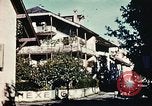
American flyers who escaped from Swiss internment during World War II
view of a building in Annecy, France, during World War 2. Flags of Britain, Soviet Union, United States, and Poland displayed together. A busy street with many bicyclists. A truck driving on a road carrying a group of American flyers who have escaped internment in Switzerland. The flyers, in civilian clothes, smile and wave at the camera from the back of the truck. Change of scene to front view of the truck arriving at Annecy airfield. some flyers are riding on the fenders and running boards of the truck. view of German prisoners of war clearing stones from a field near the airfield runway. A C-47 transport aircraft landing on the field, in background. The German POWs pose for the camera. Cyclists on a dirt road near the airfield, pause to watch a C-47 taking off. Children on bicycles wave to the camera. View again, of German prisoners clearing stones from the field. Local children looking to the sky for airplanes.

Aerial bombing by German forces of Dunkirk and the English Channel at the Battle of Dunkirk during WW2
A animated map showing the gradual German invasion of Flanders through the Ruhr Region during World War II. On the map, German forces reach northern France and encroaches Dunkirk in the Northern French coast, causing the Battle of Dunkirk. A Heinkel He 111 in flight. A German Luftwaffe soldier unloads bombs from the aircraft to bomb Dunkirk. More bombs fall from a Nazi Heinkel He 111 bomber to Dunkirk. Dunkirk in smoke from bombing. Stuka Junkers JU 87 fighters slightly angle downward to begin dive bombing. Aerial point of view (POV ) of Dunkirk from Stuka Junkers JU 87. German pilot pulling down the center stick, controlling the speed and prevent further descent. Pilot's face as he aims down to Dunkirk and unloads a bomb to the English Channel to attack warships and transport. Side view of flying Stuka Junkers JU 87. Ships sailing in the English Channel.
CRITICALPAST.COM: About Us | Contact Us | FAQs - How to Order | License Agreement | My Account | My Lightboxes | Shopping Cart | Advanced Search | Featured Collections | Website Terms & Conditions | Privacy Policy ©2026 CriticalPast LLC.
License Agreement |
Terms & Conditions |
Privacy Policy
©2026 CriticalPast LLC.