


 Francais
 Deutsch
 Italiano

Refine Your Search
Colombey-les-Belles France 1918 stock footage and images
- Showing 469 to 474 of 6533 results more
 Hide
Color Sound
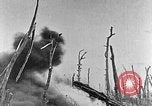
Extract from film "The Somme" depicts German troops in trench warfare against South African Brigade in Battle of the Somme, World War I.
Scenes from British feature film "The Somme" made in 1927, about the Battle of the Somme in World War 1. Part of it depicts events involving the South African Brigade in the battle. The extract opens with shells bursting all along No Man's Land among fragments of trees. Explosions and smoke everywhere. On July 18, 1916, Nine German Battalions deploy to drive the South African Brigade from the Delville Wood. Several soldiers of the Brigade seen entrenched in a sand-bagged position as a German shell explodes only yards from them. German soldiers advance through the broken trees and brush, while under fire by British gunners using Vickers machine guns. Some German soldiers falling and others seeking cover in abandoned trench. A line of South African troops firing their rifles from a trench, as several German soldiers reach them and are shot dead just feet away. A British soldier is shot while climbing out of a trench containing several fallen comrades. Other British (or South African) troops scrambling to find a safer place. One crawling across the ground. A British gunner firing a Lewis gun. German troops starting to go over-the-top, from their trench. British soldiers advancing. German gunner firing Maxim gun from fortified position, as shells burst in the distant background. A horizontal line of British troops advancing toward the German position. Some are cut down by the machine gun fire. German gunner firing a captured British Vickers machine gun. British soldiers hunkered down in a deep shell hole behind a ridge. They use their trenching tools to dig in deeper. Several German shells burst in the air. Two British soldiers watch as a tank approaches through the smoke. Large numbers of British troops attack downhill through smoke and haze. German soldiers preparing to defend an occupied structure, as more British troops charge forward. Post-battle view of the area, with fallen soldiers marked by rifles stuck in the ground with helmets on them. (Note: The tanks shown in this film are models Mark V which did not enter service until 1918.)
Emperor Hirohito watches maneuvers performed by soldiers in Japan.
Conditions in Japan in 1927-1928. An animated map of the Pacific Ocean depicts the growth of Japanese military might since 1894. The map depicts areas under Japanese empire in 1894, the Chinese Japanese War of 1894-1895, the Russian Japanese War Of 1904-1905 (Russo-Japanese War), the territory under Japanese influence and World War I from 1914-1918. Officers watch as Japanese soldiers march. Japanese cavalry units. Soldiers run forward. Japanese Emperor Hirohito looks at the maneuvers at the Imperial Japanese Military Academy in Tokyo. He salutes standing at a dais. The soldiers parade. A naval smoke screen is laid to shield the army at a river crossing. The Emperor looks on as soldiers in a barge land at a shore. Two vessels in a water body. Japanese sailors march. Emperor Hirohito in conversation with military officials. From the deck of his flagship 'Katori', he watches as naval guns are fired.

Governor of Puerto Rico Horace M Towner, Colonel George H. Estes, and other officials welcome Charles Lindbergh in San Juan.
Aviator Charles Lindbergh visits San Juan, Puerto Rico. A huge crowd awaits his arrival at an air field. Lindbergh's plane 'Spirit of Saint Louis' lands and taxis. Men move towards the plane as it comes to a halt. Closeup of the 'Spirit of Saint Louis'. Several officials stand near the airplane as Lindbergh prepares to leave the cockpit. Among them is George H. Estes, Jr., Commander of U.S. Troops in Puerto Rico. ( He held rank of Brigadier General, in 1918, but now wears peacetime rank insignia of Colonel.) Others greeting Lindbergh include Puerto Rican government officials and civilians, who watch as Lindbergh climbs out of the cockpit. Lindbergh poses with Governor of Puerto Rico, Horace M Towner, and other officials.
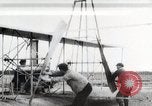
First joint flight by Wright Brothers in 1910 near Dayton Ohio. Also scenes from other "firsts" in early aviation history up until 1919.
Wright brothers' first aircraft flight together near Dayton Ohio in 1910. Wilbur Wright is in the pilot's seat with Orville Wright as passenger to his right. (Until this flight, the Wrights had never flown together so that if one of them was killed, the other could continue their work.) Next, a view of Alberto Santos-Dumont, and the first European flight made by him on 13 September 1909. Following segment shows crowds gathered at Washington DC Polo field as truck arrives carrying mail to be loaded on the first U.S. Air mail flight, May 15, 1918. Army pilot, Lieutenant Webb, in his JN-4H airplane, on Southbound flight from New York, takes off from Philadelphia, where he stopped to pick up more mail. He flies over the Washington Polo Field upon arrival. We see his airplane being unloaded as he jumps down from cockpit and crowds watch. Views of first transatlantic flight begins with takeoff of three out of four existing United States Navy Curtiss flying boat aircraft from Newfoundland, on May 16, 1919. Curtiss flying boats NC-1, NC-3, NC-4 are seen at takeoff from Newfoundland on first leg of the transatlantic journey. Flying Boat NC-4 is also seen at one of its foreign ports, though which is unclear (Azores, Lisbon, or England).
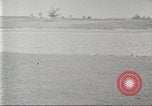
Walter Hagen demonstrates golf techniques and plays golf with two other men at a golf course in Michigan.
Walter Hagen and two other players demonstrate and play golf in the United States. Walter Hagen demonstrates several different shots from varying terrain. Water in the background. Ball roles into the hole and Hagen takes it out. Hagen hits the ball from a sand bunker. Hagen is joined by two other players and the golfers tee off. The course is likely Oakland Hills Country Club, where Walter Hagen was the first club professional beginning in 1918.
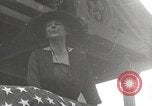
Jeannette Rankin, first woman elected to U.S. Congress, speaks in Union Square, New York City
Jeannette Rankin, of Montana, the first woman elected to U.S. House of Representatives (served April 1917 through December 1918). A pacifist, co-founder of the American Civil Liberties Union, and champion of humanitarian causes, she is seen addressing a group from a speakers pavilion in Union Square, Manhattan, New York City, in September, 1924. She accepts a glass of water from an associate (unseen). Closeups of Rankin leaning over the railing above an American flag, as she speaks to assembled group of men and women. From further away, several men and women associates can be seen at work behind her in the pavilion. Views from behind and to her right, with listeners below and cars parked in the square. Street scene in background. As before, Ms Rankin leans forward to be better heard. (There is no evidence of microphone in use.)
CRITICALPAST.COM: About Us | Contact Us | FAQs - How to Order | License Agreement | My Account | My Lightboxes | Shopping Cart | Advanced Search | Featured Collections | Website Terms & Conditions | Privacy Policy ©2026 CriticalPast LLC.
License Agreement |
Terms & Conditions |
Privacy Policy
©2026 CriticalPast LLC.