


 Francais
 Deutsch
 Italiano
Refine Your Search
Colombey-les-Belles France 1918 stock footage and images
- Showing 5371 to 5376 of 6520 results more
more Hide
Hide
United States troops advance in an open field and practice procedures for mustard gas attack in World War 1
A United States Army training film about defense against chemical warfare. United States troops train in the United States during World War 1 and simulate falling prey to German enemy gas shells. An explosion on the ground with smoke surrounding the area. U.S. soldiers fire rifles. The enemy fires mustard gas shells. The troops advance on a field in formation. A soldier passes through gassed underbrush and is affected by the poisonous gas. A topographic map is marked with the words "GAS" where the gas is present.
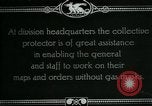
U.S. soldiers at Division Headquarters and in the field train for defense, disposal, and clean up of chemical warfare agents
A United States Army training film about defense against chemical warfare during World War I. The "Collective Protector" enables a general and the staff to work on their maps and orders without gas masks at the Division Headquarters. Two soldiers outside the headquarters wearing gas masks. They guard a low entrance doorway and enclosed tunnel with a heavy, flexible door designed to keep out gas. A soldier lifts the flap of the door and enters. Officers converse with each other while looking at a map on a wall. Soldier stands by rotating a handle on a device continuously. It has a long wide pipe connected to it, perhaps managing fresh air intake or air exchange. U.S. soldiers wearing gas masks load ammunition onto trucks. "Enemy" aircraft flies overhead throwing a cloud of poisonous gas that quickly envelops the area. A soldier wearing a gas mask fires his rifle into the air at the aircraft, through the heavy smoke screen. Gas sentries neutralize the gas around a dump. They dig in the ground with pick axes and mattocks, and then spread a white powder over the area. They then cover the area with a thin layer of the dirt they had dug up.
U.S. troops training film: Some soldiers suffer enemy gas attack while those not affected rest at Division Headquarters
A United States Army training film about defense against chemical warfare in World War I. Dramatization of a division chemical officer going over chemical warfare situation with the chemical officer from a new division. The officers seated inside a tent exchange notes. Gas casualties are taken out of ambulances. Disciplined soldiers return to rest areas at the Division Headquarters. A soldier removes his mask and goes to sleep.
United States soldiers create a smokescreen using Stokes Mortars during a training operation in the United States
A United States Army training film about chemical warfare service. United States soldiers in World War 1 fire Stokes Mortars after assembling them. Soldiers in arms-length line pass readied mortars forward and fire them in rapid succession. Explosions in the distance with smoke spreading and overcoming the area in smokescreen. (World War I; World War 1; WWI; WW1)
King of Romania Ferdinand I, King Alexander I of Greece and Herbert Hoover in Europe during World War I, also surrender of Jerusalem.
United States Food Administrator Herbert Hoover in Belgium. Herbert Hoover drinks tea and converses with officials. In Brussels, Belgium, Cardinal Désiré-Joseph Mercier is seen in conversation with a man standing beside a street. Next scene shows King of Romania Ferdinand I on horseback as he reviews his last brigade. Queen Marie of Romania stands with her daughter, Princess Ileana, during a ceremony. King Alexander I of Greece reviews his army before he sends them to battle against Bulgaria. Prince Arthur, the Duke of Connaught and Strathearn and head of the British mission to Salonika is seen greeting King Alexander I. Greek Patriarch is also present. A ceremony of the surrender of Jerusalem in Palestine to the British under General Allenby. Last scene is from a ceremony of recognition in which Chaim Weizmann presented a Jewish scroll to Allenby (Weizmann seen on Allenby's right before the dignitaries are seated).
Allies prepare for final offensive in World War 1. Views of key commanders and leaders on all sides.
Generals of united Allies Armies prepare the final offensive against Kaiser Wilhelm II in Europe during World War 1. Marshal Ferdinand Foch, British Field Marshal Douglas Haig, French General Philippe Petain, United States Army General John Pershing and Italian Commander General Diaz gather in discussion. Closeup of Marshall Ferdinand Foch. Marshall Joseph Joffre talking to U.S. Army General Pershing. King Victor Emmanuel and General Diaz reviewing troops. Field Marshal Haig posing with a group of Generals. Marshal Ferdinand Foch and Marshal Philippe Pétain together. Georges Clemenceau greeting French officers. U.S. Secretary of War, Newton D. Baker, passes by a line of French soldiers and is seen using binoculars in the field. American General Bliss (Tasker Howard Bliss), U.S. representative on the Supreme War Council, speaking to a woman as other officers stand by. Closeup view of U.S. Army General Robert Bullard, Commander of the First American Army. General John Lejeune, Commander of U.S. Marines, speaking to a group. Kaiser Wilhelm II with his heir, Crown Prince Wilhelm of Prussia, in front of a building as the Kaiser speaks to a German officer. German Field Marshal Paul von Hindenburg with General Erich Ludendorff. German military band leads large column of German soldiers marching on a road. Long line of German soldiers walking up a turning road. British soldiers improving roads and transporting supplies. British soldiers and cavalry riding on horseback. Long line of British soldiers marching through trench and through a bombed out building. British soldiers marching on road. Allies, British and French forces on the move. U.S. General Pershing addressing a huge crowd of soldiers in an open field area. Lines of American soldiers marching. Colonel Teddy Roosevelt watches as U.S. Army soldiers advance. Italian Army soldiers marching and ascending a hill. Huge artillery piece being towed on a road.
CRITICALPAST.COM: About Us | Contact Us | FAQs - How to Order | License Agreement | My Account | My Lightboxes | Shopping Cart | Advanced Search | Featured Collections | Website Terms & Conditions | Privacy Policy ©2026 CriticalPast LLC.
License Agreement |
Terms & Conditions |
Privacy Policy
©2026 CriticalPast LLC.