


 Francais
 Deutsch
 Italiano
Refine Your Search
Colombey-les-Belles France 1918 stock footage and images
- Showing 5695 to 5700 of 6520 results more
more Hide
Hide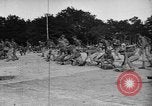
U.S. Marines in prone positions holding guns and practice the use of weapons in the United States during World War I.
U.S. Marines practice with Lewis machine guns during World War I. U.S. marine three-man machine gun teams set up Lewis machine guns and fire them during training at Key West, Florida, in World War 1. Teams set up in prone positions, with gunner ready to fire. Second man fastens circular ammunition magazine atop the gun and third man stays low behind. The guns are on a bipods, and equipped with large cooling shields around their barrels. The gunners fire one magazine, replace it, and fire again.
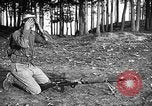
A U.S. Marine machine gunner demonstrates weapon familiarity by field stripping his weapon, blindfolded, in World War I
A U.S. Marine demonstrates his weapon familiarity by taking a blindfold test. The blindfolded marine kneels on the ground next to his Lewis machine gun. The gun is set on the ground in front of him on a bipod support. He reaches and removes the cylindrical magazine from the gun. Then he removes the stock and proceeds to field strip the weapon down to the smallest parts, entirely by feel. He leans back and removes his blindfold, when done, and stands up.
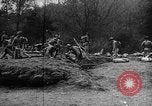
U.S. Marines practice trench warfare techniques during their training in World War I
U.S. Marines occupy trenches at their training facility in World War 1. Once positioned in them, they climb from the trenches, in squads, and charge forward. They are followed by a second wave of squads. Some marines are seen down in a dugout of the trench. Another scene shows more squads of marines going over the top of deep trenches, in successive waves. They climb rustic ladders to get out of these deep trenches.
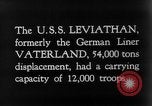
U.S. Navy troop transport operations in New York and New Jersey in World War I
The SS Leviathan, the largest ocean liner afloat, (former German ocean liner Vaterland, seized and renamed by the U.S. Government in 1917, as America entered World War 1). Tug boats assist the three-stacker Leviathan as she enters New York harbor. Tug boats working with another troop ship (two-stacker) in the harbor. Ferry boat in background. A sleek troop transport ship with two slanted stacks and rakish lines, accentuated by camouflage, in a New Jersey harbor.Two Navy troop ships underway with an airplane flying overhead. A column of U.S. Navy troop transport ships underway in the Atlantic ocean. A barrage balloon is seen overhead.
U.S. Army training film on poisonous gas, flamethrowers, gas cylinders and gas artillery shells used by Germany in World War I.
A training film titled 'Gas and Gas Mask' shows how lethal gas is disseminated from gas cylinders and artillery shells in Europe by Germany during World War 1. German soldiers wearing gas masks move out from a trench through a screen of smoke or gas.The soldiers in prone positions advance through poisonous gas smoke and carry square shields. American forces demonstrate use of liquid fire (flame thrower) like that used by German troops to spray liquid fire in the trenches. Condensed gas in a cylinder. The cylinder lying on the ground in a horizontal position. A U.S. Army soldier wearing a gas mask opens the knob of the cylinder. The gas comes out. A gas cloud is formed and moves in the direction of the wind. A soldier holds a German gas shell. A large number of gas shells are exploded. A U.S. soldier demonstrates two different forms of gas masks. The first is a basic scarf which holds a small pad of cotton soaked in soda solution. He puts on the scarf mask. Next he puts on a more advanced "Gas helmet" (early gas mask).
A U.S. soldier demonstrates how to carry a mask and wear the mask in an alert position during World War I.
A World War 1 training film shows how to carry and don a gas mask. A U.S. soldier stands at attention. He carries a mask in a satchel. The satchel is slung over the shoulder of a soldier. He shows the satchel. He turns. The soldier demonstrates the way to carry the satchel in trenches. The satchel is slung around his neck. He opens the satchel, takes out a string and ties it around. He opens the satchel and takes out the mask . He puts his chin forward and wears it.
CRITICALPAST.COM: About Us | Contact Us | FAQs - How to Order | License Agreement | My Account | My Lightboxes | Shopping Cart | Advanced Search | Featured Collections | Website Terms & Conditions | Privacy Policy ©2026 CriticalPast LLC.
License Agreement |
Terms & Conditions |
Privacy Policy
©2026 CriticalPast LLC.