


 Francais
 Deutsch
 Italiano
Refine Your Search
Coney Island New York 1898 stock footage and images
- Showing 6721 to 6726 of 11259 results more
more Hide
Hide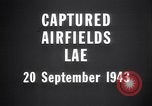
Destruction from Allied bombing at Lae airfield, New Guinea. B-25s fly bombing missions against Japanese targets in Wewak area.
Opening slate gives date as September 20, 1943. Scenes show devastation wrought by Allied bombing of the Japanese airfield at Lae, New Guinea. Most views are from the ground, as Allies occupy the field. Numerous Japanese aircraft are destroyed along with all the buildings and facilities. Next, is shown the view from inside a B-25 bomber, on September 27, 1943, as it flies in a 100 aircraft bombing mission to attack coastal facilities, ships, and airfields in the Wewak area, including the main air base at Wewak and its satellite fields at Boram, Dagua and But. Several B-25s are seen ahead in formation. View of the coastal area below as the camera plane (B-25) comes under fire by Japanese anti-aircraft guns. A pall of smoke hangs over the Wewak area from bombing by B-24s earlier. view from cockpit as the B-25 makes very low strafing and bombing attack against the Japanese satellite airbase at Boram. Another B-25 seen as it flies close to the ground. View to the rear shows small parachutes being released by the B-25, carrying single 100-lb fragmentation bombs and 23-pounders in clusters of three. The fragmentation bombs explode amongst palm trees sheltering Japanese aircraft. view out the back of the camera B-25 shows it continuing to fly, just over the tree tops, at very low altitude. Next, several B-25s are seen rejoined up in formation, ahead. Scene shifts to view from high altitude of bombs striking in the Wewak waterfront area. View from below of three B-25s in formation. Then view from cockpit of a B-25 flying low over the water strafing a ship. (Narrator says they dive low to skip-bomb a ship trying to escape.) Various views of the high hills at the waterfront. View from B-25 strafing Japanese aircraft on the ground at Dagua and Boram airfields. several B-25s in formation headed home. (World War II period).
1st Cavalry Division of the United States military in New Guinea.
Reconstruction of an airstrip. A plane lands on the airstrip.1st Cavalry Division moves to Manus. A unit of 1st Marine Division moves from Gloucester to Talasea which is only 160 miles from Rabaul. Japanese 17th Army surrenders. Animated map shows 163rd and the 127th Infantry to land at Tadji Airstrip. The 24th and 41st division to land in Hollandia to capture three airstrips Hollandia, Sentani and Cyclops. Admiral Nimitz and General MacArthur study maps. The 5th Air Force planes drop bombs on Hollandia. A Japanese convoy is strafed and bombed. Wrecked Japanese planes. Australian infantry advances through New Guinea jungles. Soldiers addressed and explained the importance of team work. 1st Cavalry troops briefed. A General addresses the soldiers through a microphone. (World War II period).

U.S. transport airplanes drop supplies and the New Guinea natives carry wounded to the field hospitals during the World War II.
Allied Forces fight the Japanese in the South Pacific during World War II. U.S. transport airplanes bring supplies for the American and the Australian soldiers in New Guinea. The natives look up as the planes fly. The planes swoop and drop supplies. The Allied soldiers pick up the supplies from the mountainside. The troops clean their rifles. The Australian troops on offensive against the Japanese. The troops return back to the outposts. The natives carry wounded soldiers to the field hospitals. Soldiers tend to the wounded. A soldier lights a cigarette for another who is on a stretcher. A soldier with his arm in a sling. The Australian soldiers walk through ankle deep mud.
British Royal Couple visit the Ruakari and Aranui caves in New Zealand
Queen Elizabeth II and Prince Philip visit the Ruakari and Aranui caves in New Zealand. The couple enters the cave and moves down a staircase. Limestone formations such as stalactites are seen hanging from the roof of the cave.

Allied paratroopers jump in Markham Valley, New Guinea.
General Douglas MacArthur speaks to Allied paratroopers before their landing in Markham Valley, New Guinea. Paratroopers briefed with the help of a map. Paratroopers look at Tommy guns and other weapons. Equipment loaded onto a truck. Paratroopers loaded onto a military truck move to the airbase. Planes lined up at the base. Men put on their combat gear and board the aircraft. Aircraft in flight. Paratroopers jump and descend at Markham Valley. Planes in flight as parachutes descend during the first mass parachute jump in Southwestern Pacific. (World War II period).
United States soldiers land at New Guinea beach to invade Japanese positions in Los Negros during World War II.
The American campaign against the Japanese in the South West Pacific during World War II. United States troops loaded in landing crafts as they head towards New Guinea beach. The landing crafts hit the beach and the soldiers unload from the crafts and land. A number of landing crafts head towards the beach. The crafts at the beach as the soldiers land.
CRITICALPAST.COM: About Us | Contact Us | FAQs - How to Order | License Agreement | My Account | My Lightboxes | Shopping Cart | Advanced Search | Featured Collections | Website Terms & Conditions | Privacy Policy ©2026 CriticalPast LLC.
License Agreement |
Terms & Conditions |
Privacy Policy
©2026 CriticalPast LLC.