


 Francais
 Deutsch
 Italiano
Refine Your Search
Coney Island New York 1898 stock footage and images
- Showing 7633 to 7638 of 11259 results more
more Hide
Hide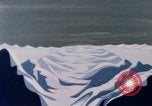
Scientists implement various methods for searching of new oil fields in United States.
Animation shows the process of formation of crude oil inside the earth's crust. Migration of oil toward underground reservoirs inside sedimentary and porous rocks. Geologists and scientists conduct surveys for possible oil fields. Soil samples being collected for oil-search. Helicopters and marsh buggies provide reconnaissance for search of new oil fields. Scientists use gravity meters, magnetometers and seismographs for searching new oil fields. Geo-forms being lowered in water for oil discovery.
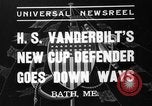
Harold S. Vanderbilt launches a new J-Class yacht to defend the America's Cup in races.
A new J-Class yacht ready to go down the ways at Bath Iron Works shipyard in Bath, Maine. On her stern are the words: "Ranger, Newport." (She will be the last J-Class yacht to defend the America's Cup in races.) Shipyard workers begin removing stays from the Ranger's hull. Owner, Harold Stirling Vanderbilt, descends ladder from cockpit of the yacht. Vanderbilt's wife, Gertrude "Gertie" Vanderbilt, stands beside the new yacht, holding a bouquet of flowers. From below, she strikes a bottle of champagne on the bow of the Ranger, to christen her. The yacht Ranger goes quickly down the ways into the water. Using a derrick, shipyard workers lower the Ranger's 154 foot mast into place, as Harold Vanderbilt watches.
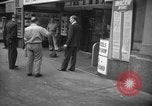
Latest news reports about the war posted for the public to read during World War II
Men in a U.S. city, stand around near bulletin boards posting the latest war news during World War 2. A bridge behind them has wording on it reading: "The Information and War Activities Center." Closeup of a civilian and a U.S. Navy sailor reading Invasion News dispatches posted on the board. Closeups of the dispatches (out of focus). Closeup from behind of many men stopping to read the latest postings. Closeup of "flash" dispatches (out of focus).
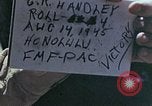
People celebrate VJ Day as a boy sells newspapers carrying news bout the end of World War II.
Celebration of 'Victory over Japan' (VJ) day in Honolulu, Hawaii. Crowd of service men and civilians gathered for the celebration. Crowd celebrates on the street. USO building in view. People stand on the roof top of a building. Sailors on the street. News boy sells papers consisting of the VJ Day peace news.
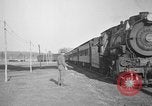
New Civilian Conservation Corps recruits are processed at Army center, receiving personal gear and billet assignments
New Civilian Conservation Corps (CCC) recruits arrive at Army processing center in the Great Depression. CCC recruits arrive by train and bus. A soldier passes out information sheets to the new recruits. Another soldier leads them to an administrative tent where they are interviewed and processed by Army clerks. The recruits are assigned to various tents, and they receive duffel bags and mess gear.
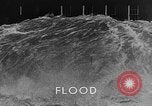
New bridge built in Petersburg and flood walls rebuilt by Work Progress Administration.
A raging flood in 1936 in West Virginia. Flood waters seen moving swiftly. WPA Workers during the Great Depression are seen building a new bridge at Petersburg West Virginia, spanning the South Branch of the Potomac River. Car crosses the bridge. New flood walls and dikes built by the WPA are shown, created to prevent recurrence of losses in future floods.
CRITICALPAST.COM: About Us | Contact Us | FAQs - How to Order | License Agreement | My Account | My Lightboxes | Shopping Cart | Advanced Search | Featured Collections | Website Terms & Conditions | Privacy Policy ©2026 CriticalPast LLC.
License Agreement |
Terms & Conditions |
Privacy Policy
©2026 CriticalPast LLC.