


 Francais
 Deutsch
 Italiano
Refine Your Search
Coney Island New York 1898 stock footage and images
- Showing 8365 to 8370 of 11259 results more
more Hide
Hide
Interview of British bride after reuniting with her American serviceman husband after the end of WW2
An American serviceman and his British wife look at their crying daughter on the right reuniting after World War II. Husbands and wives with their babies posing happily together. A British woman, part of the War Brides who arrived on the SS Argentina to reunite with their American servicemen husbands, is in a podium with her American serviceman husband, who is holding their baby. The British woman speaks about some societal disapproval of foreign marriages like hers and said, “Love is love, all over the world”. Reflecting the postwar ethos, the American serviceman adds, “This is a beginning of a new life for me”.
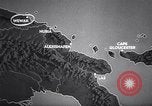
USAAF B-24 Liberator bombers drop 1000 lb demolition bombs over Nubia in World War II.
1943: An animated map depicts the strategic Japanese air and shipping base at Nubia in Papua New Guinea, during World War Two. 25 August 1943, Nubia: USAAF 5th Air Force B-24 Liberator bombers drop 1000 lb demolition bombs, from 16,000 feet, over Nubia. They target bivouac and supply areas. That afternoon, U.S. B-25s, flying low to the ground, make strafing attacks against the Japanese airfield at Nubia. United States soldiers unload jeeps, bulldozers, scrapers and other construction equipment in an abandoned Japanese airfield at Nadzab. U.S. 5th AAF constructing their air base. USAAF C-47s bring Australian infantrymen to the new base.

Early Bell Laboratory technology in computer art and computer animation for communication, advertising, motion pictures.
Computer screen showing animation of a silhouette of a man running. Narrator states that the first such image was generated at Bell Telephone Laboratories in New Jersey in the early 1960s. More views of the so called "Olympic Runner" graphic design generated by the Bell Laboratories newest digital computer. Colors like pink, blue and red are used in the early, historic computer art and animation technology. Men seated in a control room, interacting with the digital computer and other animation and recording hardware. Views of computer monitor screens and discussion by narrator about various visual forms created by computers. Various computer generated images are shown on the screen. Engineer stands in front of video tape machine where the images are being recorded. More computer and animation hardware is shown including an Animation Aid. Narrator describes process of photographing analog computer art work onto motion picture film and then enhancing it with color choices. Engineer is seen operating camera, and then a close up view of motion picture film running on machines and on reels. Animation and color consultant in discussion as they stand over some frames of the film that they have isolated. Sample work of early computer artists is shown, with moving animated art seen on screen, combining color and motion in new ways that were not possible before the digital computer. Another view of the video tape machine operating. Narrator discusses use of the computer also in development of computer generated music that accompanies the visual images. Animated clock is seen. Different kinds of animations are seen.
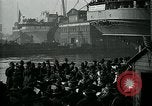
USS George Washington with President Woodrow Wilson and party on board departs for Paris Peace Conference
Following the armistice of World War I, President Woodrow Wilson and his party depart Hoboken New Jersey bound for the Paris Peace Conference. Band on a transport pier near building marked "Pier 5 U.S. Army Transport Service" at Hoboken, New Jersey port. Converted liner USS George Washington seen with sailors and dignitaries aboard, leaving port. Sign "Naval Transport George Washington" seen briefly on the ship. People stand on ship and on shore waving. A tugboat at the port with many people aboard bidding farewell to the President and his party. Steam rises from stack of USS George Washington. President Woodrow Wilson stands on the ship talking to others. USS George Washington underway in the harbor.
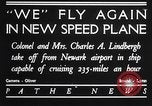
Colonel Charles A. Lindbergh and Mrs. Anne (Morrow) Lindbergh take a flight in a Lockheed 8A Sirius (Altair) airplane
Spectators watch as Charles A. Lindbergh and his wife, Anne Morrow Lindbergh, arrive by car at the Newark, New Jersey airport, where they are to try out a new Lockheed Model 8A Sirius ( Altair ) airplane, the first model equipped with retractable landing gear. Mrs.Lindbergh climbs into the rear cockpit and closes her canopy. Colonel Lindbergh converses with a Lockheed official as he climbs into the front cockpit. The aircraft taxis out and takes off. (Note: This is not the Lindberghs' airplane. This aircraft displays "NR-119-W" on its tail. It was actually purchased by the U.S. Army Air Corps as USAAC Y1C-25, number 32-393, and was damaged beyond repair in a belly up landing accident at Wright Field, Ohio, in June, 1932.)
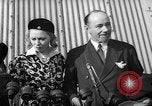
Sir Hubert and Lady Wilkins are interviewed upon arrival in the U.S. aboard the German Zeppelin Hindenburg
Australian explorer, Sir Hubert Wilkins, and his wife, Suzanne (Bennet) Wilkins, arriving at Lakehurst, New Jersey, aboard the Zeppelin Hindenburg (LZ-129). They are interviewed about their impressions. Sir Hubert talks about enjoying this trip just as much as they enjoyed travel on the "old Graf Zeppelin." But he notes the accommodations and comfort aboard the "New Hindenburg" were even better. Lady Wilkins also praised the Hindenburg airship. She tells about a storm that had no effect on the ship or passengers, noting that nobody suffered motion sickness. (Their remarks are repeated in successive takes.)
CRITICALPAST.COM: About Us | Contact Us | FAQs - How to Order | License Agreement | My Account | My Lightboxes | Shopping Cart | Advanced Search | Featured Collections | Website Terms & Conditions | Privacy Policy ©2026 CriticalPast LLC.
License Agreement |
Terms & Conditions |
Privacy Policy
©2026 CriticalPast LLC.