


 Francais
 Deutsch
 Italiano
Refine Your Search
Coney Island New York 1898 stock footage and images
- Showing 8515 to 8520 of 11259 results more
more Hide
Hide
A family of an auto worker in Detroit, Michigan.
Interior of a house, husband and wife flip through "New Homes" magazine. Man hands his wife a couple of twenty dollar bills which she places in bank deposit book. Man and woman come up, walk to door. Scenes in suburban neighborhood. Housewife hangs wash on line in backyard as neighbor comes to fence. Woman walks over to neighbor and talks. Man mowing grass with push mower, struggles with old mower. Neighbor brings him his new mower. Man and woman greet neighbors, group around a table in the living room, enjoying a game of playing cards. Man and his husband enter election headquarters. A young girl seated in a house, girl sobs over school books as her mother tries to comfort her. Father walks in, takes off coat, sits and helps daughter with school work. Woman enters "Andres Jackson Intermediate School" entrance. She walks along corridor, enters empty class room, goes over to teacher's desk, shakes hands with teacher.
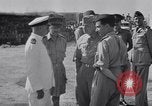
Allies force German forces almost completely out of Tunisia, North Africa, during World War II
Opens with General Dwight D. Eisenhower, Supreme Commander of Allied forces conferring with his deputy for land forces, British Field Marshal Harold Alexander, his deputy for sea forces, British Admiral Andrew Browne Cunningham, and his deputy for air operations, British air marshal Arthur William Tedder, during North African campaign in World War 2 . Map illustrates Allies military plans as analogous to internal combustion engine. General Eisenhower on an airfield consulting with his British Deputy commanders. B-17 bomber in background. Eisenhower salutes the British officers as he walks away. Lieutenant General Carl Spatz, Commander of the North West African Air Force, confers with British air marshal Tedder. Major General Jimmy Doolittle briefs airmen and smiles for camera. Strategic bombers with nose art names Pluto, Yankee Doodle, Jersey Jackass, Alice the Goon, and Fancy Pants. Picture of British Air Vice Marshal, Sir H.P. Lloyd, chief of Coastal air Force. A British Avro Anson aircraft flying air cover over a convoy of Allied ships. Diagram shows how all British and American fighter aircraft and attack bombers were placed under the command of British Air Marshal Cunningham, who is seen stepping from an airplane. British Field Marshal Harold Alexander in command of all ground forces is also seen stepping from an aircraft. Both are seen at a small camp trailer that they shared in the Tunisian mountains, where they work together, at a planning table. Marshal Cunningham is seen briefing air crews in mid March, 1943. B-24 Liberator bombers fly in formation and drop bombs on German Mareth fortifications in Tunis. German anti-aircraft guns create many black flak clouds among bomber formation. View from B-24 aircraft of the bombs exploding on the ground. British Field Marshal Harold Alexander is seen walking with a member of his staff across the sands. Diagram shows planned advance of the British 8th Army. Numerous British heavy guns fire nighttime barrages against the German positions, as British infantry advance during battle. They use scaling ladders and sappers detonate charges. Soldiers carry sticks to line trenches and set up defensive fortifications. Tanks advance. Heavy rain creates problems and some armor bogs down in mud. The next morning British troops are seen in their trenches as smoke drifts across the area. British soldiers moving cautiously under fire. German Field Marshal Rommel looks through binoculars. Additional German armored units entering the area. British gunners firing field artillery and mortars. Map illustrates how 2nd New Zealand Division under Lieutenant-General Bernard C. Freyberg, swings around behind the German line. Formation of British B-26 Marauder aircraft flying over desert. British Vickers Wellington bomber in flight. Bombardier in aircraft pressing a release button and bombs fall away creating huge explosions on ground. British mosquito bomber flying low. Bomb explodes on ground and Mosquito aircraft pulls up and away. Another Mosquito aircraft flying low on a strafing run. Tanks of 2nd New Zealand Division welcomed into El-Hamma, Tunisia, in the Battle of the Mareth line. View of South African army engineers using caterpillar tractor to build roads for Allied forces. Glimpse from rear of three British warships underway in the Mediterranean sea. Front view of a British Queen Elizabeth Class battleship underway. The battleship firing her 15-inch guns. U.S. P-38 fighter planes in formation. Glimpse of pilot in cockpit wearing leather helmet and earphones. Formation of German Junkers Ju-52 aircraft flying low over sea, carrying German troops to reinforce those in Tunisia. View of German soldiers inside the cabin of a Ju-52. Closeup of three Ju-52 transports flying very low over water. Several U.S. P-38 fighter planes attacking the transports. Pilot in one, pressing button to fire his guns. Scenes of aerial dogfight combat between U.S. Army Air Force aircraft and German Luftwaffe aircraft. Gun camera images of P-38s shooting down German transport planes. Map shows American, British, and French forces pressing Eastward against Germans. Views of battle and U.S. Lieutenant General George Patton at the front as his forces move forward during Battle of Guettar. American patrols of light tanks meet up with British patrols from their 8th Army on April 7. Views of the U.S. and British soldiers happy to meet one another and sharing cigarettes. Map shows Allied forces pushing the Germans further. Allied infantry walking into town of Enfilaville. Local families returning to their homes with all their belongings, in carts pulled by donkeys and other animals. In the town, encouraged by British troops, a group of Jewish boys remove Jewish star of David emblems from their jackets that had been used by occupying Germans to identify them as Jewish. British army doctors tending to local women and children.

International Labor Conference in Philadelphia; also Funeral of Secretary of Navy, Frank Knox (WW2)
International Labor Conference in Philadelphia during World War II. Exterior of Temple University. A sign reads 'International Labour Conference'. People go into the building. Delegates from 40 nations at the conference. Walter Nash, of New Zealand, the new president of the ILO (International Labor Organization), talks about post war labor problems. Interpreters translate for delegates wearing headphones over their ears. Chinese delegates present. Next portion of clips shows funeral of U.S. Secretary of Navy, Frank Knox on May 1, 1944. The funeral procession along Constitution Avenue, Washington DC. Flag-draped coffin rests on a caisson pulled by horses. Elements of all the three Branches of the military services parade behind the coffin, including women in the WAVES (Women Accepted for Volunteer Emergency Service) and WACs (Women's Army Corps). As the procession enters Arlington Cemetery, an honor guard of U.S. Navy admirals salute. Military pallbearers carry the casket to the burial site and an honor guard of sailors fire rifle salutes. Admiral Ernest King, Chief of Naval Operations, escorts widow, Mrs. Annie Reid Knox, from the scene.
U.S. Army's 'Round the World Flight in 1924, using Douglas World Cruiser aircraft
Documentary about the U.S. Army's flight around the world in 1924, employing four Douglas World Cruiser aircraft. A flag of United States. Crowds gather around around. the four Douglas World Cruisers, named Boston, Chicago, New Orleans, and Seattle, as they prepare to depart from Seattle, Washington, on their expedition. One of the aircraft taking off. All the aircraft in flight over Seattle Washington. Major Frederick F. Martin Commander of the flight. An animated map shows the aerial expedition's route and locations of various accidents and incidents that beset them along the way. View of one Douglas World Cruiser in flight, equipped with floats. The expedition was completed by the Cruiser,Chicago, crewed by pilot, Lt. Lowell Smith and Lt. Leslie Arnold; and by the New Orleans, crewed by pilot, Lt. Erik Nelson and Lt. Jack Harding, who are seen being congratulated by expedition Commander, Major Frederick F. Martin upon their completion of the mission in Seattle, on September 28, 1924.
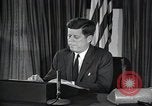
John F. Kennedy talks about the development of nuclear weapons of low weight during a speech in Washington DC.
U.S. President John Fitzgerald Kennedy delivers a speech in Washington DC. President Kennedy seated on a podium and delivers his speech. He speaks into the microphone. A flag of United States on the stage. In the context of U.S. resumption of nuclear testing, President Kennedy talks about the constant change in nuclear weapon technology and development of the weapons according to the changes. He states that if the weapons have to be secure flexible and selective in impact, experiments with new designs have to be made. He also speaks about the development of low weight new series weapons for survival in a surprise attack. The weapons will be of low weight and high explosive content.
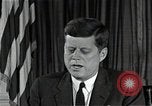
John F. Kennedy speaks about the change in technology and development of nuclear weapons in Washington D.C.
U.S. President John F. Kennedy speaks on disarmament and testing of nuclear weapons in Washington D.C. A flag of United States on the stage. A flag of United States on the stage. He talks about the constant change in nuclear weapon technology and development of the weapons according to the changes. He says that if the weapons have to be secure, flexible, and selective in impact, experiments with new designs have to be made. He also speaks about the development of low new series weapons for survival in a surprise attack. The weapons will be of low weight and high explosive content.
CRITICALPAST.COM: About Us | Contact Us | FAQs - How to Order | License Agreement | My Account | My Lightboxes | Shopping Cart | Advanced Search | Featured Collections | Website Terms & Conditions | Privacy Policy ©2026 CriticalPast LLC.
License Agreement |
Terms & Conditions |
Privacy Policy
©2026 CriticalPast LLC.